

Most construction mistakes start with a drawing that was misread. Whether you are a fresh graduate on your first site, a mason trying to understand room layouts, or a site supervisor coordinating trades, knowing how to read architectural drawings is a skill you cannot afford to skip.
Architectural drawings communicate the design intent of a building.. what goes where, how big each space is, and how different elements connect. In simple terms, if you cannot read the drawings, you cannot build correctly.
This guide breaks down exactly how to read architectural drawings, covering floor plans, sections, elevations, symbols, and scales used on construction sites in Kenya and across Africa.
Quick Answer: To read architectural drawings, start by identifying the drawing type (plan, section, or elevation), then read the title block, scale, and legend before studying the details. Floor plans show room layouts from above, sections show internal cuts through the building, and elevations show the external faces.
Start with the Title Block — It Contains Critical Information
Every architectural drawing has a title block, usually located in the bottom-right corner. This block tells you everything you need before you read a single line on the drawing.
The title block typically contains: the project name and location, the drawing title (e.g. Ground Floor Plan or Section A-A), the drawing number and revision number, the scale of the drawing, the name of the architect and their stamp, and the date of issue.
Before anything else, read the title block. A drawing marked “Rev. 03” means it has been revised three times.. using “Rev. 00” on site is a serious error that has caused expensive rework on many projects.
Understanding the Scale Is Non-Negotiable
Architectural drawings are drawn to scale, meaning real dimensions are reduced proportionally to fit on paper. The most common scales used in Kenya and East Africa are:
| Scale | Best Used For |
|---|---|
| 1:100 | Floor plans of entire buildings |
| 1:50 | Room layouts and wall details |
| 1:20 | Construction details and joints |
| 1:10 | Door and window frames |
| 1:5 | Connection details, fixings |
When a drawing says 1:100, it means 1 centimetre on paper equals 100 centimetres (1 metre) on site. The truth is, many site workers skip this step and assume dimensions.. that is where costly errors begin.
Always use a scale ruler to verify dimensions. If dimensions are written on the drawing, use those. Do not scale from the drawing unless necessary, because printed drawings may not always be to exact scale after printing.
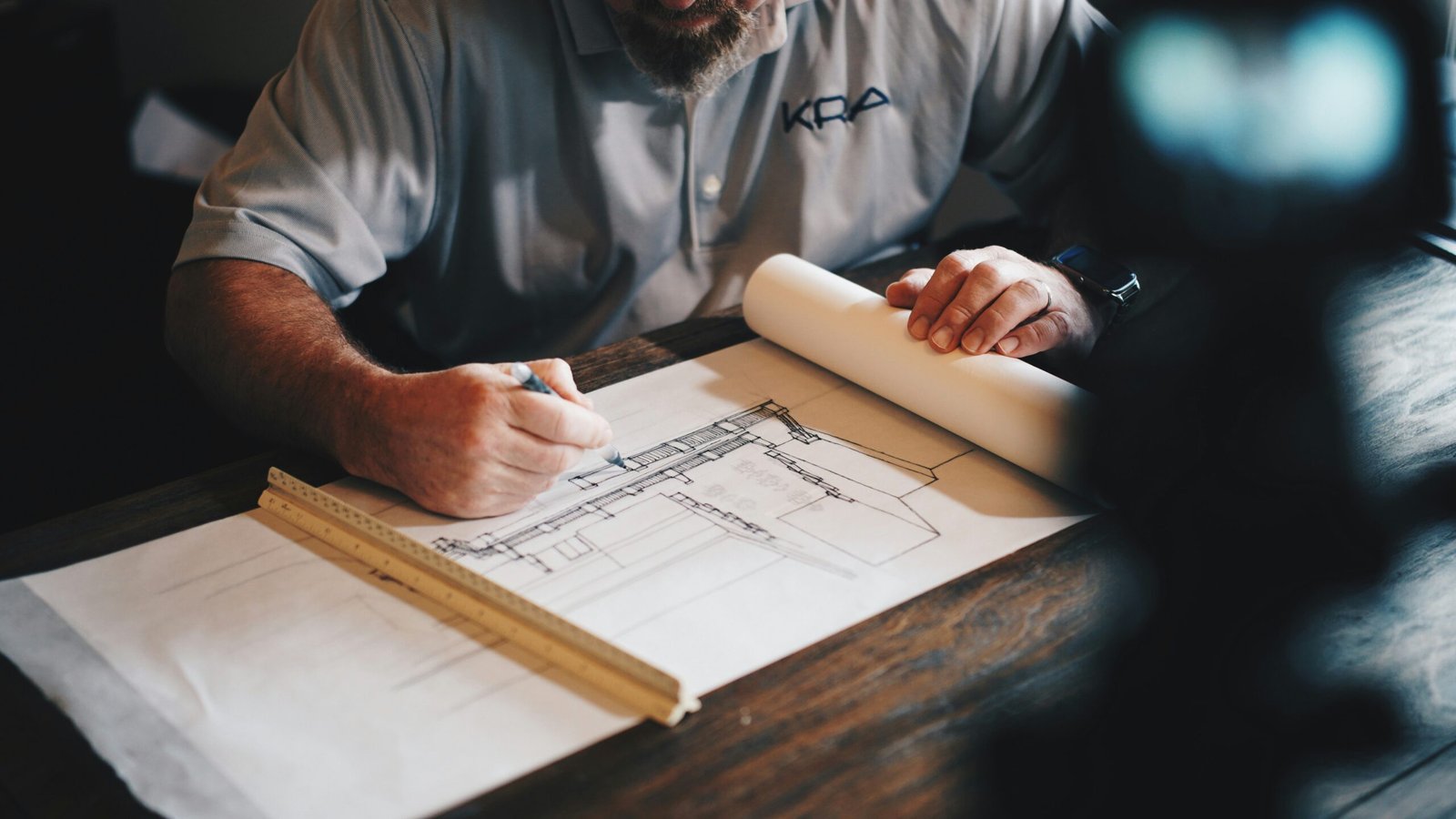
The Three Main Types of Architectural Drawings
Understanding what type of drawing you are looking at is the first step to reading it correctly.
Floor Plans show the building as if you cut through it horizontally at about 1 metre above floor level and look down. They show walls, doors, windows, room labels, and dimensions. Floor plans are the most common drawing type on site.
Sections show the building as if you cut through it vertically and look at the cut face. Sections reveal internal heights, floor-to-ceiling dimensions, staircase profiles, and how different levels connect. A section marked “A-A” on the floor plan means there is a corresponding sectional view labeled “A-A” elsewhere in the drawing set.
Elevations show the external face of a building as seen from outside. There are typically four elevations.. North, South, East, and West. Elevations show window and door positions, wall finishes, roof pitch, and overall building height.
Honestly, many site workers focus only on the floor plan and ignore sections and elevations. That is a mistake. The floor plan alone cannot tell you ceiling heights, beam depths, or how the roof ties into the walls.
Reading Symbols and Conventions on Architectural Drawings
Architectural drawings use standardised symbols to communicate information efficiently. These follow conventions set out by the Kenya Bureau of Standards (KEBS) and international standards including BS 1192 for construction drawing practice.
Common symbols every construction professional must know:
- Thin solid lines = visible edges and outlines
- Dashed lines = hidden elements above the cut plane, e.g. overhead beams
- Centre lines = axes of symmetry, column centrelines
- Hatching = material indication (brick, concrete, insulation, earth)
- Door swings = show which direction a door opens
- Grid lines = reference lines labeled A, B, C for columns and 1, 2, 3 for rows
Grid lines are especially important when coordinating architectural drawings with structural drawings. When an architect says the bathroom is between grid A and grid B, the site team and the structural engineer are working from the same reference.. that is the system that keeps the whole project aligned.
How Architectural Drawings Relate to Other Drawing Sets
Architectural drawings do not exist in isolation. On a full construction project, you work with three primary drawing sets: structural drawings showing columns, beams, slabs, and reinforcement.. MEP drawings showing mechanical, electrical, and plumbing services.. and architectural drawings showing layout, finishes, and specifications.
The architectural drawings set the layout. The structural drawings tell you how to build it safely. The MEP drawings tell you where services run. All three must agree.
The truth is, conflicts between these three drawing sets are one of the most common causes of site delays. An electrical conduit running through a structural beam, or a plumbing stack clashing with a column.. these are coordination failures that start with drawings that were not cross-referenced before work began.
Before excavation starts, the site supervisor, structural engineer, architect, and MEP engineer should walk through the drawing sets together and resolve all conflicts. This process is called a drawing review meeting.. and skipping it always costs more than doing it.
Frequently Asked Questions
Q: What is the difference between a floor plan and a site plan?
A floor plan shows the internal layout of a building.. rooms, walls, doors, and windows. A site plan shows the building position on the land, including setbacks, access roads, drainage, and neighbouring properties. Both are part of the same drawing set but serve different purposes.
Q: Do I need to know how to draw to read architectural drawings?
No. Reading and producing drawings are two different skills. You need to understand symbols, scales, and drawing conventions.. not drafting skills. That said, a basic understanding of how drawings are produced in AutoCAD makes you a faster and more confident reader on site.
Q: What should I do if dimensions on a drawing conflict with each other?
Stop work on that element and raise a Request for Information (RFI) to the architect immediately. Never assume which dimension is correct. Proceeding with conflicting information is a common cause of rejected work, wasted materials, and costly rework on site.
Conclusion
Reading architectural drawings is a core skill for every construction professional.. not just architects. The faster you can extract the right information from a drawing set, the more valuable you are on site and in the office.
Start with the title block, understand the scale, identify the drawing type, and learn your symbols. With consistent practice, reading drawings becomes second nature.
Want more practical construction knowledge delivered directly to you?
👉 Subscribe to our YouTube channel: https://www.youtube.com/@TheCivilEngineeringHub-001
PS: Join our engineering WhatsApp community for daily learning at +254731393520
This is so helpful ☺️
Glad this helped, Teresiah. Reading architectural drawings is one of those skills that looks intimidating on paper but clicks fast once you know what each element is showing you.
Thanks for enlightenment
Glad it helped, Manasse. Reading architectural drawings is one of those skills that transforms the way you see a construction site once the basics click. If you want to keep building on this, join our WhatsApp community at +254731393520 — there is a lot more practical knowledge shared there every week.
Thanks for great work engineer.
The problem with graduates and interns do not know how to identify those line symbols.
You are right, Felix. Line symbols are one of those things that lecturers rush through in class, and students arrive on site with no idea what they are looking at on a live drawing. That gap between classroom and site is exactly what this guide is meant to close. If you want to go deeper on drawing interpretation, join our WhatsApp community at +254731393520 — we break this down regularly.
Nice it’s helpful
Glad to hear it, Abba. Reading architectural drawings is one of those foundational skills that makes everything on site clearer once it clicks. If you want to keep building on this, join our WhatsApp community at +254731393520 — we share practical construction knowledge there regularly.