

A bridge is one of the most demanding structures a civil engineer can work on. It has to carry moving loads across a gap, resist wind and water forces, and perform reliably for decades. Yet the choice of bridge type is something many civil engineers cannot explain clearly when asked on site or in a design meeting.
In this guide, you will learn the six main types of bridges in civil engineering, how each one transfers load structurally, their span ranges, and the conditions under which each type is specified. This knowledge applies whether you are designing infrastructure, supervising bridge construction, or studying for your engineering exams.
Quick Answer: The main types of bridges in civil engineering are beam bridges, arch bridges, truss bridges, cantilever bridges, suspension bridges, and cable-stayed bridges. Each type transfers loads to its foundations through a different structural mechanism, and the right choice depends on the crossing span, ground conditions, traffic loading, and project budget.
The Six Main Types of Bridges in Civil Engineering
Every bridge transfers load from the deck down to the foundations. The structural system that does this transfer is what defines the bridge type. Here are the six types you will encounter most often in practice.
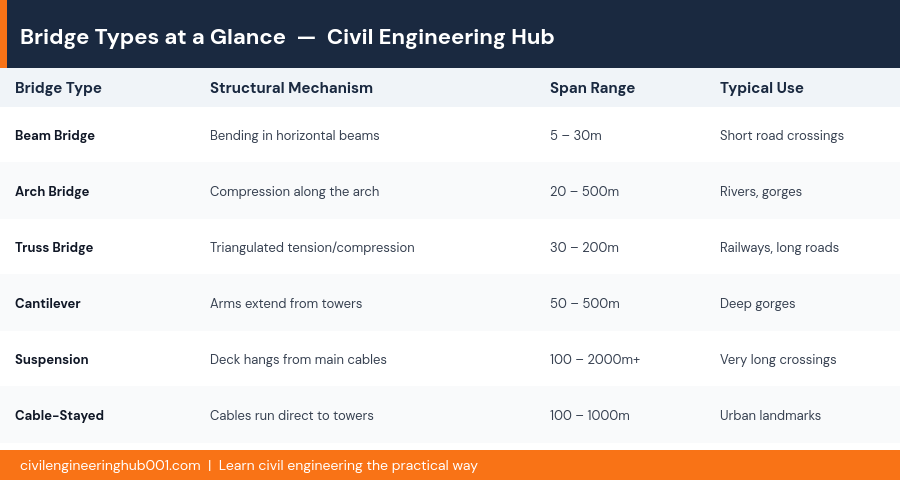
| Bridge Type | Load Transfer Mechanism | Typical Span | Common Use |
|---|---|---|---|
| Beam Bridge | Horizontal beams carry load in bending to end supports | 5m to 30m | Road crossings, short river crossings |
| Arch Bridge | Load travels as compression along the arch to abutments | 20m to 500m | River crossings, gorges, aesthetic structures |
| Truss Bridge | Triangulated members carry load in tension and compression | 30m to 200m | Railway bridges, long road spans |
| Cantilever Bridge | Arms extend from towers and meet in the middle | 50m to 500m | Deep gorges, heavy traffic routes |
| Suspension Bridge | Deck hangs from cables anchored at each end of the span | 100m to 2000m+ | Very long crossings, major highways |
| Cable-Stayed Bridge | Cables run directly from towers to the deck | 100m to 1000m | Urban crossings, medium to long spans |
Beam Bridges Are the Most Common Bridge Type in East Africa
The beam bridge is the simplest bridge structure in civil engineering. A horizontal beam spans between two supports, and the deck sits on top. Loads travel from the deck into the beam, causing bending, and then transfer to the abutments or piers and down to the foundations.
In Kenya and East Africa, the majority of road bridges with spans under 30m are reinforced concrete or prestressed concrete beam bridges. Under the Kenya Roads Design Manual and BS 5400, simply supported beam bridges are the standard solution for low to medium traffic roads crossing streams, rivers, or drainage channels. Prestressed concrete I-beams and T-beams are the most commonly specified elements for spans between 10m and 25m.
The limitation of a beam bridge is span. As the span increases, the beam depth required to resist bending increases rapidly, making the design impractical and uneconomical beyond about 30m. That is when other structural systems take over.
Arch Bridges: Efficient Structures for Gorges and River Crossings
An arch bridge carries loads through compression in the arch rib. Instead of the deck bending between supports, the arch transfers loads as compressive forces that travel along the curved arch and push outward at the abutments. This means the abutments must be able to resist significant horizontal thrust, which is why arch bridges require strong, stable ground or rock at the supports.
Arch bridges are highly efficient because concrete and masonry are very strong in compression. Modern reinforced concrete arch bridges can span up to 500m. The truth is.. arch bridges are often underused in East African infrastructure because designers default to beam bridges. On sites where strong natural rock is available at both abutment points, an arch can be more economical than a long-span beam bridge.
Suspension and Cable-Stayed Bridges: What Makes Them Different
Both suspension and cable-stayed bridges use high-strength steel cables to carry the deck. The key difference is in how the cables are arranged.
In a suspension bridge, the main cables run over towers and are anchored into the ground at each end. Vertical hangers drop from the main cables to the deck. The deck hangs in tension. Suspension bridges can span very long distances.. the longest exceed 2000m. However, they are flexible and require careful dynamic analysis for wind and traffic loading.
In a cable-stayed bridge, cables run directly from the tower to the deck at multiple points. There is no main cable between anchor points. This makes the deck stiffer and the system more stable than a suspension bridge. Cable-stayed bridges are increasingly common for medium to long urban crossings where visual appearance also matters.
How to Choose the Right Bridge Type for Your Project
Selecting a bridge type is driven by three primary factors: the required crossing span, the ground conditions at the site, and the project budget.
- Span under 30m: Use a reinforced or prestressed concrete beam bridge. Fastest and most economical for standard road projects.
- Span 30m to 200m: Consider a truss bridge, multi-span beam bridge with intermediate piers, or a concrete arch where ground conditions allow.
- Span over 200m: This requires cantilever, cable-stayed, or suspension bridges. These need specialist design teams and significantly higher budgets.
- Poor ground conditions: Avoid arch bridges if the foundation cannot resist horizontal thrust. A beam bridge on piled foundations is safer.
- Urban or landmark site: A cable-stayed bridge may be worth the additional cost for its visual impact and structural stiffness.
Honestly.. most infrastructure projects in East Africa will never require anything beyond a well-designed beam bridge or a multi-span concrete viaduct. The important thing is to understand the structural logic behind each type so you can make informed decisions and communicate them clearly to clients and consultants.
Frequently Asked Questions
Q: What is the most common type of bridge used in Kenya?
The reinforced concrete beam bridge is the most common bridge type on Kenyan road networks. For short crossings under 20m, precast prestressed concrete beams are widely used. KeNHA and the Kenya Roads Design Manual guide the design of these structures on classified roads.
Q: What is the difference between a bridge and a culvert?
A culvert is a closed drainage structure, typically a pipe or box section, installed under a road to allow water to pass through. A bridge carries a road or railway over an open crossing such as a river or valley. The Kenya Roads Design Manual specifies that waterway openings below 2.0m are typically designed as culverts rather than bridges.
Q: Do structural engineers design bridges differently from buildings?
Yes. Bridge design accounts for dynamic moving loads from vehicles, braking forces, wind loads, and in some cases seismic effects. BS 5400 and the Kenya Roads Design Manual govern bridge loading and design in Kenya. Buildings are primarily designed for static gravity and lateral loads under BS 8110 or Eurocode 2.
Bridge Knowledge Is Core Civil Engineering
Bridges are not just infrastructure. They are applied structural engineering in its clearest form. Every bridge type is a physical demonstration of a load path.. forces travel from the deck, through the structural system, and into the ground. When you understand that logic, you understand why structures are built the way they are.
Whether you are reviewing drawings for a river crossing or designing a rural road drainage scheme, knowing your bridge types makes you a more capable and confident civil engineer.
Want more practical construction knowledge delivered directly to you?
👉 Subscribe to our YouTube channel: https://www.youtube.com/@TheCivilEngineeringHub-001
PS: Join our engineering WhatsApp community for daily learning at +254731393520
Haven’t been engaged with this practically…though theoretically I know most of the things. It mainly focuses on National roads.