

On a construction site, confusion costs money. A drawing that does not match what you see on the ground, a specification that leaves out a critical detail, a design gap nobody caught until the concrete truck arrived on site.. this is exactly where a Request for Information, or RFI, protects the project.
An RFI is a formal written question raised by the contractor or site team to the architect, engineer, or client when project documents are unclear, incomplete, or contradictory. In simple terms, it is how you ask “what do you actually want us to do here” in writing, without guessing and without stopping work on a hunch.
This post breaks down how to write an RFI that gets answered fast, who should review it before it leaves the site office, and how to track it so nothing gets lost between the site and the consultant’s desk.
Quick Answer: An RFI (Request for Information) is a formal written query sent by the contractor or site team to the architect, engineer, or client when project documents are unclear or incomplete. Write it with a specific question, reference drawing and spec numbers, propose a solution, set a response deadline, and log it in an RFI register so nothing is missed.
What Triggers an RFI on a Construction Site
Not every site question needs a formal RFI. A site supervisor should raise one when the answer affects cost, time, safety, or the structural integrity of the work. The truth is, most disputes on Kenyan sites trace back to a question that should have been an RFI but was instead settled verbally and forgotten.
Common triggers include:
- A structural drawing that conflicts with an architectural drawing on the same grid line
- A specification that calls for a material not available locally or no longer in production
- Missing dimensions, levels, or reinforcement details on a drawing
- An instruction from the client that changes scope but was never confirmed in writing
- A site condition (rock, water table, existing services) not shown on the drawings
If you are working under FIDIC-based contracts, common on many Kenyan public projects, the RFI process usually sits alongside the Engineer’s Instructions clause. That means an unanswered RFI is not just an inconvenience. It can become the basis for an extension of time or a cost claim.
How to Write an RFI That Gets a Fast Answer
A vague RFI gets a vague answer, or no answer at all. Consultants are busy, and they will prioritise questions that are easy to understand and easy to act on. Structure every RFI the same way, every time.
| Field | What to Include |
|---|---|
| RFI Number | Sequential, e.g. RFI-014, never reused |
| Reference | Drawing number, spec section, or BOQ item affected |
| Question | One clear question, not three questions in one paragraph |
| Proposed Solution | Your suggested way forward, so the consultant can simply approve it |
| Impact if Delayed | State plainly if the work is paused pending the answer |
| Response Deadline | A specific date, tied to your programme, not “urgent” |
Attach a marked-up photo or sketch whenever possible. A site engineer who sends a photo with a red circle around the conflict gets answered in a day. A site engineer who writes “please advise on beam B12” gets answered in two weeks, if at all.
Who Should Review an RFI Before It Leaves the Site
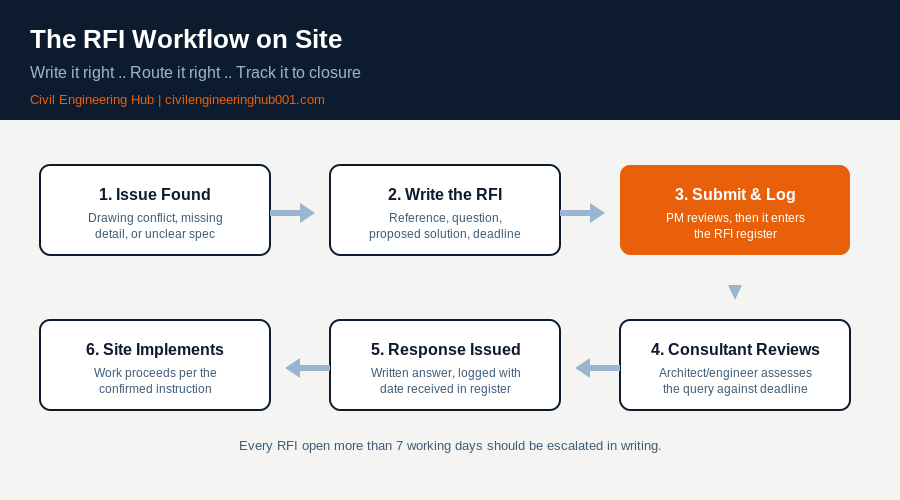
An RFI is a contractual document, not an internal memo. Before it goes out, the site supervisor or foreman should have it checked by the project manager or resident engineer. This catches two common mistakes: asking a question the drawings already answer, and accidentally admitting fault for a problem the contractor caused.
On larger projects, this review step is where the RFI gets logged into the project’s document control system, whether that is a shared spreadsheet, a tool like Procore, or a simple physical register kept in the site office. Skipping this step is how RFIs get sent twice, answered inconsistently, or lost when a supervisor changes projects.
How to Track RFIs So Nothing Falls Through the Cracks
An RFI register is non-negotiable on any project with more than a handful of open queries at a time. Keep it simple enough that anyone on the team can update it, and specific enough that it holds up if the project ends in a dispute.
- RFI number and date raised
- Drawing/spec reference and brief description of the issue
- Who it was sent to and the date sent
- Response deadline agreed
- Date the response was received
- Status: open, answered, or overdue
- Cost or time impact, if any
Review this register in every weekly site meeting. An RFI that has been open for more than seven working days without a response should be escalated in writing, not chased informally in a WhatsApp message that nobody can produce later.
What Happens When an RFI Is Ignored or Delayed
Honestly, this is where most site teams lose money without realising it. If work stops or slows because an RFI has not been answered, that delay is documentable. Under most standard forms of contract, including FIDIC and the Kenyan Building Code framework used alongside NCA regulations, a properly logged and unanswered RFI can support a claim for extension of time.
The catch is that this only works if the RFI was written correctly, sent formally, and tracked with dates. A verbal question with no record protects nobody. This is exactly why the discipline of writing and logging RFIs matters as much as the technical content inside them.
Frequently Asked Questions
Q: Who can raise an RFI on a construction site?
Typically the contractor’s site team raises RFIs, usually through the site supervisor, foreman, or project manager, and sends them to the architect, structural engineer, or resident engineer for a response. Subcontractors usually route their RFIs through the main contractor rather than sending them directly.
Q: How long should a consultant take to respond to an RFI?
Most contracts do not fix a legal deadline, which is why the sender should propose one tied to the construction programme. Seven working days is a common and reasonable standard for a straightforward query.
Q: What is the difference between an RFI and a site instruction?
An RFI is a question asking for clarification, while a site instruction is a directive from the engineer or architect telling the contractor to do something specific. An RFI response often leads to a site instruction once the consultant confirms the way forward.
Conclusion
An RFI is not paperwork for its own sake. It is how you protect your programme, your budget, and your position if a dispute ever reaches a table. Write every RFI with a clear question, a proposed solution, and a deadline, then log it and chase it in writing.
Get this habit right early in your career, whether you are a site supervisor, foreman, or project manager, and you will spend far less time arguing about who said what on site.
Want more practical construction knowledge delivered directly to you?
Subscribe to our YouTube channel: https://www.youtube.com/@TheCivilEngineeringHub-001
PS: Join our engineering WhatsApp community for daily learning at +254731393520
This is so aptly outlined and is a key part of any project. It is a good way of documenting challenges on site.
Good Job