

An undersized cable is one of the quietest ways a building can catch fire. It will not show up on a snag list, it will not fail an inspection at first glance, and it can run for months before it becomes a problem. In simple terms, electrical cable sizing means matching a cable’s current-carrying capacity to the load it will actually carry, then checking that the voltage drop across its length stays within an acceptable limit. Get either part wrong and you end up with overheating conductors, nuisance tripping, or a fire risk hidden inside a wall. This guide breaks down how cable size is actually selected on a real project, the sizes you will meet most often on site, and the mistakes that turn a correctly specified cable into a hazard during installation.
Quick Answer: Cable size is selected by calculating the design current of the circuit, applying correction factors for grouping, ambient temperature and installation method, then checking the resulting current-carrying capacity against a recognised table such as BS 7671 or the Kenya Power wiring code, while keeping voltage drop within the allowed 3-5 percent limit.
What Actually Determines Electrical Cable Size
Cable sizing starts with the design current, which is the load in watts divided by the supply voltage, adjusted for power factor on three-phase circuits. That figure tells you the minimum current the cable must carry without overheating.
The truth is, the nameplate rating of a cable in a manufacturer’s catalogue is not the final answer. That rating assumes ideal conditions, and real installations rarely match ideal conditions. Correction factors are applied for how many cables are grouped together in one trunking, the ambient temperature around the cable run, and whether the cable is buried, clipped direct, or run in conduit.
Honestly, this is where most under-sizing happens on site. An engineer specifies a cable correctly for a single run in open air, then the electrician bundles six cables into one conduit without anyone adjusting the size upward to compensate for the grouping factor.
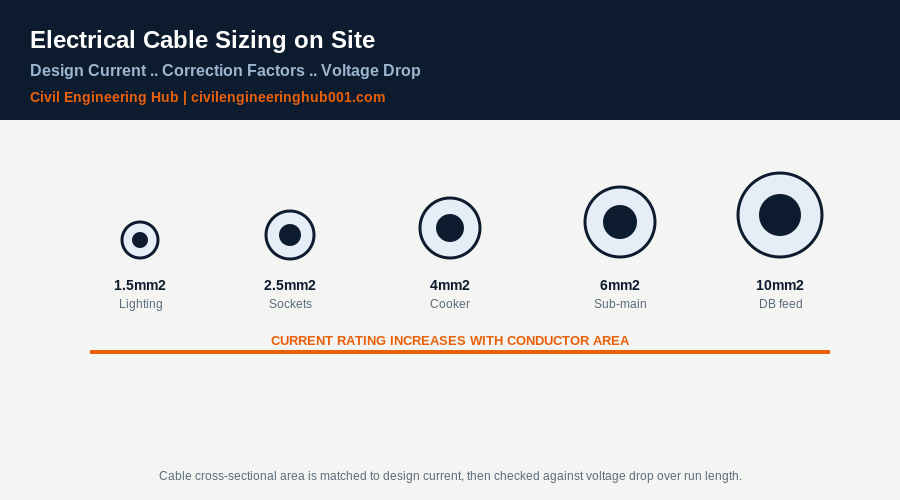
Standard Cable Sizes and Typical Current Ratings
These are typical current ratings for PVC insulated copper cables clipped direct, based on tables commonly referenced from BS 7671 and applied on Kenyan sites alongside Kenya Power wiring requirements. Always confirm against the specific installation method and correction factors for the actual site condition.
| Cable Size (mm²) | Typical Current Rating | Common Use |
|---|---|---|
| 1.5 | 17.5A | Lighting circuits |
| 2.5 | 24A | Socket outlet ring circuits |
| 4 | 32A | Cooker circuits, small power |
| 6 | 41A | Water heaters, sub-mains |
| 10 | 57A | Small distribution boards |
| 16 | 76A | Larger sub-mains, motor feeds |
Notice that lighting circuits almost never need more than 1.5mm² or 2.5mm² cable. Oversizing a lighting circuit is not a safety issue, but it wastes copper and money on a project where every cost line matters.
Why Voltage Drop Is as Important as Current Rating
A cable can carry its rated current safely and still fail the installation if the voltage drop over its length is too high. Long cable runs, especially sub-mains feeding a distribution board far from the source, lose voltage along the way due to resistance in the conductor.
Most wiring codes limit voltage drop to around 3 percent for lighting circuits and 5 percent for power circuits, measured from the origin of the installation to the furthest point on the circuit. Exceed that limit and equipment at the end of the run receives less voltage than it needs, which shows up as dim lighting, motors that struggle to start, or appliances that underperform.
This is exactly why a cable that passes the current-carrying capacity check can still fail the voltage drop check on a long run, and why both calculations belong on the same design sheet, not treated as separate steps.
Common Site Mistakes That Cause Overheating or Nuisance Tripping
Most cable failures are not due to bad design. They happen because good design gets compromised during installation. Watch for these on every site:
- Bundling multiple cables into one conduit or trunking without applying a grouping correction factor.
- Running cables through ceiling voids near roofing sheets without accounting for elevated ambient temperature.
- Extending a circuit beyond its designed length without rechecking voltage drop.
- Using the wrong cable size for a sub-main because it was copied from a similar project without recalculating the load.
- Ignoring the protective device rating, so the breaker does not match the cable it is meant to protect.
A cable that looks correct on the schedule can still overheat if the person pulling it on site does not understand why the size and grouping factor were chosen in the first place. That is the gap this guide is meant to close.
Frequently Asked Questions
Q: What is a correction factor in cable sizing?
A correction factor is a multiplier applied to a cable’s tabulated current rating to account for real installation conditions such as grouping with other cables, ambient temperature, and the method of installation. Applying these factors correctly prevents overheating that a nameplate rating alone would not reveal.
Q: Can I use the same cable size for every circuit in a building?
No. Lighting circuits, socket circuits, and sub-mains all carry different design currents and run different lengths, so each one needs its own sizing calculation. Copying one cable size across a whole building risks both undersizing high-load circuits and wasting money on low-load ones.
Q: What voltage drop limit should I design to?
Most wiring codes, including practice aligned with BS 7671 applied locally, set a limit of around 3 percent for lighting circuits and 5 percent for power circuits. Staying within these limits keeps equipment performing as designed at the end of the circuit.
Conclusion
Electrical cable sizing is not a formality to rush through before first fix. It is a calculation built on design current, protected by correction factors, and checked against voltage drop before a single metre of cable is pulled. Get the size right and install it right, and the circuit will run safely for decades. Get either one wrong, and the risk does not show up on day one, it shows up as a fire hazard hidden behind a wall.
Want more practical construction knowledge delivered directly to you?
Subscribe to our YouTube channel: https://www.youtube.com/@TheCivilEngineeringHub-001
PS: Join our engineering WhatsApp community for daily learning at +254731393520