

Every construction site runs on information. If that information is not captured daily, it gets lost, and when a dispute, delay, or accident happens, the person who cannot produce a record is the person who carries the blame.
A daily site report is the single most important document a site supervisor produces. It is not paperwork for the sake of paperwork. It is your evidence, your memory, and your defense, and it is one of the first things every young engineer moving from classroom to site needs to master.
Quick Answer: A daily site report is a written record completed by the site supervisor or foreman at the end of each working day, capturing manpower, materials, plant, weather, progress, instructions, and any incidents on site. It should take 10 to 15 minutes to prepare and must be completed before you leave site, not the next morning.
What Is a Daily Site Report and Why It Matters
A daily site report, sometimes called a site diary, is a structured summary of everything that happened on a construction site during a single working day. In simple terms, it answers one question for anyone who was not there: what happened today?
The truth is, most supervisors treat this as a formality until something goes wrong. Then it becomes the only document that can prove what actually happened. Kenya’s National Construction Authority requires registered contractors to maintain proper site records as part of project supervision, and on any project governed by FIDIC or similar standard contract conditions, the site diary is often the primary reference used to resolve claims for extension of time and additional cost.
If a subcontractor claims they were held up by a late delivery, if a client questions why a pour did not happen on schedule, or if an accident occurs and OSHA Kenya inspectors ask for records, your daily site report is what settles the argument. Without it, every dispute becomes a matter of one person’s word against another’s, and the party with a written, dated, signed record always has the stronger position.
This is also why the habit matters more than the template. A supervisor who writes a sharp, specific report every day for six months builds a project history that protects the whole team. One who skips days or writes vague entries leaves gaps that come back to cost the contractor money and reputation.
What Must Be Included in a Daily Site Report
A good report is specific, not vague. “Concrete works ongoing” tells nobody anything useful in six months. Here is what a complete report must capture.
| Section | What to Record |
|---|---|
| Date, weather, site conditions | Temperature, rainfall, wind, and how conditions affected work |
| Manpower | Number of workers per trade, by contractor and subcontractor |
| Plant and equipment | Machines on site, hours used, idle time and reason |
| Materials received | Delivery notes, quantities, supplier, any rejected material |
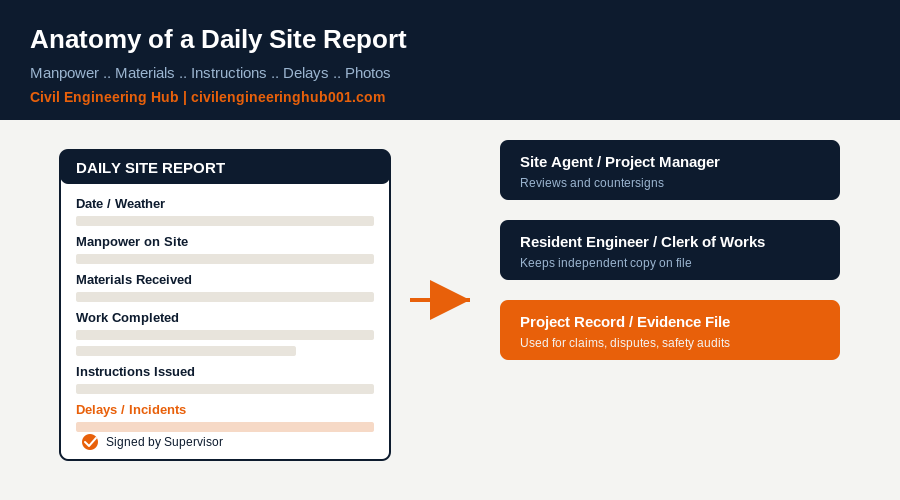
| Work done | Specific activities, locations, and quantities completed |
| Instructions issued | Verbal or written instructions from consultants or client |
| Visitors | Names of consultants, client reps, inspectors who visited |
| Safety and incidents | Near misses, accidents, safety briefings held |
| Delays | Cause, duration, and activities affected |
| Photos | Dated site photos showing progress and any issues |
Notice that quantities matter as much as descriptions. Writing “blockwork continued on ground floor” is weaker than “38 square metres of 200mm blockwork laid on ground floor, gridlines A to D.” The second version can be cross-checked against the programme and the bill of quantities. That is what makes a report useful to a quantity surveyor preparing an interim valuation, not just to you.
How to Prepare a Daily Site Report Step by Step
Honestly, the biggest reason reports fail is that supervisors try to write them from memory at the end of a long day. Build the habit around these steps instead.
| Step | Action |
|---|---|
| 1 | Carry a pocket notebook or phone note and log activity as it happens, not at end of day |
| 2 | Record manpower counts during the morning briefing when everyone is on site |
| 3 | Log every delivery immediately against the delivery note, not from memory later |
| 4 | Take timestamped photos at key stages: before, during, and after critical work |
| 5 | Note any instruction the moment it is given, and who gave it |
| 6 | Transfer everything into the formal report template before leaving site |
| 7 | Get the report signed or countersigned where the contract requires it |
| 8 | File it the same day, digitally if possible, so it cannot be lost or altered |
That means the report is not something you write. It is something you assemble, because you have already been collecting the raw material all day. Supervisors who wait until 6pm to reconstruct the day from memory are the ones who leave out the small details that matter most, such as the 40 minutes the crane stood idle waiting for a delivery truck to clear the gate.
Who Should Receive the Report and Sign-Off Requirements
A report that sits in your notebook protects nobody. Distribution and sign-off are part of the process, not an afterthought.
On most contracts, the site supervisor prepares the report and the site agent or project manager reviews and countersigns it before it is filed. Where the contract requires it, a copy goes to the resident engineer or clerk of works for their own record, which creates an independent second copy that cannot later be disputed as altered. For projects under NCA supervision, inspectors may request to review site diaries at any stage, so the report should always be current, not backdated when a visit is announced.
Where possible, get the client’s representative or consultant to countersign entries involving instructions or variations on the day they are issued. A verbal instruction that is written down and acknowledged the same day is a far stronger record than one recalled weeks later during a dispute over payment.
Daily Report vs Weekly Progress Report .. What Is the Difference
Site teams sometimes confuse these two documents, and that confusion causes gaps in the record. They serve different purposes.
| Aspect | Daily Site Report | Weekly Progress Report |
|---|---|---|
| Prepared by | Site supervisor or foreman | Project manager or site agent |
| Frequency | Every working day | Weekly, summarizing the week |
| Audience | Internal record, contract evidence | Client, consultants, management |
| Detail level | Raw, specific, activity by activity | Summarized against the programme |
| Use in disputes | Primary evidence | Supporting context |
Common Mistakes That Weaken a Site Report
A report that exists is not the same as a report that protects you. These are the mistakes that make reports useless when they are needed most.
Writing in vague language such as “works progressing well” instead of stating exactly what was done and where. Backdating entries because the report was not written on the actual day. Leaving out delays because the supervisor does not want to flag a problem to management. Failing to record instructions from consultants, which later become disputed variations. Not attaching photos, which means there is no independent proof of site conditions on that date. Copying the previous day’s entry with small edits, which courts and consultants can spot immediately when reports read identically week after week.
In simple terms, a report full of generic statements will not hold up if a contractor later claims for extension of time and you have nothing specific to counter it with.
Digital Tools vs Paper Site Diaries
More site teams in Kenya are moving to digital reporting, but paper still has a place, especially on remote sites with poor connectivity.
| Factor | Paper Diary | Digital Report (App or Excel) |
|---|---|---|
| Reliability offline | Always works | Depends on device and connectivity |
| Searchability | Slow, manual | Instant search by date or keyword |
| Photo integration | Separate, easy to lose | Attached directly to the entry |
| Tamper resistance | Harder to alter once signed | Needs timestamp and audit trail features |
| Sharing with office | Manual delivery or scanning | Instant, automatic backup |
Whichever method you use, the standard is the same: the record must be made on the day the work happened, and it must be specific enough to stand alone without your memory to explain it. Many site teams now use a simple Excel template with dropdowns for trades and weather, which keeps entries consistent without needing new software or training.
Frequently Asked Questions
Q: Who is responsible for preparing the daily site report?
The site supervisor or foreman in charge of the works prepares it. On larger projects, each subcontractor’s foreman may prepare their own section, which the main contractor’s site agent then consolidates into a master daily report for the project.
Q: Is a daily site report a legal document?
Yes, in the sense that it can be used as evidence in contractual disputes and, where relevant, in safety investigations under the Occupational Safety and Health Act. Courts and arbitrators treat contemporaneous site records as more credible than statements made after the fact, which is exactly why the report must be completed on the same day.
Q: How long should daily site reports be kept?
Keep them for the full duration of the project plus the defects liability period, and ideally longer. Many contracts and professional indemnity requirements expect records to be retained for six years or more after project completion, since disputes can surface long after handover.
Conclusion
A daily site report is not busywork. It is the record that protects you, your contractor, and your client when memory is not enough. Build the habit of capturing information as the day happens rather than reconstructing it at 6pm, and make sure every entry is specific enough to stand on its own.
Whether you are civil, structural, MEP, or managing the whole site, this discipline is what separates a professional site team from one that is constantly explaining itself after the fact.
Want more practical construction knowledge delivered directly to you?
Subscribe to our YouTube channel: https://www.youtube.com/@TheCivilEngineeringHub-001
PS: Join our engineering WhatsApp community for daily learning at +254731393520