

Fire suppression is one of those systems everyone assumes is working until the day it has to work. On most Kenyan sites, the choice between a wet and a dry system gets made quietly by the MEP engineer, and few other professionals on site ever ask why. That is a problem, because a wet system in an unheated store or a dry system in a hospital corridor is a design mistake that will show up at the worst possible moment.
Quick Answer: A wet fire suppression system keeps pipes filled with pressurized water at all times, releasing it instantly when a sprinkler head activates, while a dry system holds pressurized air or nitrogen in the pipes and only fills them with water after a valve trips, giving it a short delay but protecting against freezing and accidental discharge.
What a Wet System Actually Does
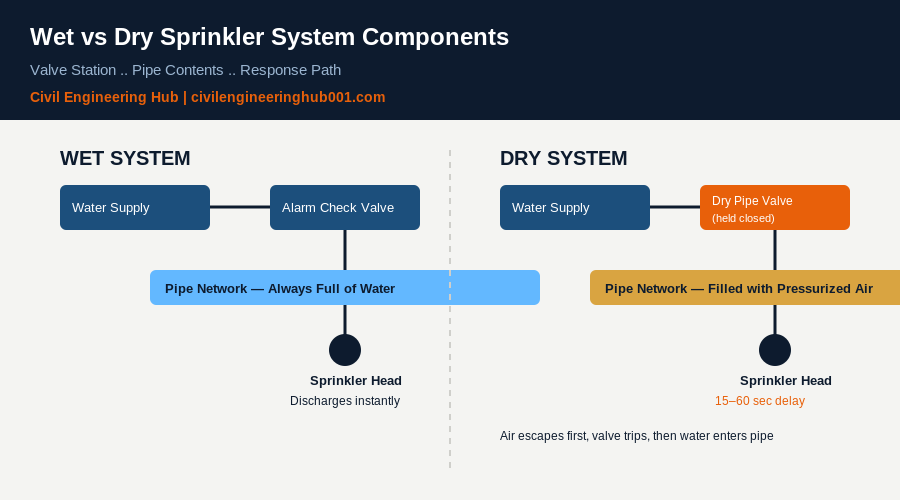
A wet system is the standard sprinkler setup you will find in most commercial and residential buildings across Nairobi and other urban centers. The truth is, it is the simplest fire suppression configuration there is. Pipes are charged with water from the supply main straight through to every sprinkler head, at all times, whether there is a fire or not.
When heat from a fire reaches a sprinkler head, the heat-sensitive element in that individual head breaks or melts, and water discharges immediately from that head only. There is no delay because the water is already sitting in the pipe waiting to come out. That is the entire advantage of the wet system: speed.
Design references for wet systems in Kenya typically draw from NFPA 13, which most local fire consultants use as the base standard for sprinkler design density, pipe sizing, and hazard classification, alongside the Kenya Building Code’s fire safety provisions. In simple terms, if your building does not face a freezing risk and does not house sensitive equipment that water damage could destroy, a wet system is almost always the default choice.
Why Dry Systems Exist at All
Dry systems solve one specific problem: freezing. In climates where pipes can freeze, water sitting in a pipe year-round is a liability. Kenya does not have that problem at sea level, but dry systems still show up here in specific applications, mainly unheated warehouses, parking structures open to the elements, and cold storage facilities where refrigeration keeps ambient temperature low enough that a wet system would be at risk.
In a dry system, the pipe network holds pressurized air or nitrogen instead of water. When a sprinkler head activates, the air escapes first, which trips a dry pipe valve that then allows water to rush in from the supply side. Honestly, this sounds fast when you describe it, but there is a real lag, typically 15 to 60 seconds depending on the size of the pipe network, before water actually reaches the activated head.
That delay is the tradeoff. You gain freeze protection and a lower risk of accidental water damage from a knocked or damaged pipe, but you lose the instant response of a wet system.
Comparing the Two Systems Side by Side
| Feature | Wet System | Dry System |
|---|---|---|
| Pipe contents | Pressurized water at all times | Pressurized air or nitrogen |
| Response time | Immediate | 15-60 second delay |
| Freeze risk | High in cold zones | None |
| Cost | Lower installation cost | Higher due to air compressor and dry valve |
| Maintenance | Simpler | More complex, requires air pressure checks |
| Typical use in Kenya | Offices, apartments, retail, schools | Cold stores, open parking structures, unheated warehouses |
Where Each System Fits on a Kenyan Project
Site engineers and project managers deciding between the two need to think about the building’s actual conditions, not just cost. A wet system installed in a space that regularly drops below freezing, like a blast-frozen storage facility, will burst pipes and cause more damage than the fire itself would have.
On the other hand, specifying a dry system in a standard office block because it “sounds more advanced” adds unnecessary cost and maintenance complexity for a building that never needed freeze protection in the first place. That is money and complexity your client did not need to carry.
There is also a hybrid option worth knowing: pre-action systems, which combine a dry system’s air-filled pipes with an additional detection trigger before water is released. These are common in server rooms, museums, and archives, where accidental discharge from a damaged sprinkler head would be catastrophic and preventable false activation matters more than a few extra seconds of response time.
| Building Type | Recommended System | Why |
|---|---|---|
| Standard office or apartment block | Wet | Fast response, lower cost, no freeze risk |
| Unheated parking structure | Dry | Exposure to outdoor temperature swings |
| Cold storage / blast freezer | Dry | Constant sub-zero ambient temperature |
| Data center / server room | Pre-action | Prevents accidental discharge on sensitive equipment |
| Museum or archive | Pre-action | Protects irreplaceable materials from accidental water damage |
What This Means for the Whole Site Team
This is not just an MEP engineer’s problem. Architects need to coordinate ceiling voids and riser locations early, because retrofitting a dry system’s air compressor and valve station after the building shell is up is expensive and disruptive. Quantity surveyors pricing a BOQ need to know which system is specified before pricing pipework, because dry systems carry higher material and labor costs. Site supervisors need to understand which system is installed so they know what “normal” looks like during a walkthrough, since a hissing sound near a dry valve station is expected, not a fault.
For electricians and plumbers working alongside the fire protection contractor, knowing the difference also prevents dangerous assumptions. Do not assume a sprinkler pipe is empty just because it is a “dry” system. Air pressure alone can cause injury if a fitting fails during maintenance work.
The Key Components Behind Each System
Understanding the hardware helps every professional on site read a fire protection drawing with more confidence, not just the specialist contractor installing it.
A wet system’s core components are simple: a water supply connection, an alarm check valve, the sprinkler piping network, and the sprinkler heads themselves. Because water sits in the pipe permanently, the alarm check valve’s only job is to detect flow and trigger the alarm when a head opens. There is no separate air system to manage.
A dry system adds three components a wet system does not need. First, an air compressor or nitrogen generator that keeps the pipe network pressurized with gas. Second, a dry pipe valve, which is the mechanical heart of the system, holding water back on the supply side until air pressure on the pipe side drops low enough to trip it open. Third, an accelerator or exhauster, which speeds up the release of air from the pipes so water reaches the activated head faster, cutting down that 15 to 60 second delay we mentioned earlier.
For a pre-action system, add a detection system, usually smoke or heat detectors, that must activate before the dry pipe valve is even allowed to open. This double-trigger requirement is exactly what makes pre-action systems the preferred choice for spaces where a false discharge would be more costly than the fire itself.
Common Mistakes Site Teams Make With These Systems
The truth is, most fire suppression failures on Kenyan sites are not design failures. They are installation and maintenance failures that happen because the site team did not fully understand what they were working with.
One recurring mistake is installing a wet system sprinkler head in an exposed, unheated area, such as a rooftop plant room or an open-sided store, without checking whether that space is genuinely protected from temperature swings. A single cold night can freeze a section of pipe and cause a burst that floods a floor below.
Another common issue is neglecting the air compressor on a dry system. If the compressor fails and air pressure in the pipe network drops undetected, the dry pipe valve can trip prematurely from a minor leak rather than an actual fire, leading to unnecessary water damage and a costly false alarm investigation.
Site supervisors also sometimes assume a hissing or clicking sound near a dry valve station indicates a fault, when in most cases it is the air compressor cycling normally to maintain pressure. Knowing the difference between routine operation and an actual problem saves unnecessary emergency callouts and keeps the client’s confidence in the system intact.
Finally, on pre-action systems, teams sometimes forget that both the detection trigger and a sprinkler head must activate before water flows. During commissioning, always test both conditions independently, not just the sprinkler head, to confirm the system will genuinely respond the way it was designed to.
Frequently Asked Questions
Q: Can a building have both wet and dry systems installed?
Yes. It is common on larger developments to run a wet system through the main occupied floors and a dry system through an attached unheated parking structure or loading dock. The two systems are typically zoned separately with their own control valves, so a fault or maintenance shutdown in one zone does not affect the other.
Q: Which system is cheaper to install in Kenya?
Wet systems are almost always cheaper, both to install and to maintain, because they do not require an air compressor, a dry pipe valve, or the additional testing that dry systems demand. Unless your building has a specific freeze or sensitivity risk, a wet system will save your client money without sacrificing protection.
Q: Do dry systems need more frequent inspection?
Yes. Dry systems require regular checks on air pressure and the dry pipe valve’s trip mechanism, in addition to the standard sprinkler head and pipe inspections that both systems need. NFPA 25 sets out inspection, testing, and maintenance schedules that most fire safety consultants in Kenya reference for both system types.
The Bottom Line
Choosing between a wet and a dry fire suppression system is not about which one sounds more sophisticated. It comes down to the building’s actual exposure to freezing, the sensitivity of what is inside it, and the client’s budget. Get this decision right at design stage, and you save your client from an expensive retrofit and, more importantly, from a system that fails when it matters most.
Want more practical construction knowledge delivered directly to you?
Subscribe to our YouTube channel: https://www.youtube.com/@TheCivilEngineeringHub-001
PS: Join our engineering WhatsApp community for daily learning at +254731393520