

Concrete looks finished the moment it is placed and struck off level. It is not. What happens in the days after placing determines whether that slab or column reaches its full design strength or ends up cracked, dusty, and weak. That process is called curing, and it is one of the most skipped steps on Kenyan construction sites today.
The truth is, most concrete failures blamed on “bad cement” or “poor workmanship” trace back to one thing: the concrete was never cured properly. In simple terms, curing keeps concrete moist and at a stable temperature long enough for the cement to fully react with water and build strength. Skip it, and you are leaving strength on the table that you already paid for.
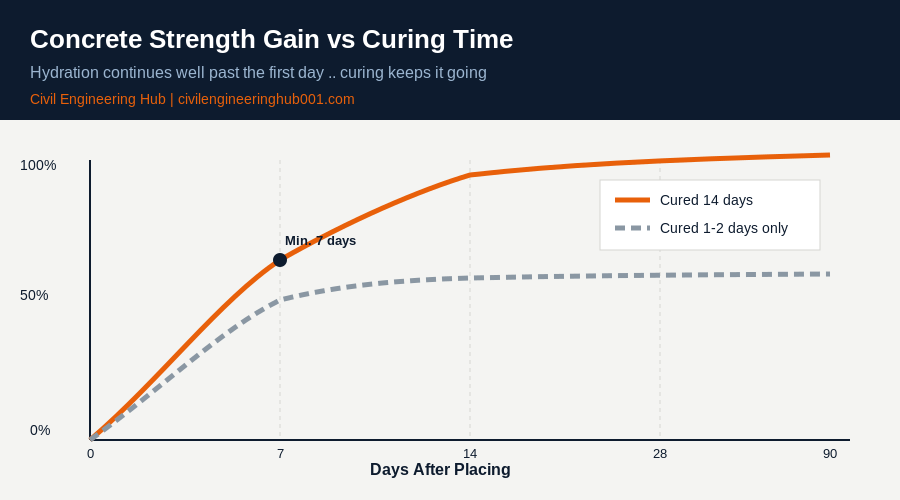
Quick Answer: Curing concrete keeps it moist so the cement can continue hydrating and gaining strength after placing. Most concrete should be cured for a minimum of 7 days, and up to 14 days for structural elements exposed to sun and wind, before it is considered to have developed adequate early strength.
What Is Actually Happening Inside Concrete During Curing?
Concrete gains strength through a chemical reaction called hydration, not by drying out. Cement particles react with water to form calcium silicate hydrate, the compound that binds aggregate together and gives concrete its strength. That reaction needs water to continue, and it does not stop after a day or two.
Honestly, this is the part most artisans get wrong. They assume once concrete is hard enough to walk on, it is done. It is not. Hydration continues for weeks, and even months, but the first 7 to 14 days matter most because that is when the bulk of usable strength develops.
If water is lost too early through evaporation, especially in hot sun or strong wind, the hydration reaction stops before it should. The result is a weaker surface layer, visible shrinkage cracks, and a slab or beam that never reaches its specified grade strength, even though the correct mix was used at batching.
How Long Should Curing Actually Last?
Kenya Building Code and BS 8110 both treat curing duration as a function of cement type, ambient temperature, and the exposure of the element. There is no single “correct” number of days. What changes is how fast strength develops and how long the surface stays vulnerable to moisture loss.
| Element / Condition | Minimum Curing Period | Notes |
|---|---|---|
| Ordinary Portland Cement, normal weather | 7 days | BS 8110 minimum for general structural work |
| Hot, dry, or windy site conditions | 10 to 14 days | Common across much of Kenya during the dry season |
| Blended or slow-setting cement (e.g. pozzolana) | 10 to 14 days | Slower early strength gain than OPC |
| Structural columns and beams | 7 to 10 days minimum | Formwork removal timing must still follow separate BS 8110 striking rules |
| Ground slabs and pavements | 7 days minimum, 14 preferred | Larger exposed surface area loses moisture faster |
| Mass concrete (thick footings, raft foundations) | 14 days or more | Heat of hydration needs controlled cooling, not just moisture |
For most residential and small commercial sites in Kenya, a practical rule that mentors pass down is simple: do not let concrete go dry for at least 7 days, and extend that to 14 days if the site is exposed to direct sun for most of the day. That single habit prevents more strength loss than almost any other site decision.
Which Curing Methods Actually Work on Site?
There is more than one way to keep concrete wet, and the right method depends on the element, water availability, and how busy the site is. Here is how the common methods compare.
| Method | Best Used For | Practical Note |
|---|---|---|
| Ponding (water retained on top with earth or sand bunds) | Flat slabs, floors | Most effective method, but only works on level surfaces |
| Wet hessian or sacks, kept damp | Columns, beams, vertical elements | Must be re-wetted at least twice a day in hot weather |
| Continuous sprinkling | Slabs and pavements | Labour-intensive; easy to forget on a busy site |
| Polythene sheeting | Slabs, especially overnight and weekends | Traps moisture without needing constant re-wetting |
| Curing compounds (membrane-forming) | Large slabs, roads, pavements | Sprayed on to seal in moisture; common on KeNHA road projects |
On most residential sites in Kenya, wet hessian combined with polythene sheeting gives the best balance of effectiveness and practicality. Ponding works well but is often skipped because it needs someone dedicated to maintaining the water bunds, and that discipline is hard to sustain past day three without supervision.
What Happens When Curing Is Skipped or Cut Short?
The visible sign is plastic shrinkage cracking, those fine, random surface cracks that appear within the first few hours to days after placing. But the real damage is often invisible: a concrete member that looks fine on the surface but has developed 15 to 30 percent less strength than its design grade because hydration stopped early.
That means a slab specified for M25 concrete can perform closer to M20 in practice, purely because of poor curing, not poor mix design. This is why cube testing at 7 and 28 days exists, to catch exactly this kind of gap before it becomes a structural risk.
For quantity surveyors and site supervisors, this has a direct cost implication too. Concrete that underperforms because of poor curing often gets blamed on the supplier or the mix, leading to unnecessary disputes and rework, when the actual fix was a five-shilling roll of polythene and someone assigned to check it twice a day.
Curing in Kenya’s Climate .. What Changes on Site
Kenya’s weather varies sharply by region and season, and curing practice should adjust accordingly. Coastal and lowland sites with high heat and humidity lose surface moisture fast, so curing should start immediately after finishing, sometimes within the hour. Highland sites like Nairobi and the central region have cooler temperatures but strong winds during the dry season, which pull moisture from exposed slabs just as aggressively as direct sun.
During the rainy season, some site teams assume rain does the curing job for them. It does not, reliably. Rain is inconsistent, can wash out fresh surface paste if it falls too early, and does not guarantee the sustained moisture that proper curing requires. Treat rainy season concrete the same way you would treat dry season concrete: protect it, and add supplemental curing if there is a dry spell of more than a few hours.
How Site Supervisors Can Verify Curing Was Done Right
Curing fails most often not because teams do not know it matters, but because no one is assigned to check it daily. A daily site report that only tracks placing and finishing, without a curing column, is missing half the job. Build curing verification into your routine the same way you would track concrete cube samples.
| Check | Frequency | Who Should Confirm |
|---|---|---|
| Curing method applied within 30 to 60 minutes of finishing | Once, at placing | Foreman on shift |
| Hessian, sand, or membrane still damp / intact | Twice daily minimum | Site supervisor or clerk of works |
| No exposed dry patches on slab or column surface | Daily visual check | Site supervisor |
| Curing period logged against placing date | Daily entry | Site diary / daily report |
| Formwork striking time cross-checked against curing progress | Before each strike | Site engineer |
This is a small addition to a daily site report, but it gives structural engineers and clerks of works a paper trail. If a cube test comes back below the specified grade weeks later, that log tells you whether curing was the likely cause, instead of guessing after the fact.
Frequently Asked Questions
Q: Can concrete be over-cured?
Practically, no. There is no structural downside to curing longer than the minimum period. The only cost is labour and water, and on most sites that cost is far smaller than the cost of rework caused by under-curing. If in doubt, cure longer, not shorter.
Q: Does curing time change if I use admixtures or add-mixtures like accelerators?
Yes. Accelerating admixtures speed up early strength gain but do not remove the need for moisture during hydration. Retarding admixtures, often used in hot weather to control setting time, generally mean curing should start slightly later but still needs to run the full recommended duration. Always follow the admixture manufacturer’s data sheet alongside BS 8110 or EC2 curing guidance.
Q: Is curing the same as protecting concrete from rain and cold?
No, these are related but different concerns. Curing is about maintaining moisture for hydration. Protection from rain, frost, or extreme heat during the first hours after placing is about preventing physical damage to the fresh surface. On most Kenyan sites, frost is not a concern, but heavy rain in the first two to three hours after finishing can still damage the surface before curing measures are even applied.
The Bottom Line
Curing is not an optional finishing step, it is part of the structural process. A well-designed mix, properly compacted and cast, can still fail to reach its specified strength if curing is rushed or skipped. The fix costs almost nothing compared to the cost of a slab that cracks, a beam that under-performs in testing, or a client dispute over concrete quality months later.
If you are on site this week, the standard to hold your team to is simple: minimum 7 days, extend to 14 in hot or windy conditions, and never let a freshly cast surface go dry in the first 24 hours. That single discipline separates concrete that performs from concrete that just looks finished.
Want more practical construction knowledge delivered directly to you?
Subscribe to our YouTube channel: https://www.youtube.com/@TheCivilEngineeringHub-001
PS: Join our engineering WhatsApp community for daily learning at +254731393520