

Every site supervisor has been there. The concrete truck has just left, the pour looks fine, and everyone moves on. But three days later, someone asks: how do you actually know that slab is as strong as the design says it should be? The honest answer is you don’t, not without testing.
The concrete cube test is the single most important quality control check on any construction site. In simple terms, it tells you whether the concrete you poured will carry the loads the structural engineer designed for. Skip it, or do it wrong, and you are gambling with the safety of the whole building.
Quick Answer: A concrete cube test measures the compressive strength of hardened concrete by crushing 150mm cube samples in a testing machine, usually at 7 and 28 days after casting, to confirm the concrete meets the design strength specified in the structural drawings.
What Is a Concrete Cube Test and Why Does It Matter
A cube test is a standard method of checking whether the concrete delivered to site actually achieves the strength the structural engineer designed for, expressed in megapascals (MPa) or as a grade such as C25 or C30.
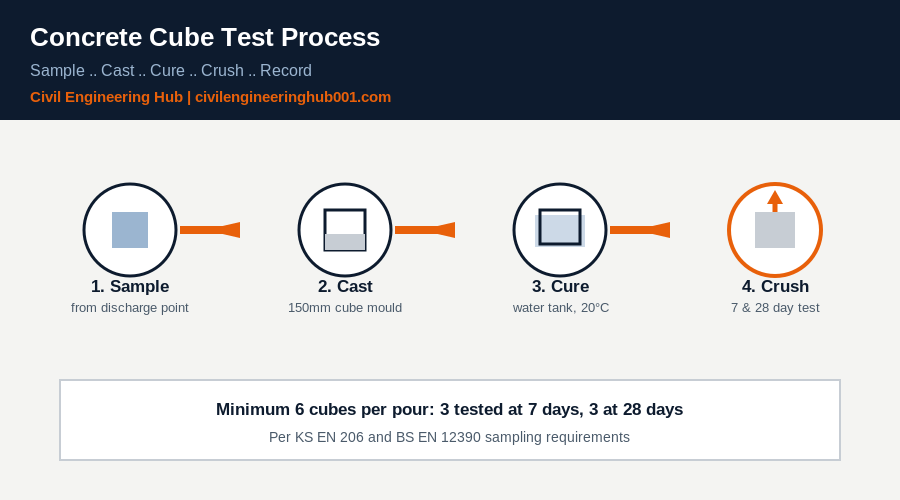
Fresh concrete is sampled from the mixer or delivery truck, poured into 150mm steel or plastic cube moulds, cured under controlled conditions, then crushed in a compression testing machine at set ages. The result tells you, in hard numbers, whether that batch of concrete can be trusted.
The truth is, concrete can look perfect on site and still fail a cube test. Poor mixing, excess water added at the last minute, wrong aggregate ratios, or bad curing can all quietly weaken a mix that appeared fine when it was poured. Cube testing is the only way to catch this before it becomes a structural problem.
Which Standards Govern Cube Testing on Site
In Kenya, concrete quality control follows KS EN 206 (Concrete – Specification, performance, production and conformity) alongside BS EN 12390, which covers the testing of hardened concrete, including cube making, curing, and compression testing procedures. Many older structural drawings still reference BS 1881, the earlier British Standard for concrete testing, so site teams should confirm which standard the structural engineer has specified before sampling begins.
The National Construction Authority (NCA) expects contractors to keep cube test records as part of site quality documentation, and consulting engineers will typically request these records before signing off critical structural elements like columns, beams, and suspended slabs.
How to Sample and Cast Cubes Correctly
Honestly, most cube test failures on Kenyan sites are not concrete failures at all. They are sampling failures. Here is the correct sequence:
| Step | Action |
|---|---|
| 1 | Take the sample directly from the discharge point of the mixer or pump, not from concrete that has already been placed |
| 2 | Fill the 150mm cube mould in three equal layers |
| 3 | Compact each layer with 35 strokes of a tamping rod, or use a vibrating table if available |
| 4 | Strike off the top surface flat and label the cube with date, element, and mix grade |
| 5 | Leave the cube undisturbed for 24 hours before demoulding |
| 6 | Cure in a water tank at 20°C ± 2°C until the test date |
For a normal structural pour, take a minimum of six cubes per sample: three for testing at 7 days and three for testing at 28 days. For larger pours such as ground beams, raft foundations, or suspended slabs, increase the sampling frequency so every batch of concrete is represented.
Understanding the 7-Day and 28-Day Results
Concrete gains strength gradually as it cures. The 7-day test is not the final judgment, it is an early warning system. In simple terms, a properly designed mix should reach roughly 65 to 70 percent of its 28-day strength by day 7.
| Concrete Grade | Design Strength (28 days) | Expected 7-Day Strength |
|---|---|---|
| C20 | 20 MPa | 13–14 MPa |
| C25 | 25 MPa | 16–17 MPa |
| C30 | 30 MPa | 20–21 MPa |
| C35 | 35 MPa | 23–24 MPa |
If the 7-day result comes in well below these ranges, that is your signal to alert the site engineer immediately, not to wait for the 28-day result before acting. Waiting means losing two to three weeks in which more of the same weak concrete may already be going into the structure.
What Happens When a Cube Test Fails
A failed cube result does not automatically mean the structure must be demolished, but it does mean it cannot be ignored. The standard response follows this order:
First, the structural engineer reviews the failed result against the design margin, since most designs are specified with a safety factor built in. Second, additional testing may be ordered, including core sampling directly from the cast element to get a more accurate strength reading than the cubes alone. Third, if the element is confirmed understrength, the engineer decides between accepting it with a load restriction, strengthening it, or in serious cases, removing and recasting it.
This is exactly why cube testing has to happen at the time of pour, not after the fact. Core testing later is more expensive, more disruptive, and still cannot fully replace a proper cube record.
Common Mistakes That Cause Low Cube Results
Honestly, most low cube results trace back to a handful of repeat mistakes on site, not bad concrete from the batching plant. Knowing these helps a supervisor catch problems before they show up in a test report weeks later.
| Mistake | Effect on Strength |
|---|---|
| Adding water on site to make concrete easier to place | Weakens the mix by raising the water-cement ratio beyond design |
| Poor compaction of the cube during casting | Leaves air voids that reduce measured strength |
| Curing cubes in open air instead of a water tank | Causes premature drying and incomplete hydration |
| Delayed transport of cubes to the testing lab | Exposes cubes to temperature swings that affect results |
| Using damaged or worn cube moulds | Produces cubes with irregular dimensions, skewing the crushing test |
The most common one by far is adding water at the site to make a stiff mix easier to pour. It feels harmless in the moment, but every extra litre of water added beyond the design mix ratio directly lowers the final strength. A supervisor who understands this can stop it happening before the pour is even finished, not after the cube report comes back low.
Building a Simple Site Quality Control System
Every site, regardless of size, should run a basic system: a cube register showing date, element cast, mix grade, cube identification numbers, and test dates; a dedicated curing tank kept at the right temperature; and a clear chain of custody so cubes are not mixed up between different pours. This is where site supervisors and quality control staff genuinely earn their role. A missing or mislabeled cube record can cost far more time later than the few minutes it takes to log it correctly on the day.
A well-run system also protects the contractor commercially. Consulting engineers and clients increasingly ask for full cube test records before releasing payment certificates or issuing practical completion, especially on projects supervised under NCA regulations. That means a site without proper records can find its own cash flow held up by paperwork that should have taken minutes to keep in order.
For teams working across multiple pours in a week, a simple spreadsheet or site diary entry per pour is enough. What matters is consistency: every cast element gets a sample, every sample gets logged, and every result gets reviewed by someone who understands what the numbers mean for that specific structural element.
Frequently Asked Questions
Q: How many cubes should be taken per concrete pour?
A minimum of six cubes is standard practice for most structural elements, three for 7-day testing and three for 28-day testing. Larger or more critical pours, such as foundations and transfer slabs, need more frequent sampling so every load of concrete delivered is properly represented in the test record.
Q: Can a cube test result be lower than expected but the concrete still be safe?
Yes, this is possible. Structural designs include a safety margin, so a mildly understrength result does not always mean failure. However, this decision belongs to the structural engineer, not the site team, and should never be assumed without a proper review of the design calculations.
Q: What is the difference between cube testing and core testing?
Cube testing uses separately cast samples taken at the time of the pour, while core testing extracts a cylindrical sample directly from the hardened structure using a diamond drill. Core testing is more accurate for assessing in-situ strength but is used only when cube results are questionable, since it damages the structure and costs more.
The truth is, concrete cube testing is not paperwork for its own sake. It is the difference between guessing and knowing that a structure will carry its design load safely for decades. Build the habit of proper sampling, correct curing, and honest record keeping on every pour, and you protect both the structure and your own professional reputation on site.
Want more practical construction knowledge delivered directly to you?
Subscribe to our YouTube channel: https://www.youtube.com/@TheCivilEngineeringHub-001
PS: Join our engineering WhatsApp community for daily learning at +254731393520