

Every concrete element on a construction site has a specification. The specification tells you what grade of concrete to use, what water-cement ratio to target, and what compressive strength it must achieve at 28 days. But most people on site pour whatever the mixer operator produces without asking whether the concrete actually meets the design requirement.
In this guide, you will learn what concrete mix design means, the difference between nominal and designed mixes, how concrete grades are specified under BS 8500, and how to ensure the concrete going into your structural elements is the strength the engineer designed for. This applies to civil engineers, structural engineers, site supervisors, and anyone involved in reinforced concrete construction.
Quick Answer: Concrete mix design is the process of selecting the proportions of cement, water, fine aggregate, and coarse aggregate to produce concrete that meets a specified strength, workability, and durability requirement. The target mean strength for a designed mix is set higher than the characteristic strength to account for production variability on site.
What Is Concrete Mix Design and Why Does It Matter?
When a structural engineer designs a reinforced concrete beam, column, or slab, they specify a concrete grade. In Kenya and East Africa, grades are expressed as C20, C25, C30, and C35, referring to the characteristic compressive strength in N/mm² measured on 150mm cubes at 28 days, following BS 8500 and BS EN 206.
Concrete mix design is the process of selecting the exact proportions of cement content, water-cement ratio, aggregate grading, and admixtures that will reliably produce concrete at or above the specified grade. It accounts for the natural variability of site production, the properties of local aggregates, and the durability requirements of the structure in its specific exposure conditions.
The truth is.. specifying C25 concrete and actually achieving C25 concrete on site are two very different things. Mix design bridges that gap between what is written on the drawing and what actually ends up in the structure.
Nominal Mix vs Designed Mix: The Key Difference Every Engineer Must Know
There are two approaches to concrete mix proportioning used on construction sites in Kenya: nominal mixes and designed mixes.
| Feature | Nominal Mix | Designed Mix |
|---|---|---|
| How it is defined | Fixed ratio by volume (e.g., 1:2:4, 1:1.5:3) | Proportions derived from material testing to achieve a target strength |
| Standard reference | Historical site practice (BS 5328, withdrawn) | BS EN 206 / BS 8500 |
| Typical use | Blinding concrete, non-structural fills, kerb beds | All structural RC: beams, columns, slabs, foundations |
| Quality control | Minimal.. relies on volume batching accuracy | Requires cube testing and batch records |
| Strength reliability | Lower.. varies with aggregate moisture and batching | Higher.. based on laboratory trials and material testing |
In simple terms.. a nominal mix like 1:2:4 (cement:sand:aggregate by volume) is convenient but imprecise. The actual strength depends heavily on the water added, the quality of the aggregates, and how accurately the ratios are measured on site. A designed mix is produced by a concrete laboratory using actual material tests to determine the exact proportions needed to consistently achieve the required grade.
On any structural project requiring C25 or above, a designed mix is the professional standard. The NCA and most consulting engineers in Kenya require designed mixes with cube test records for all structural concrete on approved projects.
Concrete Grades Explained: Which Grade to Use for Each Structural Element
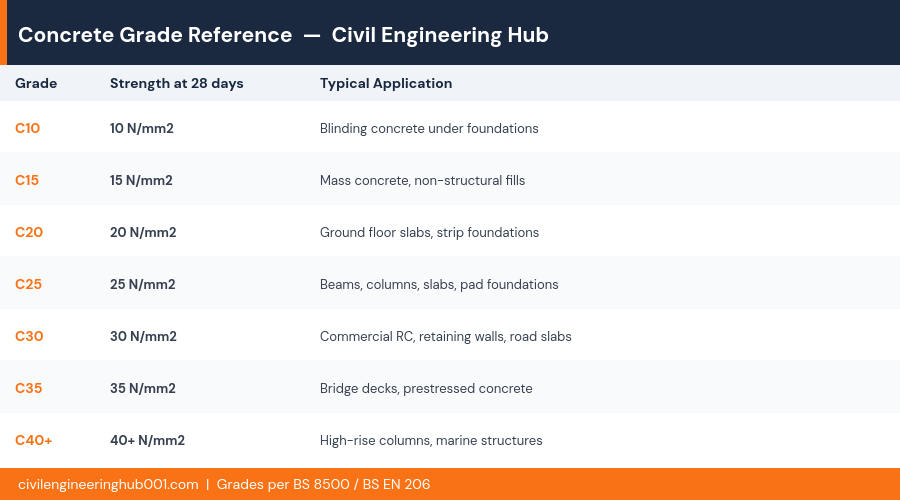
Different structural elements require different concrete grades depending on the loads they carry and the environment they are exposed to. Here is the standard guide used in practice across Kenya and East Africa.
| Grade | Characteristic Strength at 28 days | Typical Application |
|---|---|---|
| C10 | 10 N/mm² | Blinding concrete under foundations |
| C15 | 15 N/mm² | Mass concrete, non-structural fills, kerb beds |
| C20 | 20 N/mm² | Low-stress ground floor slabs, strip foundations |
| C25 | 25 N/mm² | Residential beams, columns, slabs, pad foundations |
| C30 | 30 N/mm² | Commercial buildings, retaining walls, road slabs |
| C35 | 35 N/mm² | Bridge decks, prestressed concrete elements |
| C40+ | 40+ N/mm² | High-rise columns, marine structures, piled foundations |
Under BS 8110, the minimum grade for reinforced concrete in structural applications is C25. Using C20 where C25 is specified is a structural deficiency. It may not show up as a visible problem for years, but it reduces the load-carrying capacity and long-term durability of the element.
How the Water-Cement Ratio Controls Concrete Strength
The single most important variable in concrete strength is the water-cement (w/c) ratio. The lower the w/c ratio, the stronger and more durable the concrete. This is one of the most consistent principles in concrete technology.
As more water is added to a mix, workability improves and the concrete becomes easier to pour and compact. But the excess water that is not consumed by the hydration reaction leaves voids in the hardened cement paste as it evaporates. These voids reduce density, lower strength, and increase permeability, which allows water, chlorides, and carbon dioxide to penetrate the concrete and corrode the reinforcement over time.
For C25 concrete, a typical designed mix targets a w/c ratio of 0.50 to 0.55. For C30, the target drops to around 0.45 to 0.50. If the mix is too stiff to place, the correct solution is a plasticiser admixture, not extra water. Adding water on site to improve workability is one of the most damaging practices in reinforced concrete construction.
Cube Testing: How You Know the Mix Is Working
Concrete cube tests are the standard quality control tool for verifying that the concrete placed on site meets the specified grade. Under BS EN 12390, 150mm concrete cubes are cast from samples taken during pouring, cured under standard conditions, and crushed at 7 days and 28 days.
The 7-day result gives an early indication of strength development. The 28-day result is the acceptance criterion. For a C25 designed mix, no more than 5% of test results should fall below 25 N/mm², and the mean result must exceed 25 N/mm² by a margin that accounts for production variability.
Honestly.. cube testing on site is often treated as a box-ticking exercise. Cubes are cast and left in the sun to cure incorrectly, and results are filed away without anyone acting on them. That is poor practice. Cube results are the only objective evidence you have that the concrete in your structure meets specification. They must be reviewed, recorded, and acted on if results fall short.
Frequently Asked Questions
Q: What does a 1:2:4 concrete mix mean and is it still used in Kenya?
A 1:2:4 nominal mix means 1 part cement, 2 parts sand, and 4 parts coarse aggregate by volume. It is widely used on low-rise construction sites for non-structural elements and blinding. However, it is not appropriate for structural concrete above C20 because the proportions cannot be reliably controlled on site, and the actual strength varies significantly with aggregate moisture content and batching accuracy.
Q: What is the minimum concrete grade for reinforced slabs and beams in Kenya?
Under BS 8110, which is widely applied in Kenyan structural design, the minimum grade for reinforced concrete is C25. In coastal environments or areas with aggressive groundwater or sulphate-bearing soils, C30 or higher may be required for durability. The structural engineer specifies the grade based on the design requirements and exposure conditions of the project.
Q: How do you know if concrete on site is the right grade?
The primary method is cube testing. You cast 150mm cube samples from each concrete pour, cure them under standard conditions (not in direct sunlight), and crush them at 28 days. A secondary check is to verify delivery notes from the batching plant, which should state the mix design reference and target strength. Visual inspection alone cannot confirm concrete grade.
Concrete Mix Design Is the Foundation of Every RC Structure
Every reinforced concrete element on your site was designed for a specific concrete grade. When that grade is not achieved, the structure’s load-carrying capacity is reduced.. not visibly, not immediately, but fundamentally. The consequences show up years later as cracks, spalling, or structural failure.
Understanding concrete mix design means you know what you are specifying, what you are ordering, and what you are checking. That knowledge separates an engineer who manages a structure from one who just manages a pour.
Want more practical construction knowledge delivered directly to you?
👉 Subscribe to our YouTube channel: https://www.youtube.com/@TheCivilEngineeringHub-001
PS: Join our engineering WhatsApp community for daily learning at +254731393520
This is of great importance