

If you have ever stood on a construction site and wondered why some concrete has steel bars running through it while other sections do not, you are asking the right question. The difference between reinforced concrete and plain concrete is one of the most fundamental concepts in construction.. and getting it wrong on site has serious consequences.
This post breaks it down clearly — what each type is, how they behave structurally, and where each one belongs on a project.
What Is Plain Concrete?
Plain concrete is concrete without any steel reinforcement. It is made from cement, fine aggregates, coarse aggregates, and water.. mixed in the right proportions and left to cure.
It performs well under compression. That means it can carry loads that push down on it. The problem is that plain concrete is weak in tension.. it cracks easily when pulled, bent, or subjected to lateral forces.
In simple terms.. plain concrete is strong when squeezed but brittle when stretched.
Where plain concrete is used:
- Blinding layers under foundations (a thin levelling layer before reinforcement is placed)
- Mass concrete in non-structural fills
- Paving in low-traffic areas
- Some unreinforced strip foundations in light residential construction
What Is Reinforced Concrete?
Reinforced concrete is plain concrete with steel bars (called rebar or reinforcement) embedded inside it. The steel and concrete work together — concrete carries the compressive forces, and steel carries the tensile forces.
This combination is what makes reinforced concrete so widely used in structural engineering. It can resist bending, shear, and tension that would destroy plain concrete entirely.
The truth is.. almost every structural element you see on a modern construction site — beams, columns, slabs, retaining walls, staircases — is made from reinforced concrete.
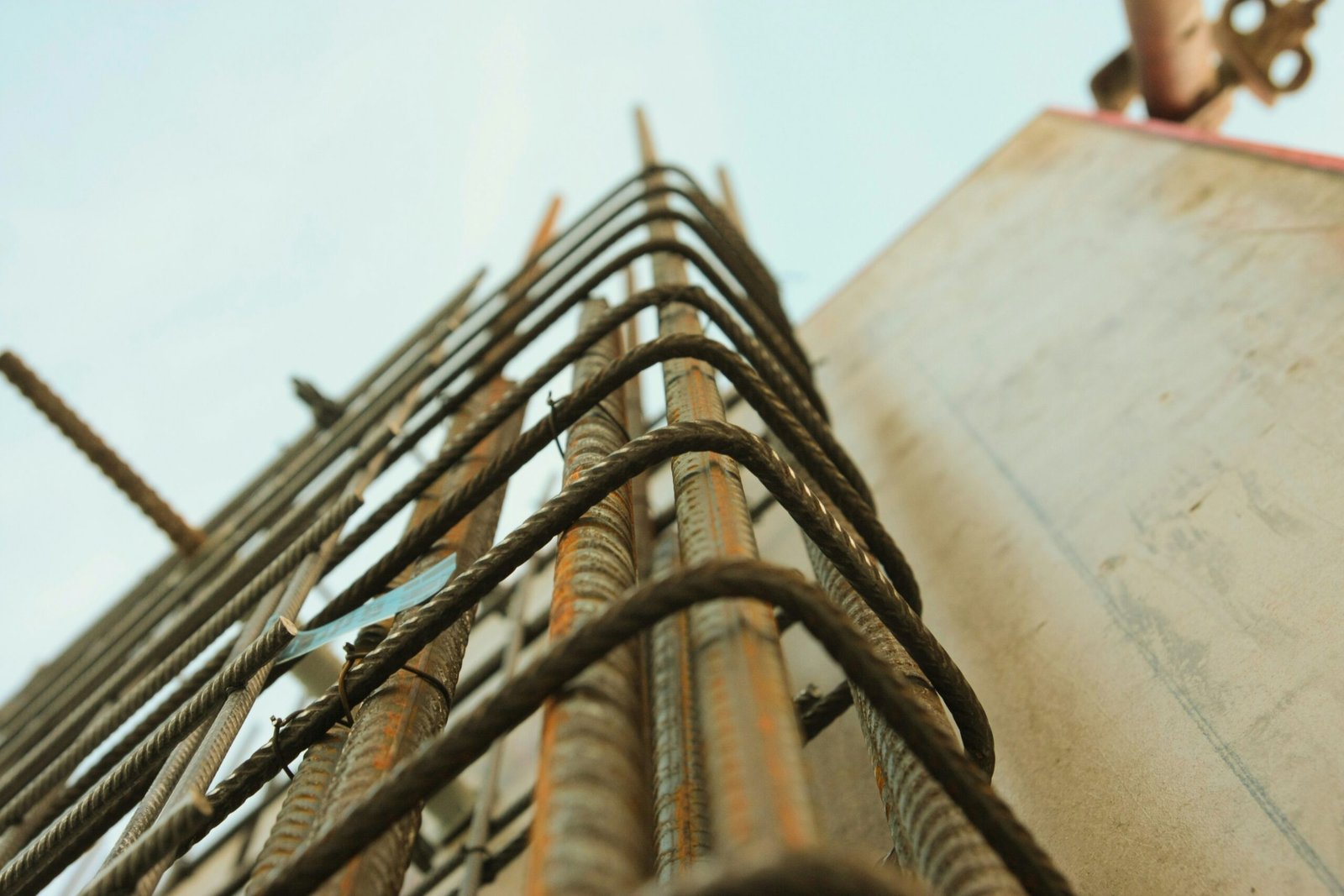
Where reinforced concrete is used:
- Foundations (pad, strip, raft, and pile caps)
- Ground and suspended slabs
- Beams and lintels
- Columns and shear walls
- Staircases
- Retaining walls and water-retaining structures
Why the Steel-Concrete Bond Matters
One thing that makes reinforced concrete work is the bond between steel and concrete. As concrete cures and hardens, it grips the steel tightly. The two materials also have very similar thermal expansion coefficients — meaning they expand and contract at nearly the same rate when temperatures change. This is why they do not separate over time.
If the bond is compromised — through poor compaction, excess water in the mix, or inadequate cover to the reinforcement — the structural integrity of the element is at risk. This is why concrete cover (the thickness of concrete between the rebar and the surface) is specified on every structural drawing and must be maintained on site.
What Happens When You Get It Wrong
Using plain concrete where reinforced concrete is specified is one of the most dangerous errors on a construction site. A slab or beam without its designed reinforcement will not fail slowly — it will fail suddenly, without warning.
Honestly.. most structural collapses investigated after the fact come down to either the wrong concrete grade, missing reinforcement, or both. These are not abstract engineering problems. They are site supervision problems.
Always check the structural drawings before any pour. Confirm the reinforcement layout, bar sizes, and spacing match what is specified. Do not proceed if something does not match.
A Quick Comparison
| Plain Concrete | Reinforced Concrete | |
|---|---|---|
| Tensile strength | Low | High (due to steel) |
| Compressive strength | Good | Good |
| Cost | Lower | Higher |
| Typical use | Blinding, fills, low-load paving | All structural elements |
| Risk if misused | High | High if steel is missing or wrong |
Conclusion
Plain concrete and reinforced concrete are not interchangeable. Each has a specific role on site, and that role is defined by the structural engineer on the drawings. Your job — whether you are a civil engineer, architect, site supervisor, or contractor — is to build exactly what is specified.
When in doubt, go back to the drawings. That is always the right answer.
Want more practical civil engineering knowledge delivered directly to you?
👉 Subscribe to our YouTube channel: https://www.youtube.com/@TheCivilEngineeringHub-001
PS: Join our engineering WhatsApp community for daily learning at +254731393520