

A poorly designed culvert will destroy a road. It is that simple. Whether you are working on a rural access road in Kenya or a major highway, the culvert is one of the most critical drainage elements on your project .. and one of the most commonly underdesigned.
This guide walks you through the full process of culvert design for road drainage: from understanding catchment area to selecting the right type and size. By the end, you will know what calculations to run, what standards to apply, and what to watch for on site.
Quick Answer: To design a culvert for road drainage, calculate the peak discharge using the Rational Method (Q = CiA), then size the culvert barrel to pass that flow with adequate freeboard. The most common culvert types used in Kenya are circular concrete pipes and rectangular box culverts, sized according to BS 5911 and the Kenya Roads Design Manual.
What Is a Culvert and Why Does It Matter?
A culvert is a structure that allows water to pass under a road, embankment, or railway. It is not a bridge .. a culvert typically has a span of less than 6 metres. But like a bridge, it must carry both the load of the road above it and the hydraulic load of the water flowing through it.
The truth is, most road failures in Kenya are drainage failures. When a culvert is undersized, water backs up, saturates the road subgrade, and the road breaks down from below. When the culvert is missing altogether, surface water cuts channels across the carriageway. Both situations are preventable with proper design.
Culverts serve civil engineers, but quantity surveyors, site supervisors, and even architects working on estate roads need to understand how they work. A culvert that fails costs far more to replace than it did to design correctly the first time.
Step 1 .. Define the Catchment Area and Estimate Peak Flow
The first step in culvert design is hydrological. You need to know how much water the culvert must carry during a design storm. The standard approach in East Africa is the Rational Method:
Q = C × i × A
- Q = Peak discharge (m³/s)
- C = Runoff coefficient (dimensionless) .. depends on land cover
- i = Rainfall intensity (m/s) for the design return period
- A = Catchment area (m²)
For rural roads, the Kenya Roads Design Manual recommends a 10-year return period for minor culverts and a 25-year return period for major crossings. Urban roads typically use a 10-year storm for side drains and a 25–50 year storm for main culverts under arterial roads.
The runoff coefficient C varies from 0.25 for flat agricultural land to 0.90 for paved urban areas. Use the AASHTO Drainage Manual or the Kenya Roads Design Manual tables to select the correct value for your catchment.
Delineate the catchment area using a topographic map or survey data. Every hectare of land that drains toward your road crossing contributes to Q. Missing even a small tributary can lead to undersizing.
Step 2 .. Select the Culvert Type
Once you have your design discharge, select the type of culvert. The main types used in road construction in Kenya are:
- Circular concrete pipe culverts .. Most common for flows below 3 m³/s. Manufactured to BS 5911. Available in diameters from 300mm to 1800mm. Easy to handle and install on site.
- Box culverts (rectangular) .. Used for higher flows or where headroom is limited. Can be precast or cast in situ. Designed to BS 8110 (or Eurocode 2 for newer projects).
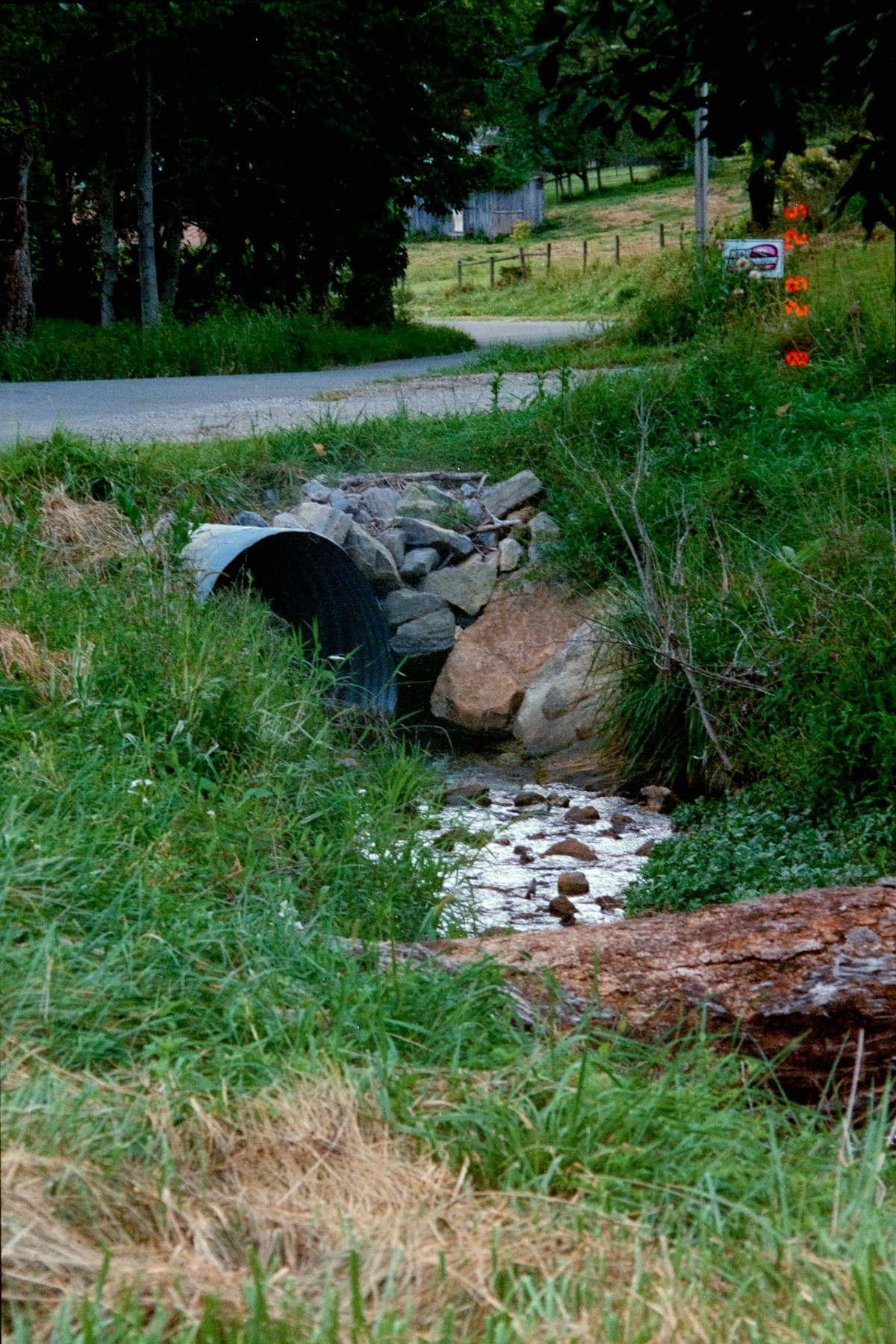
- Corrugated metal pipe (CMP) .. Used on temporary or low-volume roads. Lighter and faster to install but less durable in aggressive soils.
- Arch culverts .. Used where a wide, shallow waterway cross-section is required. Less common but useful for fish passage in environmental projects.
For most government road projects in Kenya, the Roads Department specifies precast concrete pipes or precast box culverts. On KeNHA and KURA projects, culvert specifications are included in the Bill of Quantities and the drawings package .. always confirm the type before sizing.
Step 3 .. Size the Culvert Using Hydraulic Calculations
Sizing a culvert means finding the barrel dimensions that will pass the design discharge Q without overtopping the road or causing unacceptable backwater flooding upstream.
The key hydraulic relationship is Manning's equation for full-pipe flow:
Q = (1/n) × A × R^(2/3) × S^(1/2)
- n = Manning's roughness coefficient (0.013 for concrete, 0.024 for CMP)
- A = Cross-sectional area of the barrel (m²)
- R = Hydraulic radius = A / wetted perimeter (m)
- S = Hydraulic gradient (approximate as the culvert invert slope)
In practice, most engineers use culvert sizing charts or software (HEC-RAS, CulvertMaster) to iterate quickly. The goal is to find the smallest standard size that passes Q at no more than 75–80% full capacity, leaving freeboard for debris and unforeseen events.
For a circular pipe culvert, a general rule: a 900mm diameter concrete pipe at 1% slope passes approximately 1.2 m³/s under outlet control. A 1200mm pipe at 1% slope passes approximately 2.5 m³/s. Always confirm with full hydraulic calculations .. do not rely only on rules of thumb.
Step 4 .. Design the Inlet, Outlet, and Headwalls
The culvert barrel alone is not the complete design. The inlet and outlet configurations significantly affect hydraulic performance and structural integrity.
Headwalls protect the embankment from erosion and improve the inlet efficiency. On most Kenyan road projects, headwalls are constructed in mass concrete (1:2:4 mix) or reinforced concrete where hydraulic forces are higher.
Key design decisions for the inlet and outlet:
- Wingwall angle: typically 30°, 45°, or flared .. affects inlet loss coefficient
- Apron length and protection: stone pitching or concrete aprons to prevent scour at the outlet
- Invert level: set the culvert invert to match the natural stream bed as closely as possible .. avoid sudden drops that cause scour
- Minimum cover: the top of the culvert barrel must have at least 300mm of fill below the road surface for pipe culverts (600mm in some specifications)
Honestly, the outlet is where most site problems happen. If the outlet is not protected, the high-velocity exit flow will erode the toe of the embankment within one rainy season. Specify riprap or concrete energy dissipators at the outlet for any culvert passing more than 1.5 m³/s.
Step 5 .. Check Structural Design and Bedding
A culvert must carry the dead load of the fill above it and the live loads from vehicles. For precast concrete pipes, the structural capacity is specified by the pipe class under BS 5911:
- Class H .. Standard strength, suitable for normal road fills up to 600mm
- Class S .. Super strength, used for deeper fills or heavy loading
The bedding conditions matter as much as the pipe class. A concrete pipe on a granular bed (Class B bedding per BS 9295) achieves a bedding factor of 1.9 .. meaning the installed load capacity is 1.9 times the three-edge bearing strength. Class D bedding (flat ground, no shaped bed) gives a factor of only 1.1. Always specify and inspect the bedding on site.
For box culverts, structural design follows BS 8110 or EC2. The box must be designed for soil pressure, self-weight, surcharge loads, and live loads simultaneously. This is typically done using structural design software or standard precast culvert tables from manufacturers.
Frequently Asked Questions
Q: What is the minimum size culvert allowed on a public road in Kenya?
The Kenya Roads Design Manual specifies a minimum internal diameter of 600mm for culverts on public roads. This minimum is set to allow for maintenance access and to reduce the risk of blockage from debris. Smaller pipes are only acceptable for private driveways or temporary works.
Q: How do I account for silting and debris in culvert design?
Apply a blockage factor of 25–50% to your design capacity to account for partial blockage from debris and sediment. This means your culvert should have hydraulic capacity 1.25 to 1.5 times the calculated Q. For culverts in areas with high sediment load, specify a silt trap or screen upstream of the inlet.
Q: When should I use a box culvert instead of a circular pipe?
Use a box culvert when the design flow exceeds what a single 1800mm pipe can pass, when headroom is limited (flat topography with low embankment height), or when the waterway has a wide, shallow cross-section. Box culverts are also preferred where the culvert doubles as a drift or low-water crossing on secondary roads.
Final Takeaway
Good culvert design is not complicated, but it requires discipline. Define your catchment correctly, calculate peak flow honestly, size for capacity with freeboard, and detail the inlet and outlet to protect the structure from erosion. Every step matters.
In simple terms.. a culvert is only as good as the weakest part of its design. Get the hydrology wrong and the size is meaningless. Get the size right but neglect the bedding and the pipe will crack under load. Treat it as a complete system, not a single calculation.
Apply these principles on your next project and you will design culverts that last the full design life of the road above them.
Want more practical construction knowledge delivered directly to you?
👉 Subscribe to our YouTube channel: https://www.youtube.com/@TheCivilEngineeringHub-001
PS: Join our engineering WhatsApp community for daily learning at +254731393520
I am a Civil Engineer based in Uganda. I am interested in learning various construction designs including road designs.
Hie Eng Joyce Kanyiri.
Thanks very much for your insights. It is good to transfer knowledge to the young Engineers as most of us are struggling to get some of the simple stuff in the construction industry. Which your lessons its easy to walk proudly on a construction site knowing what to do and why is it done.
If possible can you please share a video on the box culvert explanation and with real pratice drawing session in AutoCAD so that we can be trying that on our own
Victor, that means a lot — thank you. You have named exactly what site confidence looks like: knowing what to do and why, not just following instructions blindly. A box culvert video with a real AutoCAD drawing session is a solid request and it is going on the content list. In the meantime, join our WhatsApp community at +254731393520 where we cover practical design and drawing topics, and you can ask follow-up questions directly.