

Every road engineer eventually meets the same problem on site: water is coming down a natural drainage line, the road has to cross it, and someone has to decide how big the pipe underneath should be. Get it wrong and you either waste money on an oversized structure or you build a culvert that overtops in the first heavy rains and washes out the embankment.
The truth is, culvert sizing is not guesswork. It is a calculation built on catchment area, rainfall intensity, flow velocity and the type of crossing you are dealing with. In simple terms, you are matching the pipe’s carrying capacity to the volume of water it will realistically need to move during a design storm.
Quick Answer: Culvert size is determined by calculating the peak design flow (using the Rational Method or a similar hydrological model) and then selecting a culvert diameter or box size whose hydraulic capacity, checked using Manning’s equation, safely exceeds that flow without causing excessive headwater or velocity.
What a Culvert Actually Does and Why Sizing Matters
A culvert is a structure that lets water pass under a road, driveway or embankment without disrupting traffic above it. It sits between two worlds: the hydrology of the catchment feeding it, and the structural load of the road sitting on top of it.
Honestly, most culvert failures on Kenyan roads are not structural failures. They are hydraulic failures. The pipe was undersized for the catchment, water backed up, overtopped the road, and eroded the embankment from the side. An oversized culvert is not free either. It costs more in concrete, excavation and pipe material than the site needs.
That is why sizing sits at the center of every culvert design. It is the one calculation that determines whether the structure survives its first real rainy season.
The Factors That Determine Culvert Size
Before any pipe diameter is chosen, an engineer needs data. The main factors that go into a culvert sizing calculation are:
- Catchment area — the total land area draining toward the crossing point, usually measured from a topographic map or site survey.
- Rainfall intensity — the design storm return period, typically 10, 25 or 50 years depending on the road classification.
- Runoff coefficient — how much of the rainfall actually becomes surface runoff, based on land cover and soil type.
- Time of concentration — how long it takes water from the farthest point of the catchment to reach the culvert.
- Allowable headwater — how much the water level is permitted to rise upstream of the culvert before it becomes a flood risk.
- Outlet conditions — the slope and channel downstream, which affects whether the culvert flows under inlet or outlet control.
Skip any one of these and the sizing calculation is incomplete. This is where classroom theory has to meet real site data — a catchment that looks small on a map can behave very differently after deforestation or new development upstream.
How to Calculate Design Flow Using the Rational Method
For catchments under about 80 hectares, most engineers in Kenya use the Rational Method to estimate peak flow. The formula is:
Q = C × I × A / 360
Where Q is peak flow in cubic meters per second, C is the runoff coefficient, I is rainfall intensity in millimeters per hour, and A is catchment area in hectares.
The runoff coefficient is the variable most site engineers get wrong because it is tempting to use a single default value everywhere. In simple terms, a paved urban catchment and a forested rural catchment will never produce the same runoff from the same rainfall.
| Land Cover Type | Typical Runoff Coefficient (C) |
|---|---|
| Steep bare/rocky terrain | 0.70 – 0.90 |
| Cultivated farmland (average slope) | 0.30 – 0.50 |
| Grassland / pasture | 0.20 – 0.40 |
| Forested catchment | 0.10 – 0.25 |
| Urban/paved surfaces | 0.70 – 0.95 |
Once Q is calculated, the culvert is checked using Manning’s equation to confirm the pipe or box section can actually carry that flow at an acceptable velocity, usually kept between 0.6 and 4.5 meters per second to avoid both siltation and scour.
Common Culvert Types and Their Typical Capacity
Culvert type is not just an aesthetic or cost decision. Each type has a different hydraulic performance and a different suitability depending on catchment size, road classification and available headroom.
| Culvert Type | Typical Diameter/Size | Best Suited For |
|---|---|---|
| Circular RC pipe culvert | 450mm – 1200mm | Small to medium catchments, rural roads |
| Box culvert (RC) | 1m x 1m up to 3m x 3m | Larger flows, low headroom situations |
| Corrugated steel pipe | 600mm – 1800mm | Temporary works, fast installation |
| Multi-cell box culvert | Multiple box units side by side | Wide catchments, major highways |
A single 900mm pipe culvert and a 900mm x 900mm box culvert do not carry the same flow. The box section generally has a larger effective flow area, which matters when comparing options against a fixed hydraulic capacity requirement.
Inlet Control vs Outlet Control — Why It Changes Your Design
Once the peak flow is known, the next question is what actually limits the culvert’s performance: the inlet or the outlet. This distinction trips up a lot of young engineers because both conditions can produce the same symptom on site, which is water backing up in front of the structure.
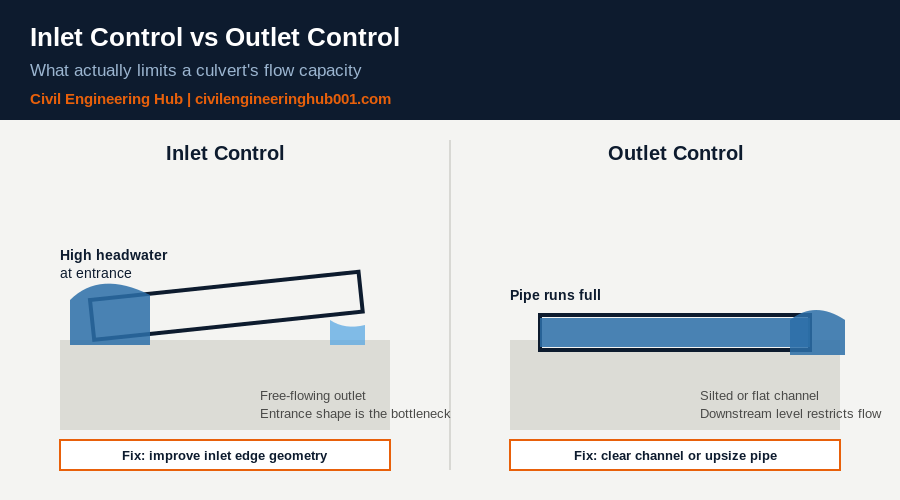
A culvert operates under inlet control when the entrance geometry, not the pipe itself, is the bottleneck. This usually happens on steep culverts with a free-flowing outlet. Here, headwater depth depends mainly on the inlet edge shape and the pipe diameter, so improving the entrance with a flared or bevelled edge can increase capacity without changing the pipe size at all.
A culvert operates under outlet control when the pipe’s friction, length, slope or the downstream water level is what restricts flow. This is common on flatter road alignments or where the outlet channel is silted or overgrown. In outlet control, increasing the pipe diameter alone will not fix a flooding problem if the downstream channel cannot carry the water away fast enough.
In simple terms, an engineer who sizes a culvert without checking which control condition applies is really just guessing at half the picture. Both KeNHA design guidance and standard hydraulic references such as the HEC-RAS culvert hydraulics manual expect this check to be part of any formal design submission.
Kenya-Specific Standards and What KeNHA Requires
In Kenya, culvert design on classified roads follows the KeNHA Road Design Manual Part III (Drainage Design), which sets out minimum return periods, freeboard requirements and design storm intensities by region. For minor roads and rural access roads, county engineers commonly reference the same manual alongside the Kenya Building Code for structural loading on culvert headwalls and wingwalls.
The manual generally requires a minimum design return period of 10 years for minor roads and up to 50 years for critical crossings on major highways. It also sets a minimum culvert size of 600mm diameter for maintenance access, regardless of what the hydraulic calculation might otherwise allow, because smaller pipes clog quickly with silt and debris.
For engineers working outside Kenya, the same principles apply under BS EN 1997 for the geotechnical side and local hydrological codes for the flow calculation. What changes country to country is mainly the rainfall intensity data and the required design return period.
Common Mistakes Engineers Make When Sizing Culverts
The truth is, most culvert sizing mistakes are not calculation errors. They are judgment errors made under time pressure on site.
Engineers frequently use rainfall data from the nearest weather station without checking whether it actually represents the catchment’s microclimate. They also default to whatever culvert size was used on the last project instead of running fresh numbers, and they forget to check outlet conditions, which can turn a correctly sized culvert into a flooding hazard if the downstream channel cannot carry the discharged flow away fast enough.
Another frequent error is ignoring future catchment changes. A catchment that is farmland today may be a housing estate in five years, and that shift in land cover changes the runoff coefficient significantly. Designing with only current conditions in mind is a shortcut that comes back to bite the road later.
Frequently Asked Questions
Q: What is the minimum culvert size allowed on Kenyan roads?
Most county and KeNHA guidelines set a practical minimum of 600mm diameter for pipe culverts, even where the hydraulic calculation suggests a smaller size would technically work. This minimum exists because smaller pipes silt up and block quickly, and the maintenance cost of constantly clearing them outweighs the material savings.
Q: Can a culvert be too big?
Yes. An oversized culvert wastes money on excavation, concrete and pipe material, and it can also run at very low velocity during normal flow, encouraging silt deposits that reduce its effective capacity over time. Sizing should match the design flow closely, not overshoot it by a wide margin.
Q: Do I always need a hydrology study for a small culvert?
For very small catchments on minor access roads, engineers often use simplified regional formulas or the Rational Method with conservative assumptions instead of a full hydrology study. For anything feeding a classified road or crossing a significant watercourse, a proper catchment assessment is required under KeNHA guidelines.
Final Takeaway
Culvert sizing is one of the clearest examples of where classroom formulas meet real consequences on site. The Rational Method and Manning’s equation give you the numbers, but judgment about catchment behavior, land use change and outlet conditions is what actually protects the road.
If you are still building your foundation in hydraulic design, start by mastering the Rational Method calculation by hand before relying on software. Understanding what the numbers mean will make you a far better engineer than knowing which button to click.
Want more practical construction knowledge delivered directly to you?
Subscribe to our YouTube channel: https://www.youtube.com/@TheCivilEngineeringHub-001
PS: Join our engineering WhatsApp community for daily learning at +254731393520