

Ask five people on a Kenyan construction site what a method statement is, and you will get five different answers. Some think it is a formality for the file. Others think it is the same as a risk assessment. Neither is correct.
Quick Answer: A method statement is a written document that explains, step by step, how a specific piece of construction work will be carried out safely, in the correct sequence, and with the right resources. It is usually prepared by the contractor or site supervisor responsible for that activity and approved by the project’s safety officer or consulting engineer before work starts.
The truth is, a method statement is one of the most practical documents on any site, civil, structural, or MEP. It bridges the gap between what the drawing says and what actually happens on the ground. Skip it, and you are exposing your team to accidents, rework, and delays that were entirely avoidable. In this guide we break down what a method statement covers, who should write it, and how it fits into everyday site practice in Kenya.
What Exactly Is a Method Statement
In simple terms, a method statement is a plan of action for one specific task, such as excavation, formwork erection, concrete pouring, scaffolding, or roofing. It answers four questions: what work is being done, how it will be done, what equipment and materials are needed, and what precautions will protect workers and the public.
It is not a general policy document. A method statement for casting a suspended slab will look completely different from one for trenching a drainage line, even on the same project. Each high-risk or technically complex activity gets its own statement.
Under the Occupational Safety and Health Act 2007 (Kenya), employers and contractors are required to assess and control risks associated with work activities before they begin. A method statement is the practical tool that demonstrates this has been done. On larger projects supervised by the National Construction Authority (NCA), method statements are often a condition of site handover for critical activities like deep excavation or crane lifting.
What a Method Statement Must Cover
Honestly, a method statement that is too short is as useless as one that is too long. It needs enough detail that a competent supervisor who was not involved in writing it could follow it and execute the work safely. The table below shows the core sections every method statement should include.
| Section | What It Should Contain |
|---|---|
| Scope of Work | Exact activity covered, location on site, and what is excluded |
| Sequence of Operations | Step-by-step order of tasks from setup to completion |
| Plant, Tools and Materials | Equipment list, specifications, and quantities required |
| Manpower and Roles | Number of workers, trades involved, and supervision structure |
| Hazards and Controls | Key risks for this activity and how each is controlled |
| PPE Requirements | Specific protective equipment for the task, not a generic list |
| Emergency Procedures | What happens if something goes wrong mid-task |
| Approval Signatures | Preparer, reviewer, and approver with dates |
A method statement for structural work should also reference the specific design standard governing that element, whether that is BS 8110, Eurocode 2, or the applicable Kenya Building Code clause, so that anyone checking the document can verify the method matches the design intent.
It is worth being specific rather than generic in every section. “Use appropriate PPE” tells a worker nothing. “Full body harness with double lanyard, hard hat with chin strap, and non-slip boots for all personnel working above 2 metres” tells them exactly what is expected. The difference between a method statement that gets followed and one that gets ignored almost always comes down to this level of detail.
Who Writes the Method Statement and Who Approves It
This is where confusion usually starts. The method statement is normally drafted by the party who will actually execute the work, not by the client or the consultant. That means:
- The main contractor’s site engineer or foreman writes statements for structural and civil activities.
- Specialist subcontractors, such as scaffolding, piling, or MEP firms, write their own statements for their scope.
- The site supervisor or project manager reviews the statement for practicality and coordination with other trades.
- The health and safety officer, resident engineer, or consultant approves it before the activity is allowed to start.
That means a mason laying blockwork, an electrician running conduit through a slab before casting, and a crane operator lifting precast panels may each need a method statement specific to their trade, even on the same floor of the same building. The person doing the work understands its real sequence and constraints far better than someone writing from a desk.
Method Statement vs Risk Assessment — What Is the Difference
These two documents are often submitted together, which is why people mix them up. In simple terms, a risk assessment identifies what could go wrong and rates the likelihood and severity. A method statement explains how the work will actually be carried out, incorporating the controls the risk assessment recommended.
| Aspect | Risk Assessment | Method Statement |
|---|---|---|
| Purpose | Identifies and rates hazards | Describes how the work will be done safely |
| Focus | What could go wrong | Step-by-step execution plan |
| Output | Risk rating matrix | Sequential work procedure |
| Combined Document | Often issued together as a RAMS (Risk Assessment and Method Statement) | |
On most Kenyan sites, contractors submit these as a combined RAMS package for review. The resident engineer or safety officer checks that the two documents are consistent, meaning every hazard flagged in the risk assessment has a corresponding control described in the method statement.
How Method Statements Work on a Kenyan Construction Site
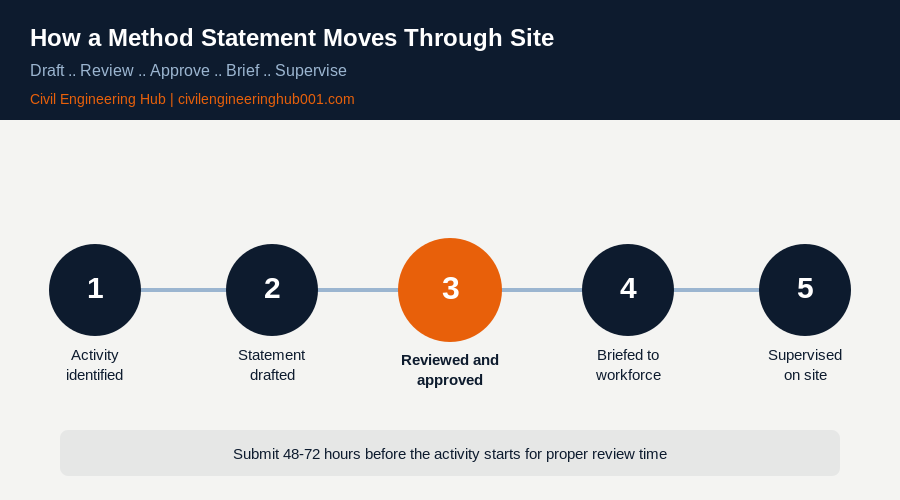
In practice, here is how the process typically runs on a well-managed site:
- The activity is identified during the weekly programme review, for example, casting a first-floor slab next Tuesday.
- The site engineer drafts the method statement, referencing the structural drawing and bar bending schedule.
- The document is submitted to the resident engineer or consultant at least 48 to 72 hours before the activity, giving time for review and comment.
- Once approved, it is briefed to the workforce through a toolbox talk before work starts, not just filed away.
- The supervisor checks compliance on the day, confirming the sequence, PPE, and controls match what was approved.
That means the method statement is a living tool, not paperwork for the office. A supervisor who cannot explain the method statement to their team in plain language has not actually understood it, and that gap is where accidents happen.
Common Mistakes That Get Method Statements Rejected
Consultants reject method statements more often than contractors expect. The recurring issues are almost always the same:
- Copy-pasting a generic template without adjusting it to the actual site conditions or access constraints.
- Missing sequence detail, for example saying “erect formwork” without specifying propping intervals or striking times.
- No named responsible person for each control measure.
- Ignoring interface risks with other trades working nearby at the same time.
- Submitting the document after the work has already started, which defeats its entire purpose.
A method statement that gets rejected once and corrected properly is far better than one that is approved on paper but ignored on site. The goal is not to satisfy a checklist. The goal is that the team executing the work actually understands and follows it.
For young engineers moving from classroom to site, writing your first method statement is a good test of whether you actually understand the sequence of the work you are about to supervise. If you cannot describe it step by step on paper, you are not ready to run it on site. Ask a senior engineer or your site supervisor to review your first few drafts before they go out for approval, and treat every correction as part of the learning curve rather than a criticism.
Frequently Asked Questions
Q: Is a method statement a legal requirement in Kenya?
The Occupational Safety and Health Act 2007 requires employers to assess and manage workplace risks, and method statements are the standard way contractors demonstrate this for construction activities. Many consultants and the NCA also require them as a condition of approving high-risk work such as excavation, scaffolding, or crane operations. Treat it as a practical necessity even where it is not explicitly named in the law.
Q: How long should a method statement be?
There is no fixed page count, but it should be as long as needed to cover the sequence, hazards, and controls without padding. Most single-activity method statements run two to five pages. If it takes longer than that to explain a simple task, the scope may be too broad and should be split.
Q: Can one method statement cover multiple trades?
Generally no. Each trade has different hazards, equipment, and sequencing logic, so combining them into one document usually produces a vague statement that helps no one. Where trades interact closely, such as MEP first-fix before slab casting, it is better to cross-reference separate statements than merge them into one.
Conclusion
A method statement is not paperwork for the file. It is the document that turns a drawing into a safe, coordinated sequence of real work on site. Get the scope right, involve the people actually doing the task, and treat it as a briefing tool rather than a formality, and you reduce accidents, rework, and disputes at the same time.
Whether you are a civil engineer, a foreman, or a young site supervisor learning the ropes, understanding method statements properly is part of moving from classroom theory to real site competence.
Want more practical construction knowledge delivered directly to you?
Subscribe to our YouTube channel: https://www.youtube.com/@TheCivilEngineeringHub-001
PS: Join our engineering WhatsApp community for daily learning at +254731393520