

A faulty earth on a site cabin can kill someone before anyone notices the problem. On a busy site with wet ground, steel scaffolding, welding sets and long extension leads, earthing and bonding are not paperwork. They decide whether a fault trips a breaker or shocks the person holding the tool.
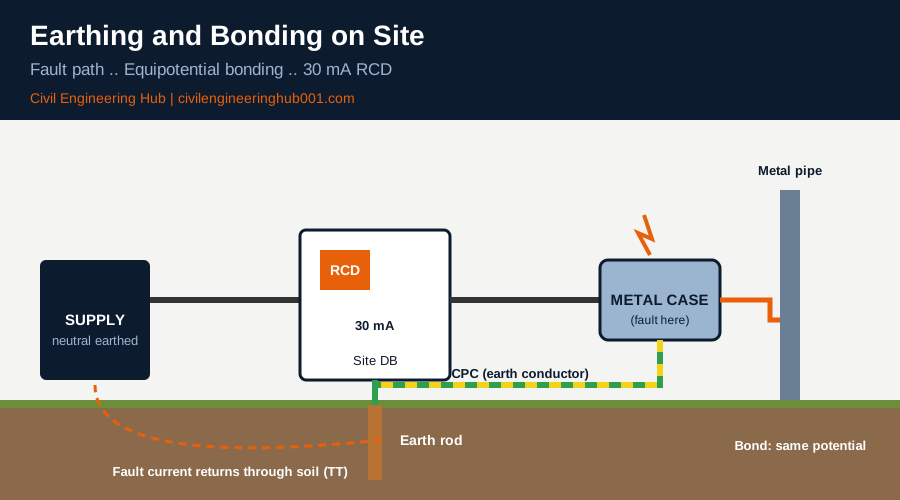
In simple terms, earthing gives fault current a safe path back to the source so the protective device disconnects quickly. Bonding joins exposed metalwork together so no dangerous voltage difference can exist between two things a person might touch at the same time.
Both are expected under BS 7671, the Energy (Electrical Installation Work) Rules and the Occupational Safety and Health Act, 2007. This guide explains how they work, which system you are probably on, how to size conductors, and which checks every site team should complete before energising anything.
Quick Answer: Earthing connects an installation to the general mass of earth so a fault makes the protective device disconnect fast, while bonding connects all nearby metalwork so it stays at the same potential. On site, both must follow BS 7671 and be tested before power is switched on.
What is the difference between earthing and bonding?
The truth is, many site teams use the two words as if they mean the same thing. They do not, and mixing them up leads to installations that look fine but fail under fault conditions.
Earthing is the connection between the electrical installation and the general mass of earth. Its job is to carry fault current so a breaker, fuse or RCD operates within the required time.
Bonding is the connection between metal parts that could carry or introduce a voltage. Its job is to keep those parts at nearly the same potential, so even when a fault occurs, there is no voltage difference to drive current through a person.
BS 7671 splits metalwork into two groups. An exposed-conductive-part is metal that belongs to the equipment, such as a motor casing, a distribution board enclosure or a generator frame. An extraneous-conductive-part is metal that is not part of the installation but can bring a potential into it, such as incoming metal water pipes, structural steel and scaffolding.
Which earthing system will you meet on a Kenyan site?
Before you install anything, find out how the supply is earthed. The earthing system decides how the fault loop is formed and what protection you need.
Honestly, most temporary site supplies in Kenya end up as TT. The contractor takes a connection from a pole-mounted transformer and has to provide a local earth. That means the electrode you drive into the ground is the only thing between a fault and a live frame.
Confirm the system with Kenya Power or your licensed electrical contractor before design. Do not assume. A site that assumes TN and relies on a poor rod with no RCD has no real protection at all.
On a TT system, the fault current returns through the soil, so the loop impedance is higher. That is why a 30 mA RCD is the main protective device, not the breaker. BS 7671 requires the earth electrode resistance multiplied by the RCD rated residual current to stay at or below 50 V. In practice, good sites aim far below that limit.
The table below compares the three systems you are most likely to meet.
| System | How earth is provided | Where you often see it | Key protection |
|---|---|---|---|
| TT | Supplier earths the neutral; the consumer drives their own earth electrode | Temporary site supplies and many rural connections | 30 mA RCD plus a tested earth rod |
| TN-S | Separate earth conductor from the supplier, often the cable sheath | Some commercial and industrial buildings | Overcurrent device, RCD where required |
| TN-C-S (PME) | Supplier combines neutral and earth, split at the intake | Some urban estates and newer developments | Overcurrent device and larger main bonding conductors |
Whatever the system, the principle does not change. Give the fault a low-resistance route home, and make sure nothing a person can touch is left floating at a different voltage.
How are earth electrodes and conductors sized and installed?
A good earth is built from the soil up. Start with the electrode, then size the conductors, then protect the joints.
Copper-bonded steel rods, typically 1.2 m to 2.4 m long and 14 mm to 16 mm in diameter, are the common choice on site. Where one rod does not achieve the required resistance, drive more rods at a spacing of at least twice the rod length and join them with bare copper conductor.
Soil matters more than most people admit. Moist clay gives low resistance, while dry sand, murram and rocky ground give high resistance. Test in the dry season, because a rod that reads well in April can read badly in August.
Circuit protective conductor (CPC) sizes follow BS 7671 Table 54.7 where the CPC is the same material as the line conductor.
| Line conductor (mm2) | Minimum CPC (mm2) | Site example |
|---|---|---|
| Up to 16 | Same as line conductor | A 4 mm2 cable uses a 4 mm2 CPC |
| Over 16 up to 35 | 16 | A 25 mm2 submain uses a 16 mm2 CPC |
| Over 35 | Half of line conductor | A 70 mm2 feeder uses a 35 mm2 CPC |
Main protective bonding conductors are generally not smaller than 6 mm2 copper, and on PME supplies they are normally 10 mm2. The conductor to the rod is commonly 16 mm2 copper where it has no mechanical protection.
All earth conductors must be green and yellow. Every clamp should carry the label Safety Electrical Connection, Do Not Remove, and the rod needs an accessible inspection pit so it can be tested later.
What bonding must be done on a construction site?
Site conditions are harsher than a finished building, so bonding discipline matters more. BS 7671 Section 704 covers construction and demolition site installations, and it asks for 30 mA RCD protection on socket outlets up to 32 A. These are the items that most often get missed.
- Incoming metal services such as water and gas pipes, bonded as close as practicable to where they enter the building.
- Temporary site cabins and containers, bonded to the earth terminal of the cabin distribution board.
- Generator frames, connected to the electrode, with the neutral and earth arrangement set out by the designer.
- Metal scaffolding and tower cranes, earthed and bonded, with lightning protection considered under BS EN 62305.
- Metal formwork, steel stairs and cladding frames that could become live through a damaged cable.
- Welding sets, where the return clamp is fixed to the workpiece and never to a random steel member.
In site washrooms and shower cabins, Section 701 of BS 7671 applies. Bonding and RCD protection there are not optional extras.
Many contractors also use 110 V centre-tapped transformers for portable tools. This reduces shock risk where the ground is wet, which is most of the rainy season in Nairobi.
How do you test earthing before energising a site installation?
Visual inspection is not enough. A green and yellow cable can sit in a clamp that is hand-tight and still carry nothing. Every installation should be tested by a licensed electrician and the results recorded.
| Test | What it proves | Acceptance guide |
|---|---|---|
| Protective conductor continuity (R1+R2) | Every CPC and bond is intact end to end | Low reading that matches the calculated value |
| Earth electrode resistance | The rod gives a usable path to earth | Resistance x RCD rating not above 50 V on TT |
| Earth fault loop impedance (Zs) | Fault current is high enough to disconnect | Within the BS 7671 limit for the device |
| RCD operation | The RCD trips fast enough | Within 300 ms at rated current, and 40 ms at 5 times rated current |
Record the results on a test sheet or installation certificate. Retest after any change to the rod, any relocation of a cabin, and after heavy rain damage. Many earthing failures trace back to a skipped test, not a missing standard.
What earthing mistakes should every site team stop making?
- Relying on reinforcement bars as the earth without testing it. Continuity through rebar is rarely proven on site.
- Driving the rod beside a wet drain and calling it done. Seasonal moisture changes the reading, so retest in dry weather.
- Running extension leads through puddles. Damaged insulation plus water defeats even a good earth.
- Bypassing the RCD because it keeps tripping. A tripping RCD is telling you about a real leakage fault.
- Leaving the electrician without a drawing. Bonding points should be marked on the services drawings so nothing depends on memory.
Honestly, none of these cost much to fix. They only cost a lot when they are ignored.
Frequently Asked Questions
Q: What is the maximum earth electrode resistance allowed on a construction site?
BS 7671 does not give one fixed number. On a TT system, the electrode resistance multiplied by the RCD rated residual current must not exceed 50 V. For a 30 mA RCD that works out at about 1,667 ohms, but many contractors aim for far lower values so the system stays safe when the soil dries out.
Q: Can one earth rod serve the whole site?
Only for a small installation on a single supply. Larger sites with several distribution boards, generators and cabins usually need extra electrodes or a designed earth grid. All of them connect to the main earthing terminal, and the combined resistance must still be tested. If the reading is too high, add rods before energising.
Q: Who can certify earthing on a site in Kenya?
Electrical installation work must be carried out by a person licensed by the Energy and Petroleum Regulatory Authority (EPRA). The site manager still carries responsibility under the Occupational Safety and Health Act, 2007 for a safe workplace. Keep test records on file for inspection by the Directorate of Occupational Safety and Health Services.
Conclusion
Earthing and bonding do not look impressive on site. A rod in the ground and a few green and yellow cables rarely make it into a photo. But they are the difference between a fault that trips a breaker and a fault that hurts someone.
Confirm the earthing system, size conductors to BS 7671, bond every piece of metalwork a person can touch, and test before you energise. Then write the results down. Do this on every site and you protect your workers, your programme and your licence.
Want more practical construction knowledge delivered directly to you?
Subscribe to our YouTube channel: https://www.youtube.com/@TheCivilEngineeringHub-001
PS: Join our engineering WhatsApp community for daily learning at +254731393520