
The truth is.. when a building falls, everyone in the construction industry asks the same question: what went wrong? On Friday 23 October 2026, a multi-storey building under construction on 9th Street in Eastleigh, Nairobi, collapsed in the afternoon. Our community has been asking us what could have caused it.
The honest answer is that nobody knows yet. Investigators are still working, and no official cause has been announced. What we can do responsibly is share what has been confirmed, be clear about what has not, and use the moment to learn how buildings under construction actually fail and how to prevent it.
This article is not about blaming anyone. It is about knowledge that protects workers, shop owners and the public on every site in Kenya. Information below is as at 25 October 2026 and may change as investigations continue.
Quick Answer: The Eastleigh building collapse of 23 October 2026 involved a multi-storey building under construction with shops operating below. The cause has not been officially determined. Buildings under construction usually fail through a small number of known routes: weak or immature concrete, early loading, formwork or foundation problems, unapproved design changes and poor supervision. Every one of them can be prevented with proper checks.
What do we actually know about the Eastleigh building collapse?
We rely only on statements attributed to officials and reported by Kenyan media. The National Construction Authority (NCA), the Interior Cabinet Secretary, the police and the Nairobi County Governor have all spoken publicly.
| Item | What has been reported |
|---|---|
| Date and place | Friday 23 October 2026, afternoon, 9th Street, Eastleigh, Kamukunji Sub-County |
| Building | Multi-storey building under construction, with shops on the ground floor and basement occupied |
| Workers | 67 construction workers on site; 66 escaped uninjured and one was hospitalised, per the Interior CS |
| Rescue | Multi-agency team led by the NCA with the Red Cross, police, county government and others; several survivors rescued on 24 October |
| Missing | Reports of six or seven people unaccounted for, depending on the date of the report |
| Registration | NCA says the project was registered on 30 July 2025 as a proposed development |
| Approvals | The Governor says there was no occupation certificate; reports on construction approval differ |
| Investigation | DCI, NCA, county inspectors and professional bodies; police are looking into criminal liability |
The NCA has listed the developer, contractor, architect and structural engineer for the project. We deliberately do not repeat those names here. A listing on a registration is not a finding of fault, and no investigation has concluded.
What is still unknown, and why should we avoid guessing?
Some claims in the media are worker accounts or opinions rather than findings. One report says workers noticed cracks in a column before the collapse. That may turn out to be important, but it has not been verified. Floor counts also differ between reports, so we will not quote one.
Honestly.. speculating about a specific cause on a real collapse with missing people is unfair to the families and risky for the profession. A structural failure is usually the result of several things going wrong together, and only a proper forensic investigation with site samples, design documents and testing can show which.
What we can say is that Kenya has seen this before. Professional bodies have called for building-failure registers, risk-based audits of existing developments and stronger inspection and supervision. That is the context for the lessons below.
How do buildings under construction usually collapse?
Studies of building failures around the world show the same patterns repeating. The table below lists the common routes, the warning signs on site, and the check that would have caught it. These are general mechanisms, not findings about the Eastleigh building.
| Possible failure route | Warning signs on site | Check that prevents it |
|---|---|---|
| Column or punching shear failure | Cracks around column heads, spalling concrete, slab sagging near columns | Correct section sizes and reinforcement against the structural drawings |
| Weak or immature concrete | Soft surfaces, honeycombing, loads placed within days of casting | Cube tests at 7 and 28 days, correct water-cement ratio, curing |
| Early removal of formwork or props | Deflection and cracks soon after striking | Follow striking times from the specification, keep back-props |
| Foundation or basement problems | Settlement cracks, tilting, water in excavations | Soil investigation, shoring, dewatering, engineer inspection |
| Design changes without approval | Extra floors, changed use, altered columns or beams | Written approval from the structural engineer for every change |
| Overloading during construction | Stacked materials on slabs, heavy equipment on fresh floors | Load limits on each floor, controlled storage |
| Progressive collapse | One element fails and loads transfer to weaker neighbours | Good detailing, tie reinforcement, robust load paths |
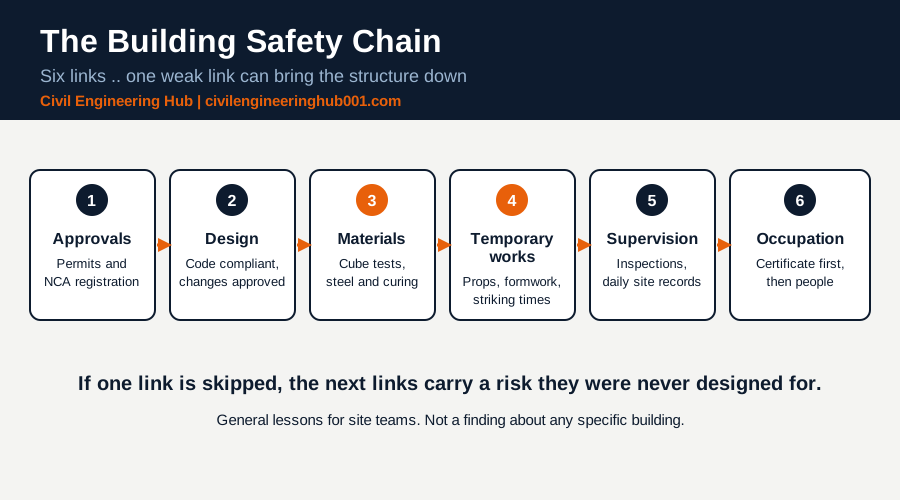
In simple terms.. a building is a chain. Concrete strength, steel placement, formwork, soil and supervision are all links. If one fails and nobody notices, the whole chain can follow.
What warning signs should every worker and supervisor never ignore?
People on site are often the first to see trouble. A mason hears a sound, a carpenter sees a prop bend, a steel fixer notices a crack. Those observations are valuable only if they are reported and acted on.
- New cracks in columns, beams or slabs, especially diagonal cracks or cracks that grow day by day.
- Props, scaffolding or formwork that bend, shift or sound unusual under load.
- Concrete that crumbles, shows exposed bars or has visible voids.
- Floors sagging or doors and frames starting to jam.
- Water or soil movement near the foundation or basement.
- Loads or work that do not match the drawings, such as extra floors or heavy storage on upper slabs.
The rule is simple. If you see something that does not look right, stop work in that area, move people away and tell the engineer. In Kenya, the Occupational Safety and Health Act, 2007 gives workers the right to remove themselves from danger.
What lessons does this collapse teach every profession in construction?
Safety is a team result. No single person holds it. The table shows what each role can do, drawn from the NCA Act, the Building Code and good site practice.
| Role | Key responsibility |
|---|---|
| Developer or client | Obtain all approvals, appoint registered professionals, never allow occupation before an occupation certificate |
| Structural engineer | Design to code (BS 8110 or Eurocode 2), inspect critical stages, approve any change in writing |
| Architect | Coordinate drawings, flag changes of use, confirm compliance before handover |
| Contractor and site agent | Build to the drawings, test concrete, control loads and temporary works |
| Foreman and supervisor | Check reinforcement and formwork before every pour, record inspections, stop unsafe work |
| Masons, steel fixers and carpenters | Follow the drawings, report defects and cracks immediately |
| QS and project manager | Budget properly for testing, supervision and safety, not only materials |
| Electricians and plumbers | Never cut or notch structural members without engineer approval |
Three lessons stand out for every site. First, approvals and registration are not paperwork. They are the checks that make sure qualified people look at the design. Second, testing and inspection must be done at every stage, not skipped to save time. Third, nobody should be working or trading underneath a structure that is still being built.
What can you do on your own site this week?
You cannot control what happens on other projects, but you can control your own. Use this short checklist as a starting point and adapt it to your site.
- Confirm the project has valid approvals and that the contractor and professionals are registered with the NCA.
- Check that the drawings on site are the latest approved set and that no change has been made without written approval.
- Make sure cube tests are being taken and results are recorded before upper floors are loaded.
- Inspect props, formwork and scaffolding every morning and after rain.
- Keep a daily site diary and report any cracks, settlement or unusual noise.
- Keep unauthorised people and other businesses out of areas under construction.
Frequently Asked Questions
Q: What caused the Eastleigh building collapse?
The cause has not been officially determined. The NCA, police and other agencies are still investigating, and only forensic testing and a review of the design and construction records can show what happened. Until then, any specific cause is speculation.
Q: Can a building under construction collapse even if the design is correct?
Yes. A sound design can still fail if the concrete is weak, the reinforcement is wrongly placed, formwork is removed too early or loads are added that the design never allowed for. That is why testing, inspection and supervision matter as much as the drawings.
Q: How can I check that a site is safe before working on it?
Ask to see the approvals, the latest drawings and the inspection and cube test records. Look at props, scaffolding and formwork for obvious defects. If something looks wrong, raise it with the engineer and stop work in that area until it is resolved.
Conclusion: Learn from it, do not guess about it
The Eastleigh collapse is a loss for families and a warning for the whole industry. We will know more once the investigation reports, and we will update our community when it does.
Until then, the best response is practical. Check your approvals, test your concrete, supervise your temporary works and listen when someone on site says something looks wrong. Honestly.. every collapse that is prevented starts with one person who decided to check. Be that person on your site.
Want more practical construction knowledge delivered directly to you?
Subscribe to our YouTube channel: https://www.youtube.com/@TheCivilEngineeringHub-001
PS: Join our engineering WhatsApp community for daily learning at +254731393520
Good content
Thank you