

If you have ever read a Bill of Quantities and stopped at a line item marked “PC Sum” or “Provisional Sum,” you are not alone. Many young quantity surveyors and site engineers confuse the two, and that confusion costs money at valuation stage.
In simple terms.. a Prime Cost (PC) sum covers work by a nominated supplier or subcontractor whose exact cost is not yet fixed at tender stage, while a Provisional Sum covers work that is not yet fully designed or measured. Both are placeholders, but they exist for different reasons and are adjusted differently at final account.
Quick Answer: A Prime Cost sum is an estimated allowance for known work to be carried out by a named nominated subcontractor or supplier, while a Provisional Sum is an estimated allowance for work that has not yet been designed or fully defined. PC sums get adjusted against actual quotes; provisional sums get adjusted or omitted once the real scope is confirmed.
What Is a Prime Cost Sum in a Bill of Quantities?
A Prime Cost sum, often shortened to PC sum, is money set aside in the BOQ for work or supply that the client or architect has already decided on, but has not yet appointed a firm price for. The classic example on a Kenyan residential project is sanitary fittings, ironmongery, or specialist finishes like imported tiles.
The design team knows the item is needed. They know roughly what it should cost. What they do not have yet is a firm quotation from the nominated supplier or subcontractor, because that appointment usually happens after the main contract is signed.
Honestly.. the PC sum exists to keep the tender process fair. Every contractor bidding for the project prices the same allowance, so no one gains an advantage by guessing low on an item they do not control.
What Is a Provisional Sum and When Is It Used?
A Provisional Sum covers work that cannot be measured accurately at tender stage because the design is incomplete or the extent of work is unknown until the contractor gets on site. Common examples include ground condition allowances, drainage connections to a road reserve, or demolition of an existing structure with unknown internal condition.
There are two types recognised under the RICS New Rules of Measurement (NRM1 and NRM2), which most Kenyan quantity surveyors reference alongside local practice:
- Defined provisional sum – the nature and extent of work is described, even though the exact quantity is not, so the contractor is expected to have allowed for programme and preliminaries around it.
- Undefined provisional sum – almost nothing is known about the work, so the contractor cannot reasonably allow for it in their programme or site overheads.
That distinction matters at claims stage. If a provisional sum was undefined and it turns out to affect the programme, the contractor has a stronger case for an extension of time.
Prime Cost Sum vs Provisional Sum – The Key Differences
The truth is.. both are allowances, but they answer different questions. A PC sum answers “how much for this known item, once we get a firm quote.” A provisional sum answers “how much might this undefined or undesigned work cost.”
| Aspect | Prime Cost (PC) Sum | Provisional Sum |
|---|---|---|
| What it covers | Work or supply by a nominated subcontractor or supplier | Work not yet designed, measured, or fully known |
| Design status | Item is decided, price is not confirmed | Item or extent is not yet decided |
| Who executes the work | Usually a nominated subcontractor or supplier | Usually the main contractor, once scope is confirmed |
| Adjustment at final account | Replaced with actual invoiced cost plus contractor’s profit and attendance | Replaced with remeasured or newly priced work once defined |
| Typical examples | Lifts, sanitary ware, specialist ironmongery, imported finishes | Ground improvement, unforeseen drainage, demolition, external works |
How These Sums Affect Valuation and Final Accounts
At every interim valuation, the quantity surveyor should confirm whether a PC or provisional sum has been expended, and by how much. This is where careless site QS work causes disputes.
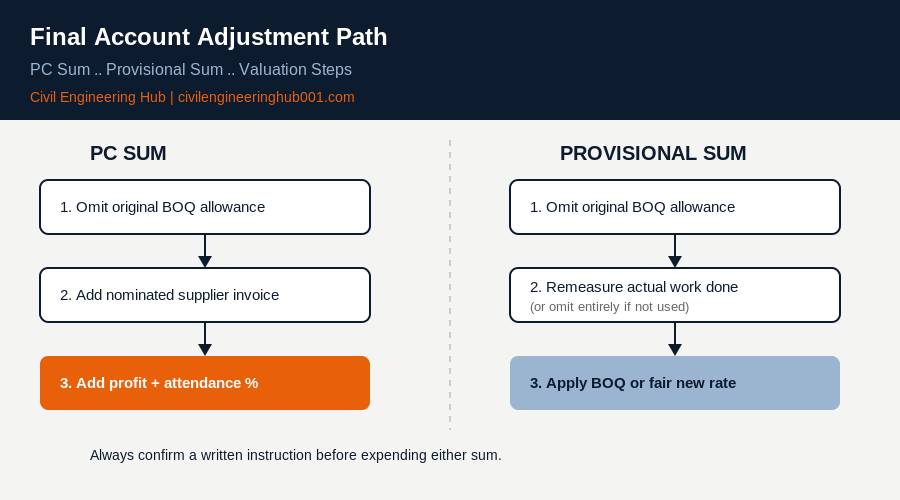
For a PC sum, the QS replaces the original allowance with the actual amount paid to the nominated supplier or subcontractor, then adds the contractor’s profit and attendance percentage exactly as priced in the BOQ. Skipping the profit and attendance addition is one of the most common errors on Kenyan sites, and it quietly costs the contractor money every time it happens.
For a provisional sum, the QS either remeasures the actual work done using the contract rates, or agrees a fair valuation if no comparable rate exists in the BOQ. Under most standard forms of contract used locally, including FIDIC and JBCC-based agreements, an unused provisional sum is simply omitted from the final account. It was never contractor money to begin with.
| Step | Action for a PC Sum | Action for a Provisional Sum |
|---|---|---|
| 1 | Confirm nominated supplier’s invoice or quotation | Confirm whether the work has actually been instructed |
| 2 | Omit the original PC sum allowance | Omit the original provisional sum allowance |
| 3 | Add the actual net cost of the item | Add the remeasured or newly agreed value of the work |
| 4 | Add contractor’s profit and attendance percentage | Apply BOQ rates where they exist, or a fair new rate |
Common Mistakes Quantity Surveyors Make With PC and Provisional Sums
The most frequent error is treating a provisional sum as if it were guaranteed contractor income. It is not. It is an estimate for work that may cost more, less, or nothing at all once the design firms up.
The second common error is forgetting profit and attendance on PC sums. Contractors price a percentage in the BOQ specifically to cover the cost of coordinating and hosting a nominated subcontractor on site. Leaving that out at final account shortchanges the contractor for real management work.
The third error, and the one that causes the most disputes, is failing to issue a written instruction before expending a provisional sum. Under most standard forms, if there is no instruction, there is no valid claim. Get it in writing before the work starts, not after.
Frequently Asked Questions
Q: Can a contractor refuse to work with a nominated subcontractor under a PC sum?
A contractor can object on reasonable grounds, such as the nominated firm’s poor track record or an unreasonable programme demand. Most standard forms give a formal objection process, and the architect or engineer must respond to it before nomination proceeds.
Q: What happens if the actual cost of a PC sum item is lower than the BOQ allowance?
The final account is adjusted downward to reflect the actual cost, and the contractor still receives their agreed profit and attendance percentage on that lower figure. The client benefits from the saving on the base cost, not from reducing the contractor’s margin.
Q: Do provisional sums attract profit and attendance the same way PC sums do?
Not automatically. Provisional sum work executed directly by the main contractor is valued at contract rates or fair new rates, which already include an allowance for profit. A separate attendance charge only applies if a nominated subcontractor is involved.
Conclusion
PC sums and provisional sums both protect fairness during tendering, but they behave very differently once the project is on site. Get comfortable adjusting both correctly at valuation stage, because this is one of the areas junior quantity surveyors get tested on hardest during their first two years on real projects.
Master this distinction now, and BOQ preparation, valuations, and final accounts will make a lot more sense going forward.
Want more practical construction knowledge delivered directly to you?
Subscribe to our YouTube channel: https://www.youtube.com/@TheCivilEngineeringHub-001
PS: Join our engineering WhatsApp community for daily learning at +254731393520