
The foundation is the most critical part of any structure. Get it wrong and nothing above it will perform as it should.. no matter how good the design is.
In simple terms, a foundation transfers the load of a structure safely to the ground beneath it. The type you use depends on three things: the load the structure will carry, the soil conditions on site, and the depth at which competent ground is found.
This post breaks down the main types of foundations used in construction, what each one is designed for, and how engineers decide which one to specify. Whether you are a student preparing for exams or an engineer heading to site, this is the foundation knowledge you need.
Quick Answer: The main types of foundations in construction are shallow foundations (pad, strip, and raft) and deep foundations (pile and caisson). The choice depends on soil bearing capacity, structural loads, and site conditions. Shallow foundations work when strong soil is near the surface; deep foundations are used when load must be transferred to deeper, more stable ground.
What Is a Foundation and Why Does the Type Matter?
A foundation is the structural element that sits between a building and the ground. Its job is to spread or transfer loads.. including dead loads, live loads, and wind loads.. into the soil without causing excessive settlement or failure.
The wrong foundation choice can lead to differential settlement, structural cracking, or in extreme cases, collapse. That is why soil investigation (a geotechnical survey) must happen before foundation design begins. The results of that investigation.. specifically the soil bearing capacity.. drive the decision on which foundation type to use.
Foundations are broadly divided into two groups: shallow foundations and deep foundations.
Shallow Foundations: The Go-To for Most Buildings
Shallow foundations are used when the soil near the surface has adequate bearing capacity to support the structural loads. They are typically placed at depths of 0.5 m to 3 m below ground level.
There are three main types:
| Foundation Type | Best Used For | Typical Depth |
|---|---|---|
| Pad foundation | Isolated columns | 0.5 m – 2 m |
| Strip foundation | Load-bearing walls | 0.75 m – 1.5 m |
| Raft foundation | Weak or variable soils, large slab areas | 0.3 m – 1 m |
Pad foundations are used under individual columns. You will see them on most framed structures.. office buildings, warehouses, factories. Each column sits on its own reinforced concrete pad, and the pad spreads the point load over a wider area of soil.
Strip foundations run continuously under load-bearing walls. They are the most common foundation type for residential construction in Kenya and across East Africa. According to BS 8110, the width of a strip foundation should be at least three times the wall thickness, though actual sizing depends on soil bearing capacity.
Raft foundations cover the full footprint of a building. They are used when the soil is weak, the loads are spread, or when you need to reduce differential settlement across the structure. The slab acts as one large plate, distributing load evenly to the ground below.
Deep Foundations: When the Surface Soil Cannot Take the Load
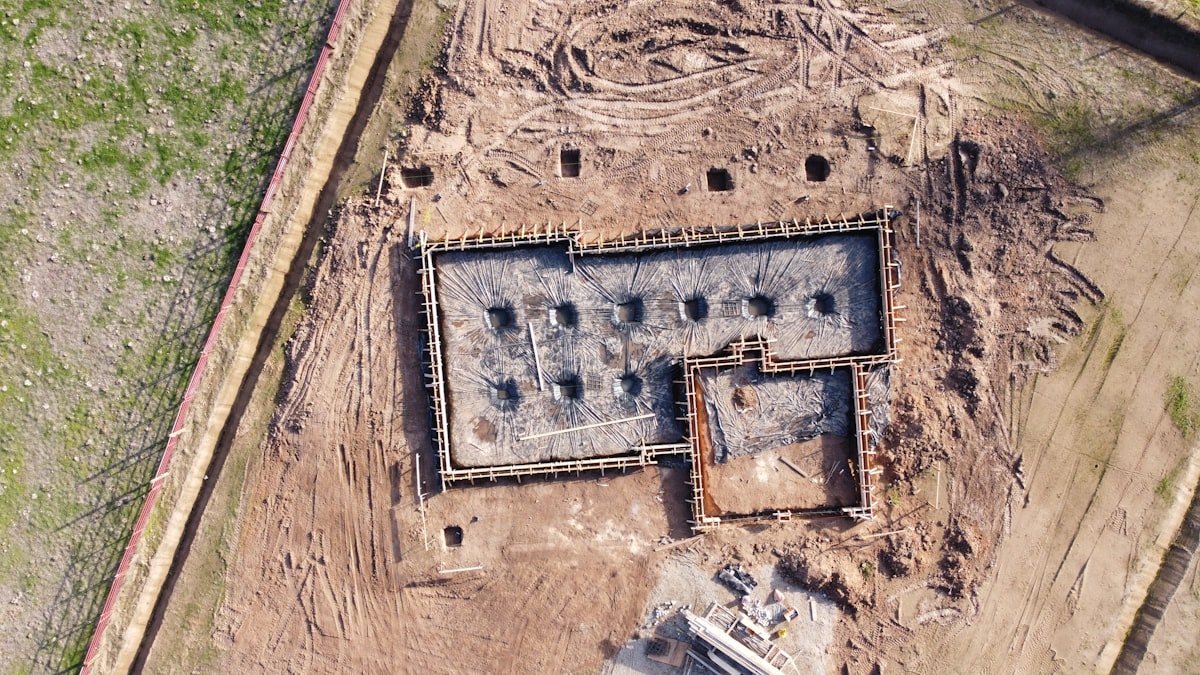
Deep foundations are needed when the upper layers of soil are too weak or compressible to support the structure safely. Instead of bearing at or near the surface, deep foundations transfer load down to deeper, more stable strata.
Pile foundations are the most common type of deep foundation. Piles are long, slender structural members.. usually of reinforced concrete or steel.. driven or cast into the ground to reach competent bearing layers or to use skin friction along their length.
There are two categories:
- End-bearing piles: Transfer load through the pile shaft to a hard stratum (rock or dense gravel) at depth.
- Friction piles: Rely on the friction between the pile surface and the surrounding soil to carry the load.
Pile foundations are common for high-rise buildings, bridges, and structures on weak, waterlogged, or made-up ground. In Nairobi, they are frequently used in areas like Westlands and Upperhill where buildings are tall and the founding strata are deep.
Caisson foundations (also called well foundations) are large-diameter deep foundations used primarily for bridge piers and structures in water or very poor ground. They are less common in standard building construction.
How Engineers Decide Which Foundation to Use
The decision is never made by guessing. It follows a clear process:
- Conduct a soil investigation.. boreholes or trial pits to determine soil profile and strength
- Calculate the bearing capacity of each soil layer using standard geotechnical methods (e.g. Terzaghi’s bearing capacity formula)
- Determine the structural loads from the superstructure design
- Compare load vs. capacity at various depths
- Select the most cost-effective foundation that achieves safe load transfer with acceptable settlement
In Kenya, the Kenya Standard KS 02-956 and BS 8004 (Code of Practice for Foundations) provide guidance on foundation design and soil testing requirements.
The truth is.. a foundation that works well in Nairobi’s Karura area may be completely inappropriate on the black cotton soils of Embakasi or the waterlogged ground near the Nairobi River. Site-specific conditions always govern.
Frequently Asked Questions
Q: What is the most common type of foundation used in residential construction in Kenya?
Strip foundations are the most widely used for residential buildings in Kenya, particularly for single and two-storey structures on firm ground. They run continuously under load-bearing walls and are cost-effective when soil bearing capacity is adequate.
Q: When should a raft foundation be used instead of a strip foundation?
A raft foundation is preferred when the soil has low or variable bearing capacity, when the structure covers a large footprint, or when differential settlement is a concern. It distributes load more evenly than strip foundations and reduces the risk of localised settlement causing structural damage.
Q: How deep should a foundation be?
Foundation depth depends on soil conditions, frost depth (less of a concern in Kenya), and load requirements. Shallow foundations typically start at 0.75 m to 1.5 m below ground level for residential work, but the founding level must always reach competent ground as confirmed by a soil investigation.
Every Structure Starts With a Foundation Decision
Get it right and the building performs as designed for decades. Get it wrong and you will spend far more fixing the consequences than you ever saved by cutting corners.
Understand the soil. Know the loads. Choose the right foundation type for the specific site conditions.. not just the cheapest one available.
Want more practical civil engineering knowledge delivered directly to you?
👉 Subscribe to our YouTube channel: https://www.youtube.com/@TheCivilEngineeringHub-001
PS: Join our engineering WhatsApp community for daily learning at +254731393520
Please for the civil Engineering Hub 001
The payment option, can you us those using MTN
Yes you can kindly whatsapp us via +254731393520 for assistance
Easy to understand and very useful.