

Every concrete pour on a Kenyan site carries a number behind it.. M15, M20, M25, M30. Contractors call it out on the delivery note, engineers spec it on the drawing, and yet many site teams still cannot explain what that number actually controls. Understanding concrete grades is not academic. It decides whether your slab, column, or foundation carries the load it was designed for.
In simple terms, a concrete grade tells you the minimum compressive strength that concrete must achieve after 28 days of curing, tested in megapascals (MPa) or N/mm². The letter “M” stands for “Mix,” and the number after it is the characteristic strength. M25 concrete, for example, must reach a minimum characteristic compressive strength of 25 N/mm² at 28 days.
Quick Answer: A concrete grade such as M20 or M30 specifies the minimum 28-day characteristic compressive strength of that concrete mix in N/mm². The higher the number, the stronger and more load-bearing the concrete, and the more cement it typically requires relative to sand and aggregate.
What Does the “M” and the Number Actually Mean?
The “M” in M20 or M25 stands for Mix. The number that follows is the characteristic compressive strength in N/mm², measured on a standard 150mm concrete cube after 28 days of curing under controlled conditions.
Characteristic strength is not the average strength. It is the strength below which no more than 5% of test results are allowed to fall. That statistical margin is why concrete mix design always builds in extra cement above the bare minimum. The truth is, if your cubes are only just scraping past the required MPa, your mix design has no safety margin left.
Kenya has largely adopted British Standards and Eurocode 2 (EC2) for structural concrete design, alongside guidance in the Kenya Building Code. Under BS 8110 and EC2, concrete grades are specified by the design engineer based on the load the element carries, its exposure condition, and its durability requirement, not by guesswork on site.
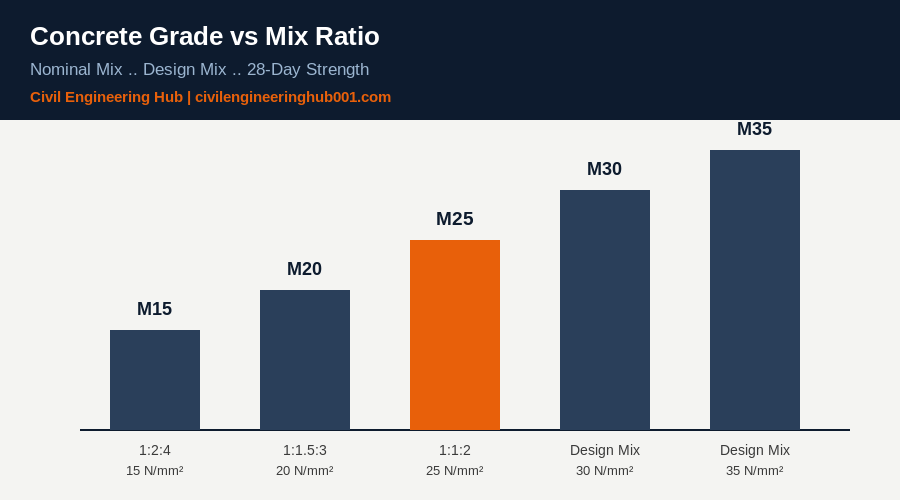
Common Concrete Grades and Where Each is Used On Site
Different elements of a building carry different loads, so they are specified in different grades. Using a lower grade than specified to save cement is one of the most common and most dangerous shortcuts taken on Kenyan sites.
| Grade | Nominal Mix Ratio (Cement:Sand:Aggregate) | Characteristic Strength (28 days) | Typical Use On Site |
|---|---|---|---|
| M10 | 1:3:6 | 10 N/mm² | Blinding layer, mass concrete, levelling course |
| M15 | 1:2:4 | 15 N/mm² | Non-structural floors, kerbs, pavement bedding |
| M20 | 1:1.5:3 | 20 N/mm² | Residential slabs, footpaths, low-rise foundations |
| M25 | 1:1:2 | 25 N/mm² | RC beams, columns and slabs in residential and light commercial buildings |
| M30 | Design mix | 30 N/mm² | Structural columns, beams and slabs in mid-rise and commercial buildings |
| M35 to M40 | Design mix | 35 to 40 N/mm² | High-rise structures, water-retaining structures, bridges |
Honestly, most residential jobs in Kenya sit comfortably between M20 and M25. Once you move into commercial buildings, multi-storey structures, or anything spanning long distances, the structural engineer will almost always specify M25 and above, backed by a design mix rather than a nominal ratio.
Nominal Mix vs Design Mix .. What Is the Difference?
This is where many artisans and even young engineers get confused. A nominal mix uses fixed proportions of cement, sand, and aggregate by volume, based on general guidance rather than lab testing of the actual materials being used. A design mix is calculated in a laboratory using the specific properties of the cement, sand, aggregate, and water available for that project.
| Factor | Nominal Mix | Design Mix |
|---|---|---|
| Basis | Fixed ratio by volume (e.g. 1:2:4) | Calculated from material test results |
| Typical grade range | Up to M20 | M25 and above |
| Material efficiency | Less efficient, often over-cemented | Optimised, more economical at scale |
| Testing required | Minimal | Trial mixes and cube testing mandatory |
| Where it applies | Small residential works | Structural elements, commercial and high-rise buildings |
For anything above M20, BS 8110 and EC2 both expect a design mix supported by trial batches. That means the days of “just add water and mix by eye” are over once you cross into structural concrete for beams, columns, and suspended slabs.
How Do You Verify You’re Actually Getting the Specified Grade on Site?
The only way to confirm concrete has reached its specified grade is the cube test. Fresh concrete is cast into 150mm cube moulds, cured under controlled conditions, and crushed at 7 and 28 days to measure compressive strength against the design value.
A well-run site should be casting at least three cubes per pour for every 25 to 50 cubic metres of concrete, or at minimum three cubes for every distinct structural pour, whichever gives closer control. That means a site pouring a suspended slab should never skip cube casting just because “the mix looked strong.”
In simple terms, if your cubes fail at 28 days, you have a structural problem that no amount of good intentions on site will fix after the fact. That is why cube testing has to happen at the time of pour, not after someone raises concern about cracking six months later.
What Mistakes Do Contractors Commonly Make With Concrete Grades in Kenya?
The most common mistake is substituting a lower grade than specified to cut cement costs, especially on foundations and slabs where the difference is not visible until years later. The second is mixing by volume using inconsistent gauge boxes, which changes the actual water-cement ratio from batch to batch even when the labelled ratio stays the same.
A third mistake, common on smaller sites, is ignoring water-cement ratio entirely and adding water to make placing easier. This directly weakens the final strength regardless of how much cement went into the mix. The truth is, workability and strength are in constant tension, and every litre of extra water added beyond the design ratio reduces the final MPa the concrete will achieve.
How Does Curing Affect Whether You Actually Reach the Specified Grade?
Mixing the right ratio is only half the job. Concrete gains strength through a chemical reaction between cement and water called hydration, and that reaction needs moisture and time to complete. Cure a slab poorly and even a perfectly designed M25 mix can end up performing like M15 in the finished structure.
The Kenya Building Code and BS 8110 both call for a minimum curing period of 7 days for ordinary Portland cement concrete, extending to longer periods in hot or windy conditions typical of many Kenyan sites. In simple terms, that means keeping the surface continuously wet through ponding, wet hessian, polythene sheeting, or curing compound, not a quick splash of water once in the morning.
Nairobi and highland sites lose moisture differently from coastal sites like Mombasa, where higher ambient humidity slows evaporation naturally. Site teams working in hot, dry, or windy conditions need to start curing within 30 minutes of finishing the surface, because rapid moisture loss in the first hours causes plastic shrinkage cracking that no amount of later curing can undo.
| Curing Method | Typical Application | Minimum Duration |
|---|---|---|
| Ponding / flooding | Flat slabs, floors | 7 days minimum |
| Wet hessian or sacking | Columns, beams, vertical surfaces | 7 days minimum, continuously wet |
| Polythene sheeting | Slabs, footpaths, exposed pours | 7 days, sealed at edges |
| Curing compound | Large pavement and road works | Per manufacturer specification |
How Does Grade Selection Affect Cost and Durability Together?
A higher grade is not automatically the safer choice everywhere. Specifying M30 for a simple boundary wall foundation wastes cement and money without adding real value, because the load never approaches what M30 is designed to carry. Equally, under-specifying grade on a water-retaining structure or a coastal building exposed to salt-laden air is a durability failure waiting to happen, even if the load calculation alone would have allowed a lower grade.
This is why the structural engineer looks at exposure condition alongside load when assigning grade, following the exposure classes set out in EC2 and referenced in the Kenya Building Code. Reinforced concrete in a marine or high-humidity environment is typically specified at M30 or higher purely for durability, protecting the reinforcement from corrosion, independent of what the pure structural load calculation would have required.
Frequently Asked Questions
Q: Can I use M20 concrete for a column instead of M25?
No, not without the structural engineer’s approval. Columns carry compressive and sometimes bending loads that were calculated against a specific grade. Reducing the grade without redesigning the column size and reinforcement compromises the safety factor built into the original design.
Q: How long should I wait before loading concrete after casting?
Concrete gains roughly 70% of its design strength by day 7 and reaches its full characteristic strength at 28 days under proper curing. Formwork for slabs and beams should only be removed once the concrete has gained enough strength to carry its own weight plus construction loads, guided by the engineer’s striking time schedule, not a fixed number of days alone.
Q: What happens if my concrete cubes fail the strength test?
A failed cube test triggers further investigation, which may include additional cube testing, core sampling from the actual structural element, or non-destructive testing. The structural engineer then decides whether the element needs load restriction, strengthening, or in serious cases, removal and recasting. Do not ignore a failed cube result and hope it holds.
Conclusion
Concrete grade is not a label on a delivery note. It is the strength promise behind every slab, beam, and column on your site. Get the grade right, mix it correctly, and test it properly, and the structure will carry the load it was designed for. Get it wrong, and no amount of good finishing will hide a structural problem waiting to surface.
Want more practical construction knowledge delivered directly to you?
Subscribe to our YouTube channel: https://www.youtube.com/@TheCivilEngineeringHub-001
PS: Join our engineering WhatsApp community for daily learning at +254731393520
I would like you to send me such good and learning engineering knowledge.