

A contractor tells you at 4pm that a wall must be broken out and rebuilt before tomorrow. The drawings do not cover it. The BOQ has no rate for it. Nobody can say how long it will take.
This is exactly where a daywork schedule earns its place. It is a priced list of labour, material and plant rates that lets small, urgent or uncertain work be paid for by the recorded time and resources used, instead of a measured quantity.
The truth is, many site disputes in Kenya do not start with the work itself. They start with how it was recorded and who signed for it. In this guide you will learn what a daywork schedule contains, when it should be used, how to price and record it, and where it goes wrong.
Quick Answer: A daywork schedule is a list of rates for labour, materials and plant, priced at tender stage, that is used to value small or unmeasurable extra work based on the actual time and resources used, as instructed and signed for on site.
What exactly is a daywork schedule in a construction contract?
A daywork schedule is a section of the tender documents, usually placed at the end of the Bill of Quantities. The contractor prices hourly rates for each trade, a percentage addition on materials, and hourly rates for plant. Nothing is measured.
In simple terms.. it is a pre-agreed price list for work nobody could predict. Because the rates are fixed at tender, the employer is protected from inflated prices later, and the contractor is protected from arguments about what an hour of a mason or an excavator is worth.
Under the JBC Agreement and Conditions of Contract for Building Works used on many Kenyan projects, the Architect or Supervising Officer can instruct variations, and work that cannot properly be measured is typically valued by daywork. Public projects also follow the Public Procurement and Asset Disposal Act, 2015, which expects rates to be priced and compared at tender.
| Component | What is priced | Typical basis |
|---|---|---|
| Labour | Mason, carpenter, steel fixer, plumber, electrician, general labourer | Rate per hour, including overheads and profit |
| Materials | Materials not covered by any BOQ item | Invoice cost plus a tendered percentage |
| Plant | Excavator, concrete mixer, vibrator, compactor | Rate per hour, with or without operator |
| Supervision | Foreman time, if not already in the labour rates | Stated percentage or hourly rate |
When should daywork be used instead of measured work?
Daywork is the last option, not the first. Measured work gives the employer price certainty, so the Quantity Surveyor should only fall back on daywork when the work cannot be measured properly, or when it is so small and urgent that measuring it would cost more than the work itself.
Honestly, the biggest mistake on site is treating daywork as a shortcut. If a task can be described, measured and priced from a drawing, it belongs in the BOQ as a variation, not on a daywork sheet.
| Situation | Daywork or measured? | Reason |
|---|---|---|
| Breaking out a wall to reach a hidden service | Daywork | Extent unknown until opened up |
| Extra 20 m of drain trench with known width and depth | Measured | Dimensions can be taken off |
| Emergency propping after a formwork problem | Daywork | Urgent, and the scope changes hourly |
| Making good after electrical chasing in a finished wall | Daywork | Too small to measure economically |
| Crew standing idle because of an employer delay | Claim, not daywork | Handled as loss and expense under the contract |
| Repairing the contractor’s own defective work | Neither | It is the contractor’s cost |
On a building site in Nairobi, this comes up all the time with services coordination. The electrician needs a chase in a finished block wall, and the mason has to cut and make good. Nobody knows the extent until the wall is opened, so daywork is reasonable.
How do you record, price and certify daywork on site?
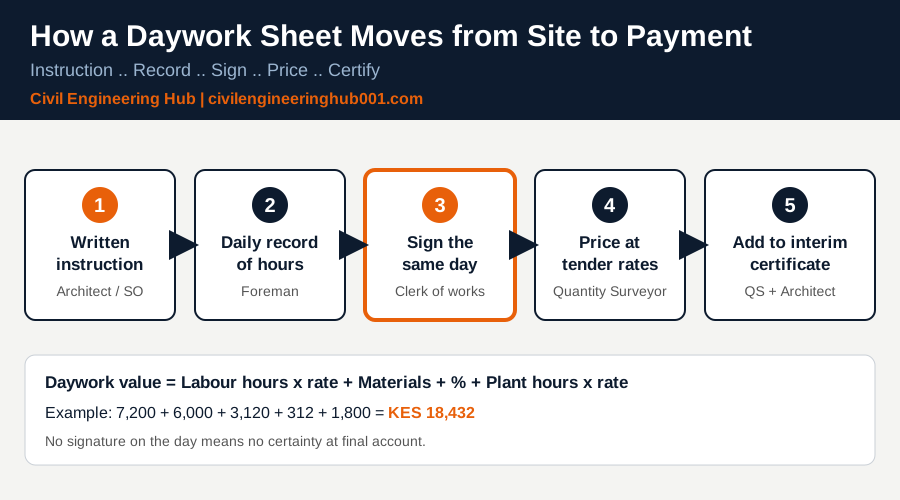
Daywork lives or dies on paperwork. If the sheet is not signed on the day, you will be arguing about it at final account stage, and by then nobody remembers who worked where.
| Step | Action | Who |
|---|---|---|
| 1 | Written instruction stating the work to be done on a daywork basis | Architect or Supervising Officer |
| 2 | Daily list of names, trades, hours, materials and plant used | Contractor’s foreman |
| 3 | Sheet checked and signed the same day | Clerk of works or site representative |
| 4 | Signed sheets submitted within the time stated in the contract | Contractor |
| 5 | Sheets priced using the tendered daywork rates | Quantity Surveyor |
| 6 | Valued amount added to the next interim certificate | QS and Architect |
The pricing itself is simple arithmetic. Hours multiplied by the tendered hourly rate for each trade, plus materials at invoice cost with the tendered percentage, plus plant hours at the tendered plant rate. Here is a worked example for a masonry make-good job. The rates are illustrative only.
| Item | Quantity | Rate (KES) | Amount (KES) |
|---|---|---|---|
| Mason | 16 hours | 450 | 7,200 |
| General labourer | 24 hours | 250 | 6,000 |
| Cement | 4 bags | 780 | 3,120 |
| Percentage addition on materials | 10% | of 3,120 | 312 |
| Concrete mixer | 3 hours | 600 | 1,800 |
| Total | 18,432 |
How is daywork different from measured variations and lump sum quotes?
All three are ways of paying for extra work. The right one depends on how well the work can be defined. Many contracts also refer to the RICS definition of prime cost of daywork to guide what labour and plant costs may be included, so check what your contract adopts.
| Feature | Daywork | Measured variation | Lump sum quote |
|---|---|---|---|
| Basis of payment | Actual hours and materials | Measured quantity times BOQ rate | Agreed fixed price |
| Price certainty | Low | High | Highest |
| Admin effort | High, daily sheets | Medium, measurement | Low once agreed |
| Best for | Small, urgent, unknown scope | Defined extra work | Well defined, larger extras |
| Main risk | Inflated hours | Disputed rates | Pricing the unknown too low or too high |
What are the common daywork mistakes and how do you avoid them?
Most daywork disputes come from the same few errors. Fix these and you remove most of the arguments.
- Starting without a written instruction. A verbal word from the site agent is not enough. Get the instruction in writing before work begins.
- Signing sheets late. Sign daily. A sheet signed three weeks later is a guess, not a record.
- Using untendered rates. Daywork must be priced at the tendered schedule. New rates need written agreement.
- Charging supervision twice. If the foreman is already in the labour rate, do not add him again.
- Using daywork for measurable work. It removes price certainty and invites inflated hours.
On public projects, remember that payments are tied to certified work under the contract and procurement rules. A daywork claim without a valid instruction can be rejected at audit, even when the work was genuinely done.
How can a Quantity Surveyor keep daywork under control?
Daywork has no measured quantity to check against, so control comes from process. A good QS does not wait for the end of the month to look at the sheets. They check them weekly and compare the hours against what the task should reasonably take.
Here is a simple test. If a two-person crew claims 16 hours each to make good one chased wall of about 6 square metres, ask why. A mason can usually plaster and finish a patch like that in a fraction of the time. The sheet may still be correct, but you need the explanation on file.
| Control check | What to look for | Action if it fails |
|---|---|---|
| Instruction on file | Dated written instruction matches the work claimed | Withhold valuation until it is provided |
| Hours realistic | Hours match the task size and the crew on site | Query with the foreman and clerk of works |
| Names and trades | Same people are not claimed on two jobs at once | Reject the duplicate hours |
| Material invoices | Invoices attached for every material claimed | Value only what is supported |
| Rates used | Only tendered schedule rates are applied | Re-price the sheet |
Keep a running daywork register per project. It shows the total spent on daywork against the contingency sum, and it warns the client early when unforeseen work is eating the budget.
Frequently Asked Questions
Q: Can a contractor start daywork without a written instruction?
The contractor can start, but they carry the risk of not being paid. Most contracts require a written instruction from the Architect or Supervising Officer before extra work is valued. Without it, the QS has no basis to certify the amount, so always get the instruction first.
Q: Who signs the daywork sheets on site?
The clerk of works or the employer’s site representative signs, usually the same day. The contractor’s foreman prepares the sheet. The QS later prices it, but the QS does not witness the work, so the signature is the evidence that the hours were actually worked.
Q: Are daywork rates the same as market rates?
Not always. Daywork rates are set at tender and include the contractor’s overheads and profit. They may be higher or lower than the day rate for a casual fundi that week. The contract rate applies unless both parties agree in writing to change it.
Conclusion
A daywork schedule is a safety net for work that cannot be measured. It protects the employer through tendered rates and protects the contractor through proper recording. It only works when the instruction is written, the sheets are signed daily and the rates are the ones that were tendered.
Use measured variations whenever you can describe the work. Use daywork when you honestly cannot. Treat the paperwork as seriously as the work itself, and your final account will be a lot easier to agree.
Want more practical construction knowledge delivered directly to you?
Subscribe to our YouTube channel: https://www.youtube.com/@TheCivilEngineeringHub-001
PS: Join our engineering WhatsApp community for daily learning at +254731393520