

A snag list tells you what is wrong on the day of handover. The defects liability period tells you who pays when something else goes wrong afterwards. Many young site engineers, foremen and subcontractors treat it as a formality, and then get caught out when the client calls about a leaking roof eight months after the keys changed hands.
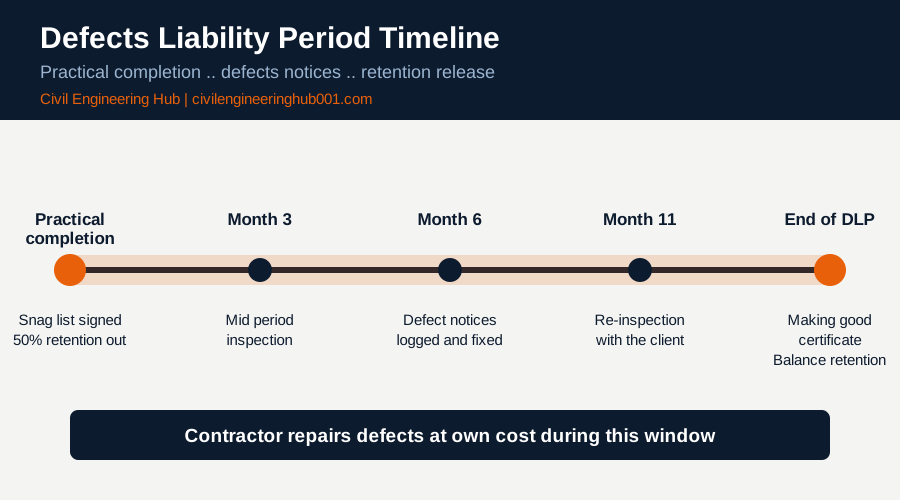
In simple terms, the defects liability period (DLP) is a fixed time after practical completion during which the contractor must return to site and fix defects at their own cost. On most building contracts in Kenya, that period is six or twelve months.
This guide explains what the DLP covers, what it does not, how retention money is tied to it, and what every site supervisor, project manager, foreman, mason and electrician should be doing from the day of handover to the day of final release.
Quick Answer: The defects liability period is the time after practical completion (usually 6 to 12 months in Kenya) when the contractor must repair defects in their work at no cost to the client, and when part of the retention money stays held until those repairs are done.
What does the defects liability period actually mean on a Kenyan project?
The DLP starts on the date of practical completion stated in the architect’s or engineer’s certificate. It ends on a date fixed in the contract, and only then can the final certificate be issued.
Different contract forms use different names. The Joint Building Council of Kenya (JBC) conditions use the term defects liability period. FIDIC forms use Defects Notification Period (Clause 11 in the 1999 books). Public projects procured under the Public Procurement and Asset Disposal Act, 2015 normally use the standard tender documents, which fix the period in the contract data.
| Contract form | Term used | Typical length | Who certifies |
|---|---|---|---|
| JBC Building Agreement | Defects Liability Period | 6 months, often 12 | Architect |
| FIDIC Red Book (1999) | Defects Notification Period | 365 days unless stated | Engineer |
| Public sector standard tender documents | Defects Liability Period | Set in contract data | Project Manager |
The truth is, the number on the page matters less than the wording around it. Always read what your own contract says about start date, extensions and who has the right to instruct repairs.
What defects must the contractor fix, and what is not their problem?
The contractor is responsible for defects caused by poor workmanship, materials that do not meet the specification, or work that does not match the drawings. They are not responsible for damage caused by the client’s misuse, normal wear and tear, or poor maintenance.
On site, the line is often blurry. A cracked floor tile could come from a weak bedding mix, or from a client dragging a heavy generator across it. Photos taken at handover and a signed snag list are what settle that argument.
| Situation | Contractor’s cost? | Evidence that decides it |
|---|---|---|
| Plaster cracking from a poor mix or no curing | Yes | Mix records, site diary, photos |
| Roof leak at a poorly lapped sheet | Yes | Inspection report, drawings |
| Tiles chipped by the tenant’s furniture | No | Handover snag list showing no chips |
| Blocked drain from client dumping waste | No | CCTV or inspection of the line |
| Faulty socket circuit wired against the drawing | Yes | As built electrical drawings |
How is retention money tied to the defects liability period?
Retention is the percentage the client holds back from each interim payment as security. Rates vary by contract, commonly 5 to 10 percent of the certified value, often capped at a maximum percentage of the contract sum.
Most contracts release the first half at practical completion and the second half at the end of the DLP once all defects are made good. If the contractor ignores defect notices, the client can use the retained money to hire someone else to do the repairs.
Honestly, this is why a contractor who disappears after handover hurts their own cash flow. That final retention release often represents the entire profit margin on a job.
| Milestone | Retention action | Example on a KES 20,000,000 contract at 5% |
|---|---|---|
| During works | 5% deducted from each certificate | KES 1,000,000 held in total |
| Practical completion | Half released | KES 500,000 paid out |
| End of DLP, defects cleared | Balance released | KES 500,000 paid out |
What should the site team do during the defects liability period?
The DLP is not a quiet waiting period. It is a managed process, and the contractor who treats it as one keeps the client’s trust and gets paid on time.
- Agree the handover record. Walk the building with the client’s representative, sign the snag list, and take dated photos of every room, roof and external works.
- Name a contact person. One supervisor should receive all defect reports and log them with date, location and description.
- Respond fast. Visit within a few days of any notice, and agree a repair date in writing.
- Brief the trades. Mason, plumber, electrician and roofer must know they may be called back, and the subcontract should say so.
- Do a mid-period inspection. At month three or six, inspect the building yourself rather than waiting for complaints.
How do subcontractors and artisans fit into the defects liability period?
The main contractor answers to the client for every defect, including those caused by the tiler, electrician, plumber or roofer. That is why the subcontract must pass the same obligation down the chain, with a matching DLP and a retention clause.
Here is a mistake we see often. The main contractor pays the subcontractor in full at completion, the subcontractor moves on to another county, and a month later the client reports leaking joints. Now the main contractor is paying twice.
A sound subcontract keeps a portion of the subcontractor’s retention until the main DLP ends. It also states a response time, for example attending site within five working days of a written notice.
| Trade | Typical DLP callbacks | What the foreman should keep on file |
|---|---|---|
| Masonry and plaster | Cracks, hollow plaster, damp | Mortar and plaster mix records, curing log |
| Tiling and screeding | Lifting tiles, uneven falls in bathrooms | Screed level checks, adhesive batch details |
| Plumbing | Leaking joints, slow drains | Pressure test certificates, as built layout |
| Electrical | Tripping breakers, dead sockets | Test results, circuit schedule on the board |
| Roofing and carpentry | Leaks, warped doors | Material delivery notes, fixing details |
Honestly, the foreman who keeps a tidy file of test records and delivery notes is worth more than the one who simply works fast. Records are what win a dispute.
How do you close out the defects liability period properly?
A clean close out starts about a month before the DLP ends. The project manager and architect or engineer walk the building again, compare the findings with the defects log, and confirm that every item is marked as repaired and signed off by the client’s representative.
Only then does the architect or engineer issue the certificate of making good defects, which opens the way to the final account and the release of the remaining retention.
- Review the defects log and mark each item open or closed with the repair date.
- Re-inspect any repaired area with the client’s representative present.
- Submit a short close out report with photos and test records.
- Request the certificate of making good defects in writing.
- Submit the final account and invoice for the balance of retention.
| Close out document | Prepared by | Purpose |
|---|---|---|
| Defects log | Site supervisor | Shows every notice, response and repair date |
| Re-inspection record | Architect or engineer | Confirms repairs are complete |
| Certificate of making good defects | Architect or engineer | Triggers final retention release |
| Final account | Quantity surveyor | Settles the full contract value |
In simple terms, the DLP closes on paperwork, not on goodwill. If it is not written and signed, it did not happen.
Which defects usually show up first, and how do you prevent them?
After years of watching handovers, the same problems come back. Most can be prevented before the DLP even starts, which is the cheapest time to fix them.
| Common defect | Usual cause | Prevention during construction |
|---|---|---|
| Roof leaks | Poor sheet laps, missing flashings, loose fixings | Inspect laps and flashings before ceilings go up |
| Hairline cracks in walls | Thermal movement, no movement joints, rushed plaster | Correct mix, curing, mesh at junctions |
| Hollow or lifting tiles | Poor bedding, dirty screed, no adhesive coverage | Tap test a sample area before tiling continues |
| Damp patches | Missing damp proof course, leaking pipes | Pressure test pipes before covering up |
| Doors and windows that stick | Green timber, wrong frame tolerances | Check moisture and fit before painting |
What are the legal and practical limits of the defects liability period?
The end of the DLP does not erase all responsibility. Latent defects, meaning serious faults that could not be seen at handover, can still be pursued under the law of contract and tort. In Kenya, the Limitation of Actions Act (Cap 22) sets time limits for such claims, so keep your records for years, not months.
Regulators also expect competent work. Contractors should be registered with the National Construction Authority (NCA), and structural failures raise questions with the Engineers Board of Kenya and the Board of Registration of Architects and Quantity Surveyors. Quality on the day of handover protects your name long after the DLP expires.
Frequently Asked Questions
Q: When does the defects liability period start?
It starts on the date of practical completion stated in the architect’s or engineer’s certificate, not the date the contractor leaves site. If minor works are still outstanding, the certificate should say so. Keep a copy of that certificate, because every later date in the contract is counted from it.
Q: Can the DLP be extended?
Yes, in many contracts. When a serious defect is repaired, the repaired element can get a fresh DLP from the date of the repair. This is why contractors should fix problems properly the first time instead of patching them.
Q: What if the contractor will not return to fix defects?
The client, through the architect or engineer, issues a written notice giving a reasonable time to comply. If the contractor still does not respond, the client can hire others and recover the cost from retention money or a performance bond. Written notices and dated photos make this process clean and fair.
Conclusion
The defects liability period rewards teams that run a disciplined handover and respond quickly afterwards. Keep the signed snag list, log every defect, brief your trades, and protect your retention by finishing what you started.
If you are a student or young professional, learn this early. Knowing how the DLP works makes you a more trusted supervisor, a sharper quantity surveyor and a safer contractor.
Want more practical construction knowledge delivered directly to you?
Subscribe to our YouTube channel: https://www.youtube.com/@TheCivilEngineeringHub-001
PS: Join our engineering WhatsApp community for daily learning at +254731393520