Walk onto any busy site in Nairobi, Kisumu or Mombasa and the first thing you notice is the machinery. An excavator cutting a trench, a roller compacting a road base, a mixer turning concrete. Each machine was chosen for a specific job, and choosing the wrong one costs time, fuel and sometimes lives.
Construction plant and equipment is the term for the machines and mechanical tools used to build, as opposed to the materials that end up in the structure. Plant is usually one of the largest cost lines on a civil project, so every engineer, QS, architect, foreman and supervisor needs to understand it.
In simple terms, if you can name the machine, state its job and know its limits, you can plan the programme, price the work and keep the crew safe. This guide covers the main machines, what each one does, and how to manage plant on Kenyan sites.
Quick Answer: Construction plant is grouped by function: earthmoving machines excavate and haul, compaction machines densify soil and asphalt, concrete plant mixes and places concrete, and lifting plant moves heavy loads. Match each machine to its task, capacity and site conditions, and always check operator competence and safety certification.
What is construction plant and how is it classified?
Plant covers every machine on site that is too big or too specialised to be called a hand tool. Equipment is the broader word and includes smaller items such as vibrators, cutters and pumps. In the BOQ you will usually find both priced under the Preliminaries or in the contractor’s rates.
The easiest way to understand plant is by function. Ask what the machine does to the material, and the category becomes obvious.
| Category | Typical machines | Main function |
|---|---|---|
| Excavating | Excavator, backhoe loader, bulldozer | Dig, cut and push soil |
| Hauling | Tipper truck, dumper | Move spoil and materials |
| Compaction | Vibrating roller, plate compactor | Increase soil and asphalt density |
| Concrete | Truck mixer, concrete pump, poker vibrator | Mix, transport, place and compact concrete |
| Lifting | Tower crane, mobile crane, hoist | Raise and position heavy loads |
| Grading | Motor grader, paver | Shape and level road layers |
Which machines handle excavation and earthmoving?
Earthworks start almost every project, from foundation trenches to road formation. Five machines do most of the work.
The excavator is the most flexible. It digs trenches, loads tippers and, with a hydraulic breaker, breaks rock. A 20 tonne tracked excavator is a common choice on Kenyan road and building sites.
The bulldozer pushes and spreads material over short distances, usually under 100 metres. The backhoe loader suits smaller jobs such as service trenches and stockpile loading. The motor grader finishes the work by trimming subgrade and gravel layers to level and camber.
| Machine | Best used for | Site limitation |
|---|---|---|
| Excavator | Trenches, bulk excavation, loading | Slow travel, needs a stable standing |
| Bulldozer | Clearing, pushing and spreading fill | Inefficient over long haul distances |
| Backhoe loader | Small trenches, loading, utilities | Low output on large volumes |
| Motor grader | Final trimming, camber, gravel roads | Needs a prepared, reasonably firm surface |
| Tipper truck | Hauling spoil and fill | Needs a stable, drained haul road |
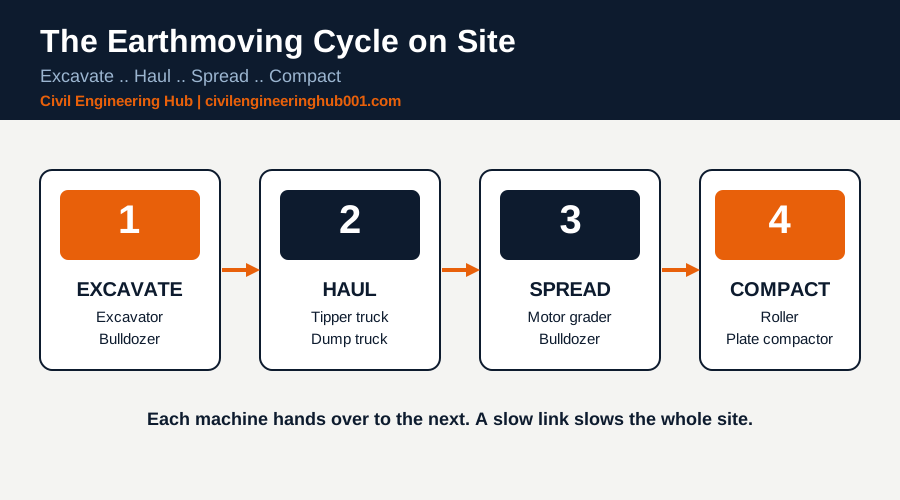
On site, the key is balance. If you deploy one excavator with only two tippers, the excavator waits. If you deploy five tippers, they queue and burn fuel. Match the haul fleet to the loading rate and the distance to the tip or fill area.
Honestly, most plant inefficiency comes from poor matching rather than poor machines.
What equipment compacts, mixes and places concrete?
Once the ground is excavated or filled, it must be compacted. Vibrating rollers compact granular fill and gravel base, while smooth drum rollers finish asphalt. In narrow spaces such as trenches and around culverts, plate compactors and rammers do the job. Compaction is checked against the Proctor test and the specified density, commonly 95 percent of maximum dry density for subgrade.
For concrete, the choice depends on volume and access. Small buildings use a diesel drum mixer on site. Larger pours use ready-mix delivered by truck mixers and placed with a concrete pump, or a crane and skip. The poker vibrator removes trapped air, and it is the step most often skipped when the crew is rushed.
| Equipment | Role | Practical check |
|---|---|---|
| Drum mixer | On-site mixing for small pours | Fixed batch volume, water measured by bucket count |
| Truck mixer | Delivers ready-mix concrete | Check the delivery note and batching time |
| Concrete pump | Places concrete at height or distance | Prime the line, confirm slump suits pumping |
| Poker vibrator | Compacts fresh concrete | Insert vertically, withdraw slowly, keep off formwork |
| Vibrating roller | Compacts soil and aggregate layers | Test density after a set number of passes |
Lifting plant needs its own mention. Tower cranes serve tall buildings, mobile cranes serve short-term lifts, and builder’s hoists move materials on mid-rise jobs. All of them must be erected, inspected and operated by competent people.
How do you select the right machine for a task?
Selecting plant is a planning decision, not a guess made on the morning of the work. The engineer or site manager should work through the same questions every time, and the answers usually point to one or two suitable machines.
Start with the quantity of work. A 30 cubic metre trench does not need a 30 tonne excavator, and a 5,000 cubic metre cut does not suit a backhoe. Then look at access, ground conditions, programme and cost. A wet season in Western Kenya or the coastal belt can turn a haul road into a swamp, and rubber-tyred machines will stall where tracked machines keep working.
| Step | Question to ask | Example on a Kenyan site |
|---|---|---|
| 1 | How much work is there? | Read quantities from the BOQ before choosing machine size |
| 2 | What is the ground like? | Black cotton soil in wet weather favours tracked plant and good drainage |
| 3 | What access is available? | Narrow plots in estates may limit you to compact machines |
| 4 | What does the programme allow? | A tight programme may justify two machines instead of one |
| 5 | What will it cost per unit of work? | Compare hire rate against output per hour, not rate alone |
That last step is where many contractors slip. A cheaper machine with a lower output can cost more per cubic metre than a dearer, faster one. Always think in cost per unit of work.
Maintenance planning belongs here too. A machine that breaks down on the critical path delays everyone behind it, including masons, steel fixers and electricians waiting for their work fronts. Ask the plant owner for a standby machine on critical activities, or agree a response time for repairs in writing.
Finally, think about the people. A good operator can get far more from an ordinary machine than a poor operator can from a new one. Check licences, ask about experience on similar work, and brief the operator on site hazards such as buried services, overhead power lines and soft ground before the first pass.
Should you hire or buy plant for a Kenyan project?
Most small and mid-sized contractors in Kenya hire plant rather than own it. Ownership ties up capital, and a machine standing idle between projects still costs money in insurance, parking and depreciation. Hire makes sense for short or specialised tasks, while ownership makes sense when the machine works most days of the year.
The type of hire matters because it changes who carries the risk.
| Option | What is included | Who carries the risk |
|---|---|---|
| Dry hire | Machine only | Contractor provides operator, fuel and maintenance |
| Wet hire | Machine, operator and usually fuel | Hire company carries most breakdown and operator risk |
| Own plant | Machine owned by the contractor | Contractor carries depreciation, repairs and idle time |
QSs should price plant using the hire rate, the expected working hours and the standing time. Ask for a daily record of hours worked, hours idle and breakdowns, because those records settle disputes and support dayworks claims.
What safety rules and standards apply to plant on site?
In Kenya, the Occupational Safety and Health Act, 2007 (OSHA) places a duty on the contractor to keep machinery safe, guarded and operated by trained people. Lifting equipment such as cranes and hoists must be examined by a competent person at set intervals, with the certificates kept on site. For crane work, BS 7121 is widely used as the code of practice for safe use, and NCA expects registered contractors to run safe, well managed sites.
The basics that prevent most accidents are simple:
- Only trained and authorised operators use plant, and licences are checked.
- A banksman guides reversing machines near workers.
- Exclusion zones keep pedestrians away from working excavators and cranes.
- Daily pre-start checks cover brakes, hydraulics, lights, alarms and leaks.
- Machines are never parked or worked close to unsupported trench edges.
Frequently Asked Questions
Q: What is the difference between plant and equipment on a construction site?
Plant usually refers to large machines such as excavators, cranes and rollers. Equipment is the wider term and includes smaller items like poker vibrators, generators and cutting tools. In practice the two words are often used together, and the BOQ rarely separates them strictly.
Q: What is the difference between an excavator and a backhoe loader?
An excavator has a rotating cab and a long boom, so it digs deeper and handles bulk work. A backhoe loader has a loader bucket at the front and a digging arm at the back, so it does smaller jobs of both kinds. Choose the excavator for volume and the backhoe for versatility on small sites.
Q: How often should construction plant be serviced?
Follow the manufacturer’s manual, which sets service intervals by running hours, commonly around every 250 hours for engine oil and filters. Daily pre-start checks catch leaks and wear between services. Keep a service log for every machine, because it protects both safety and resale value.
Conclusion
The truth is, plant decides how fast and how safely a project moves. Know the main categories, match each machine to its task, and balance the fleet so no machine waits on another.
Decide early whether to hire or buy, record hours daily, and treat OSHA requirements and operator competence as non-negotiable. Whether you are an engineer planning the programme, a QS pricing the work or a foreman running the crew, understanding plant makes you better at your job.
Want more practical construction knowledge delivered directly to you?
Subscribe to our YouTube channel: https://www.youtube.com/@TheCivilEngineeringHub-001
PS: Join our engineering WhatsApp community for daily learning at +254731393520