

Every professional on a construction project hears both words daily: tender and contract. Quantity surveyors price the tender. Architects and engineers evaluate it. Site supervisors inherit the contract. Yet on many sites, people use the two words as if they mean the same thing.
The truth is, they sit at completely different stages of a project, and mixing them up can cost real money.
In simple terms, a tender is an offer. It is the price and method a contractor submits to win the work. A contract is the binding agreement that exists once the employer accepts that offer and both parties commit to their obligations.
Honestly, a lot of disputes on Kenyan sites start with someone treating a tender document as if it were a signed contract, or the reverse. This guide breaks down the difference stage by stage, so you know where you stand whether you are pricing, supervising, designing or building.
Quick Answer: A tender is a contractor’s priced offer to carry out works, submitted in response to an invitation. A contract is the legally binding agreement formed when the employer accepts that offer and both parties sign, fixing price, scope, time and conditions.
What exactly is a tender in construction?
A tender is a formal, priced proposal. The employer or the consultant team issues tender documents, and each contractor responds with how much they will charge, how long they need, and how they plan to do the work.
The tender pack normally includes the drawings, the specification, the Bills of Quantities, the form of tender and the instructions to tenderers. Contractors price every item and return a signed form of tender before a stated deadline.
Until the employer accepts it, a tender creates no obligation to build. The employer can still reject every bid, and the contractor can withdraw within the rules of the tender.
On public projects in Kenya, the process is governed by the Public Procurement and Asset Disposal Act, 2015, with oversight from the Public Procurement Regulatory Authority (PPRA). Private clients are free to set their own process, but good ones copy the same discipline.
Contractors must also hold valid registration with the National Construction Authority (NCA) in the right category and class to bid for the value of the work.
What turns a tender into a legally binding contract?
A contract needs an offer, acceptance, consideration and an intention to be legally bound. The tender is the offer. The employer’s letter of acceptance is the acceptance. The agreed price for the works is the consideration.
For building works in Kenya, the parties then sign a formal agreement. Many private and public building projects use the Joint Building Council (JBC) Agreement and Schedule of Conditions of Building Contract. Larger or international projects often use FIDIC forms.
Before signing, the employer usually receives a performance security, and the contractor receives clarity on the commencement date and the programme. Skipping these steps is how projects start with a handshake and end in court.
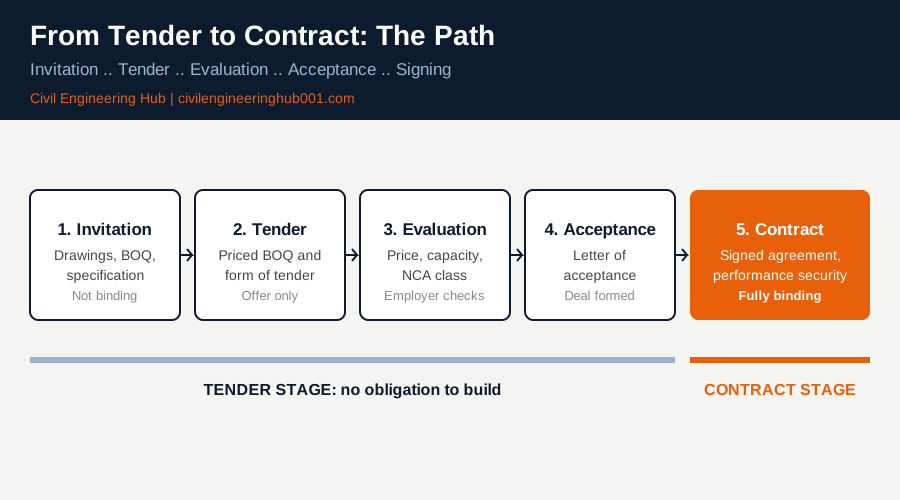
| Stage | What happens | Binding? |
|---|---|---|
| Invitation to tender | Employer issues drawings, BOQ, specification and instructions | No |
| Tender submission | Contractor returns priced BOQ and signed form of tender | Offer only |
| Evaluation and award | Employer checks compliance, price and capacity, then issues letter of acceptance | Acceptance formed |
| Contract signing | Both parties sign the agreement and conditions | Yes, fully binding |
| Site possession | Employer hands over the site, works begin | Yes |
Notice that money only becomes owed after the contract exists. Work started on a tender alone is the riskiest position a contractor can put themselves in.
How do the tender and the contract differ side by side?
The easiest way to separate the two is to compare what each one actually does on a project.
| Feature | Tender | Contract |
|---|---|---|
| Nature | Offer to do the work at a stated price | Binding agreement to do and pay for the work |
| Who prepares it | Contractor, using documents issued by the consultants | Both parties, based on the accepted tender |
| Key figure | Tender sum | Contract sum |
| Can it be withdrawn? | Yes, within the rules and before acceptance | No, only by termination under the conditions |
| Legal effect | None until accepted | Enforceable in law and through arbitration |
| Security | Tender security, where required | Performance security and insurances |
| Main users | QS, estimator, procurement team | Project manager, supervisor, QS, contractor |
The tender sum is not always the contract sum. Arithmetical errors get corrected, provisional items may be adjusted and negotiated savings can be agreed before signing. The figure written into the agreement is the one that counts.
Which documents form part of the contract?
Once signed, a bundle of documents becomes the contract. Each one has a job, and site teams should know which one wins if they disagree.
Typically the contract documents include the Agreement and Conditions, the Contract Drawings, the priced Bills of Quantities, the Specification, and the programme. The order of precedence is stated in the conditions, so read it before arguing on site.
The priced BOQ is especially important. Its rates are what the QS uses to value variations and interim payments, so a rate that looked harmless at tender stage becomes a live pricing tool for the whole project.
What does each professional need to do at each stage?
The tender and contract stages ask different things of every member of the team. Knowing your lane keeps the project clean.
| Professional | At tender stage | At contract stage |
|---|---|---|
| Civil and structural engineer | Issue clear, complete drawings and specifications | Inspect works, approve changes, certify quality |
| Architect | Coordinate documents, run tender queries and addenda | Administer the contract, issue instructions and certificates |
| Quantity surveyor | Prepare BOQ, evaluate tenders, check arithmetic | Value work, assess variations, prepare final account |
| Contractor and site supervisor | Price carefully, flag ambiguities in writing | Build to the documents, keep records, claim on time |
| Electrician and plumber (sub-contractors) | Price MEP packages against clear scope | Coordinate with main contractor, follow agreed programme |
Honestly, the most expensive habit on site is verbal instruction. If it changes the scope, the price or the time, it should be written, signed and priced under the contract’s variation clause.
What are the common mistakes between tender and contract?
These mistakes appear again and again on Kenyan projects, from small residential builds to county works.
- Starting work before signing. Without a signed contract, payment terms and variations become arguments instead of procedures.
- Pricing without reading the conditions. Retention, liquidated damages, defects period and payment periods all affect cash flow and should shape the tender rates.
- Ignoring tender queries. Ambiguities that are not raised in writing before the deadline become the contractor’s risk later.
- Unbalanced rates. Loading early items to improve cash flow can lead to rejection at evaluation.
- Weak records. Without daily reports, instructions and photos, valid claims are lost.
A useful rule: price the tender as if you will be held to every line, because under the contract, you will.
How do payment and risk change once the contract is signed?
At tender stage, risk sits mostly with the contractor, who carries the cost of pricing wrongly. After signing, risk is shared according to the conditions, and the contract tells you exactly who pays for what.
Payment moves through interim certificates, usually monthly, valued by the QS from work done on site. The employer typically holds back retention from each certificate until practical completion, and releases the balance after the defects liability period.
| Contract term | What it means on site |
|---|---|
| Performance security | Guarantee that protects the employer if the contractor defaults |
| Retention | Percentage held from payments to secure completion of defects |
| Liquidated damages | Agreed daily sum payable if the contractor finishes late |
| Defects liability period | Time after completion when the contractor must fix defects at their cost |
| Variation clause | Process for valuing changes to scope, using the BOQ rates |
The exact percentages and periods differ between projects, so always read the appendix to the conditions. Do not rely on what a previous project used.
For artisans, electricians and plumbers working as sub-contractors, the same logic applies one level down. Your sub-contract is your protection, so agree scope, rates, payment dates and how variations are instructed before you start, not after.
Frequently Asked Questions
Q: Is a letter of acceptance already a contract?
It can be. If the tender is clear and the letter accepts it without conditions, a binding agreement may already exist, even before formal signing. For this reason, employers should word acceptance letters carefully, and contractors should not treat them as casual.
Q: Can a contractor withdraw a tender after submission?
Usually only within the rules of the tender, which often set a validity period during which the offer stays open. Withdrawing inside that period can forfeit the tender security. After acceptance, withdrawal is a breach of contract.
Q: Does the lowest tender always win?
No. Employers also check NCA registration, financial capacity, experience, programme and compliance with the tender documents. On public projects, the evaluation criteria in the tender document must be followed under the Public Procurement and Asset Disposal Act, 2015. An abnormally low bid is often a warning sign, not a bargain.
Conclusion
A tender is the offer. A contract is the commitment. Everything between them, from clarifications to the letter of acceptance and the signed agreement, decides who carries the risk once the first excavator arrives.
If you work on site, learn the contract documents as well as you know the drawings. If you price work, read the conditions before the rates. Clear paper at the start saves the whole team from conflict later.
Want more practical construction knowledge delivered directly to you?
Subscribe to our YouTube channel: https://www.youtube.com/@TheCivilEngineeringHub-001
PS: Join our engineering WhatsApp community for daily learning at +254731393520