

Ask ten people on a building site what the difference is between the tender sum and the contract sum, and you will get ten different answers. Some say they are the same number. Others say one belongs to the client and the other to the contractor. Neither is right.
The tender sum is the total price the contractor offers when bidding. The contract sum is the figure written into the signed agreement after the tender has been checked, corrected, and accepted. They are often close, but they are not always equal, and the gap between them is where disputes usually start.
The truth is, a quantity surveyor who cannot explain this clearly will struggle with interim certificates, variations, and the final account. In this guide we break it down in plain language, with a worked Kenyan example, so you can use both terms correctly on your next project.
Quick Answer: The tender sum is the contractor’s total offered price at bidding stage. The contract sum is the agreed figure stated in the signed contract, after arithmetic corrections, any negotiation, and acceptance by the employer.
What is a tender sum and what does it include?
In simple terms, the tender sum is the contractor’s offer. It is the grand total at the end of the priced Bill of Quantities (BQ), and it is the number read out at the tender opening.
That total is built from several parts. Each rate in the BQ is multiplied by its quantity, the sections are added up, and the section totals are carried to the General Summary page. The contractor then signs the Form of Tender with that figure written in words and in figures.
| Component | What it covers | Who sets the amount |
|---|---|---|
| Measured work | Substructure, frame, walls, roof, finishes | Contractor prices the rates, QS measures the quantities |
| Preliminaries | Site setup, insurance, supervision, temporary works | Contractor |
| Provisional sums | Work not yet fully defined | QS and employer |
| Prime cost (PC) sums | Nominated suppliers and subcontractors | QS and employer |
| Contingency | Allowance for unforeseen work | Employer |
| VAT | Usually shown at the foot of the summary, as the tender document directs | Fixed by law |
Under the Public Procurement and Asset Disposal Act, 2015, a public entity must evaluate tenders strictly against the criteria stated in the tender document. The tender sum is only the starting point for that evaluation. It is not yet the price the project will be built for.
What is a contract sum and how is it different?
The contract sum is the amount named in the Articles of Agreement when the employer and contractor sign. Under the JBC Agreement and Conditions of Contract for Building Works, it is the figure from which everything else is measured.. certificates, retention, variations, and the final account.
It starts life as the tender sum, but it can change before signing. Arithmetic errors are corrected, any agreed discount is applied, and the employer may adjust provisional sums or omit items to fit the budget. Whatever figure both parties finally agree on becomes the contract sum.
Honestly, this is the part students skip, and it is the part that matters most once you reach site.
| Feature | Tender sum | Contract sum |
|---|---|---|
| Stage | Bidding | After award, at signing |
| Main document | Form of Tender and priced BQ | Articles of Agreement |
| Legal status | An offer by the contractor | A binding agreed price |
| May contain errors | Yes, until checked | No, errors are corrected before signing |
| Can it change? | Yes, through correction and negotiation | Only through contract mechanisms such as variations and fluctuations |
| Used for | Ranking bidders | Valuing certificates, retention, and the final account |
One more term completes the picture. Once variations are added to or deducted from the contract sum, the result is called the adjusted contract sum. It is a running figure that changes every time the architect or engineer issues a valid instruction.
The contract sum itself stays fixed. Think of it as the starting line, while the adjusted contract sum shows where the project stands today. A site supervisor who understands this can answer a client’s question about the current cost without guessing.
How does the tender sum become the contract sum on a Kenyan project?
The route is similar on public and private jobs, even if the paperwork differs. On public projects the steps follow the Public Procurement and Asset Disposal Act, 2015 and its Regulations. Here is the sequence a QS should know by heart:
- Tenders are opened and the read-out totals are recorded.
- The evaluation committee checks each tender for responsiveness against the tender document.
- The QS checks the priced BQ for arithmetic errors, such as wrong extensions, wrong additions, or totals carried forward incorrectly.
- Corrections are made using the rules in the tender document, and the bidder is notified.
- Any negotiation, where the tender document and procurement law allow it, is carried out and recorded in writing.
- The employer issues the notification of award. Public entities observe the standstill period of at least 14 days before signing.
- The final agreed figure is written into the Articles of Agreement as the contract sum.
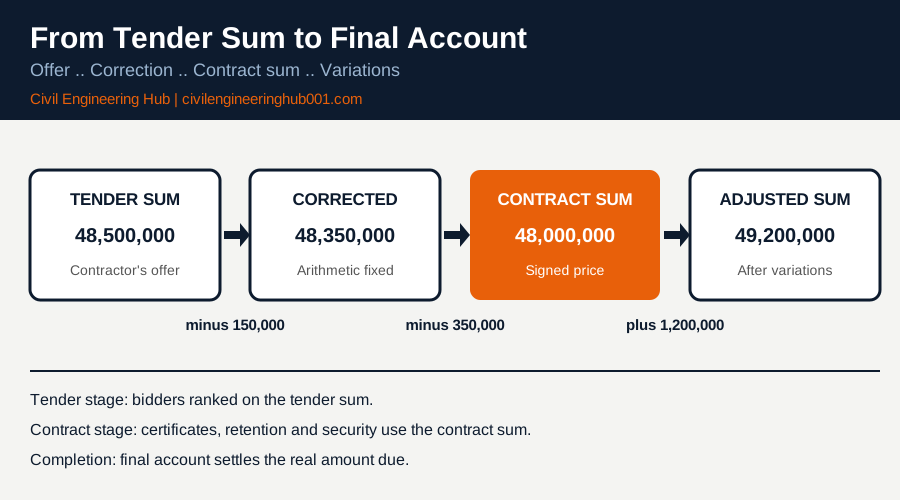
Now see how the figure moves with a simple example from a mid-size residential block. All amounts are in Kenya shillings.
| Stage | Adjustment | Running total (KES) |
|---|---|---|
| Read-out tender sum | None | 48,500,000 |
| Arithmetic correction | Minus 150,000 | 48,350,000 |
| Negotiated discount | Minus 350,000 | 48,000,000 |
| Contract sum signed | None | 48,000,000 |
| Approved variations during construction | Plus 1,200,000 | 49,200,000 |
Notice that the contract sum never changes after signing. Variations are added on top of it to give the adjusted contract sum, and the final account then settles the real amount due.
Why does the difference matter on site?
On site, almost every money calculation is tied to the contract sum, not the tender sum. If a QS uses the wrong one, the error flows into every certificate that follows.
- Performance security: It is calculated as a percentage of the contract sum, as stated in the tender document. Public works often use 10 percent, but always confirm in the Appendix.
- Retention: The retention percentage and its limit are applied to the value of work done under the contract, with the limit set against the contract sum.
- Interim valuations: The QS values work using the rates in the contract BQ, which must reflect any agreed corrections or discounts.
- Variation control: Public contracts cap total variations as a percentage of the original contract sum. Check the current limit in the Act and Regulations before approving instructions.
- Final account: The contract sum is the starting figure. Add variations, adjust provisional and PC sums to actual cost, then apply fluctuations if the contract allows them.
For site supervisors and project managers, this also explains why a contractor cannot simply claim for the original tender figure when the signed contract says something else. The signed document wins.
What mistakes do QSs and contractors make with these two figures?
Most mistakes come from treating the tender stage as finished business. A few patterns appear again and again on Kenyan projects:
- Certifying against the read-out tender sum after a correction or discount has already been agreed.
- Failing to update the BQ after negotiation, so rates in the valuation no longer match the agreement.
- Treating provisional sum spending as a variation, when it is an adjustment to a sum already inside the contract sum.
- Forgetting how VAT is treated in the tender document and mixing inclusive and exclusive figures in certificates.
- Leaving negotiation outcomes in emails instead of recording them in the contract documents.
The fix is simple. Keep one reconciliation sheet that shows the tender sum, every correction, every discount, and the signed contract sum, and attach it to the contract file.
In simple terms, the tender sum wins you the job and the contract sum runs the job. Treat them as two separate numbers with two separate purposes, and your documents will always agree with each other.
Frequently Asked Questions
Q: Can the contract sum be lower than the tender sum?
Yes. It happens when arithmetic errors favour the contractor, or when the employer and contractor agree a discount before signing. It can also be lower if the employer omits items to fit the budget. Each change must be documented so the contract sum can be traced back to the tender.
Q: Is the contract sum the same as the final account?
No. The contract sum is the agreed price at signing. The final account is the total amount actually due once variations, provisional and PC sum adjustments, and any fluctuations are settled. Many projects end with a final account that is higher or lower than the contract sum.
Q: Who prepares the reconciliation between the two figures?
The quantity surveyor normally prepares it, working with the evaluation committee on public projects. The employer approves it, and the agreed contract sum is then entered in the Articles of Agreement. Both parties sign, so the figure becomes binding on everyone.
Conclusion
The tender sum is the offer. The contract sum is the agreement. Everything after signing.. certificates, retention, variations, and the final account.. is built on the contract sum, so getting the reconciliation right protects both the client and the contractor.
If you are a student, practise by taking any priced BQ and walking the figure through correction, discount, and award. If you are on site, ask to see the signed Articles of Agreement and check the contract sum against your latest valuation.
Clear numbers prevent disputes, and disputes are expensive.
Want more practical construction knowledge delivered directly to you?
Subscribe to our YouTube channel: https://www.youtube.com/@TheCivilEngineeringHub-001
PS: Join our engineering WhatsApp community for daily learning at +254731393520