
If you have ever looked at a geotechnical report and seen a single number labeled CBR, you have seen one of the most important figures in road design. The California Bearing Ratio, or CBR, tells an engineer how strong a soil is under load, and that number decides how thick a road pavement needs to be. In simple terms, a low CBR means weak soil that needs more pavement layers to carry traffic safely, while a high CBR means the ground can carry more load on its own.
Getting this number right protects a project from early pavement failure. Getting it wrong means potholes and cracking within a few rainy seasons. This post breaks down what CBR values mean, how the test works, and how KeNHA and AASHTO standards use them to guide pavement design in Kenya.
Quick Answer: A CBR (California Bearing Ratio) value measures the strength of subgrade soil compared to a standard crushed stone material, expressed as a percentage. Low CBR values below 5 percent mean weak soil that needs thicker pavement layers or ground improvement, while high CBR values above 15 percent mean strong soil that needs less pavement thickness, as guided by KeNHA and AASHTO design standards.
What Is a CBR Value and Why Does It Matter
The California Bearing Ratio test was developed in the 1920s by the California Division of Highways, and it remains the backbone of pavement thickness design almost a century later. In simple terms, the test compares the resistance of a soil sample to penetration by a standard plunger against the resistance of a well-graded crushed stone, which is rated at 100 percent CBR.
A soil with a CBR of 5 percent has only 5 percent of the bearing capacity of that reference material. That is a weak subgrade, and it tells the design engineer that either the soil needs to be improved, or the pavement above it needs to be built thicker to spread traffic loads without failure.
The truth is, many road failures in Kenya do not start from bad workmanship. They start from a subgrade that was never properly tested, or a CBR value that was assumed instead of measured. A road built over black cotton soil with an unverified CBR can look perfect at handover and start rutting within one wet season.
How the CBR Test Is Carried Out
The CBR test can be done in the laboratory or in the field, and both methods are recognized under BS 1377 and AASHTO T193.
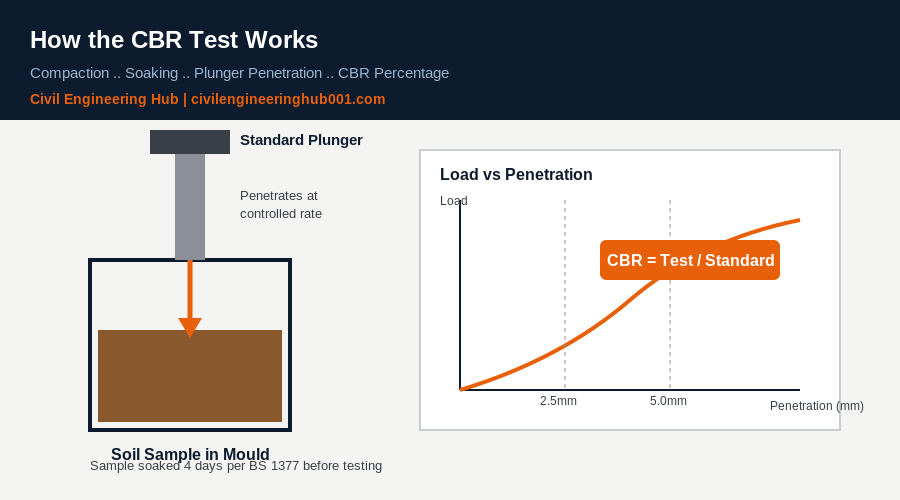
In the lab, a soil sample is compacted into a mould at a specific moisture content, usually following the Proctor compaction method. The sample is then soaked in water for four days to simulate the worst-case moisture condition the subgrade might face during service, which matters a lot in areas with poor drainage or high water tables.
After soaking, a standard plunger is pushed into the sample at a controlled rate, and the load required to achieve set penetration depths of 2.5mm and 5mm is recorded. This load is compared against the load required for the same penetration on the standard crushed stone material, and the result is expressed as a percentage.
In the field, engineers use a Dynamic Cone Penetrometer, commonly called a DCP, to get a quick estimate of in-situ CBR without waiting for lab results. It is faster, but it should never fully replace laboratory testing on a major road project, since it gives an estimate rather than the full specification value.
CBR Value Ranges and What They Mean for Subgrade Classification
Once the CBR value is known, it gets classified into a subgrade strength category. This classification is what a structural or highway engineer uses to select the right pavement design chart.
CBR Value (%) Subgrade Class Engineering Description Below 2 S1 Very weak, typically black cotton or soft clay soils 2 to 5 S2 Weak subgrade, needs improvement or capping layer 5 to 10 S3 Fair subgrade, common for many upcountry roads 10 to 15 S4 Good subgrade, adequate for moderate traffic 15 to 30 S5 Very good subgrade, often well-drained granular soils Above 30 S6 Excellent, typically natural gravel or rock-based soils These classes align closely with the subgrade classes used in the KeNHA Road Design Manual Part III, which Kenyan road designers reference when selecting pavement structures for both bitumen and gravel roads.
How CBR Values Determine Pavement Thickness
Once the subgrade class is known, the engineer selects a pavement structure from a design catalogue that matches both the subgrade strength and the expected traffic loading, usually expressed in equivalent standard axles.
Subgrade CBR Typical Pavement Response Site Implication Below 5% Requires capping layer or full soil improvement before base layers Higher project cost, longer construction time 5% to 10% Standard sub-base and base layer thicknesses apply Typical design case for most rural roads Above 15% Reduced pavement thickness possible Cost savings if verified by testing, not assumption In simple terms, every percentage point of CBR you lose on a weak subgrade gets paid back in centimeters of pavement material you have to add above it. That is why soil improvement, whether through lime stabilization, cement stabilization, or simply removing and replacing poor material, is often cheaper in the long run than building extra pavement thickness over bad ground.
Common Site Mistakes That Distort CBR Results
Honestly, a lot of CBR-related road failures trace back to a handful of repeated mistakes on site.
The first is testing soil at the wrong moisture content. A sample compacted dry will give a CBR value that looks better than what the soil will actually behave like once it is saturated during the rainy season. This is exactly why the four-day soak is part of the standard procedure, and skipping it produces misleading results.
The second is taking too few samples along a road alignment. Soil conditions can change significantly over just a few hundred meters, especially in areas with mixed geology. A single CBR value for a ten-kilometer stretch of road is rarely a safe basis for design.
The third is ignoring seasonal variation. A subgrade tested in the dry season can show a CBR value that drops sharply once the water table rises. Designers who do not account for this end up with pavements that perform well for one or two seasons and then fail once the ground saturates.
CBR Standards Referenced in Kenya
Kenyan road designers typically work with a combination of local and international standards. The KeNHA Road Design Manual Part III sets out pavement design procedures based on subgrade CBR and traffic classification specific to Kenyan conditions. BS 1377 governs the laboratory testing methodology for soils, including the CBR test procedure. AASHTO T193 is the equivalent American standard, often referenced in projects that follow AASHTO-based design guides.
Materials testing laboratories in Kenya, including those run by KeNHA, county governments, and private geotechnical firms, generally follow BS 1377 procedures when reporting CBR values on project documentation, so a young engineer reading a geotechnical report should expect to see this standard referenced directly.
How to Read a CBR Value on a Geotechnical Report
For a site engineer who is not a soils specialist, a geotechnical report can look intimidating. The truth is, you mostly need to check three things: the CBR percentage itself, the moisture condition it was tested at, and the depth or chainage it represents.
Look for whether the value is reported as “soaked CBR” or “unsoaked CBR.” A soaked value is the one that matters for design, since it reflects the worst-case scenario the subgrade will face once water penetrates during the rainy season. An unsoaked value on its own is not a safe basis for pavement thickness decisions.
Also check how many test points were taken along the road alignment, and whether the report gives a design CBR, which is usually a conservative value such as the 10th percentile of all test results rather than a simple average. Using the average instead of the design value is a common shortcut that overstates subgrade strength and leads to under-designed pavements.
If you are a contractor or site supervisor rather than a design engineer, the practical habit worth building is this: never assume the subgrade under your section of road matches the report exactly. Ground conditions shift, especially near culverts, cut-to-fill transitions, and low-lying sections, so flag any visibly different soil to the resident engineer before you proceed with base layer construction.
Frequently Asked Questions
Q: What is a good CBR value for road construction?
A CBR value above 10 percent is generally considered good for subgrade supporting a road pavement. Values above 15 percent are considered very good and may allow for a reduced pavement thickness. Anything below 5 percent is classified as weak and usually requires soil improvement before construction proceeds.Q: Can CBR value be improved on site?
Yes. Common methods include mechanical stabilization by blending in better quality material, chemical stabilization using lime or cement, and simply removing weak material and replacing it with selected fill. The right method depends on the type of soil, the depth of the weak layer, and the project budget.Q: Is a field DCP test enough, or do I need a lab CBR test?
A DCP test gives a fast estimate that is useful for quality control checks during construction. For the original design of a road, a laboratory CBR test following BS 1377 or AASHTO T193 remains the standard requirement, since it accounts for soaking and controlled compaction that a field test cannot fully replicate.Final Takeaway
CBR values are not just a lab number buried in a geotechnical report. They directly decide how much material goes into a pavement, how much a project costs, and how long a road lasts before it needs rehabilitation. In simple terms, understand your subgrade before you design your pavement, not after construction has already started.
Whether you are a civil engineer reviewing a design report or a site supervisor watching soil testing happen on the ground, knowing what these numbers mean lets you ask the right questions before problems become expensive.
Want more practical construction knowledge delivered directly to you?
Subscribe to our YouTube channel: https://www.youtube.com/@TheCivilEngineeringHub-001
PS: Join our engineering WhatsApp community for daily learning at +254731393520