
You can build the best road design on paper and still watch it fail within two rainy seasons. The reason is almost always the same: the soil was never compacted properly. The Proctor test is the laboratory check that tells you how much compaction a soil can actually take.
In simple terms, a Proctor test finds the moisture content at which a soil packs down to its highest dry density. That number, the Maximum Dry Density (MDD), becomes the target you compare every field compaction result against.
The truth is, many site teams hear “95% compaction” and nod without knowing what it is 95% of. This guide explains the test, how to read the result, and how it controls earthworks on Kenyan sites. It is useful for civil engineers, but also for site supervisors, foremen, quantity surveyors and machine operators who work around fill and roadbeds every day.
Quick Answer: A Proctor test is a laboratory compaction test (BS 1377 Part 4) that finds a soil’s Maximum Dry Density and Optimum Moisture Content. Site compaction is then checked as a percentage of that MDD, usually 95% to 100% depending on the layer.
What exactly does a Proctor test measure?
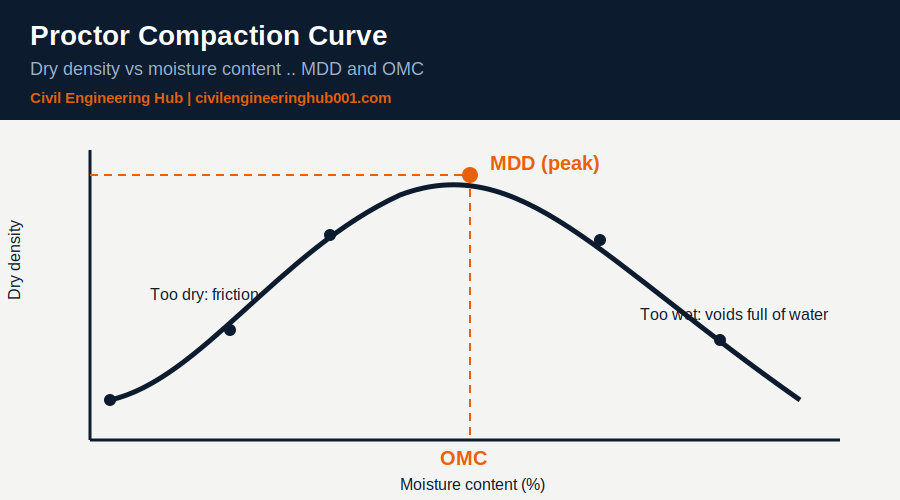
The test measures two values from one soil sample: the Optimum Moisture Content (OMC) and the Maximum Dry Density (MDD). Soil is compacted into a standard mould at several moisture contents, and the dry density is calculated each time.
When you plot dry density against moisture content, you get a curve with a peak. The top of that curve is the MDD, and the moisture content at the peak is the OMC.
Honestly, this is just common sense made measurable. Too dry and the soil particles resist movement because of friction. Too wet and water fills the voids and cushions the particles, so the roller only pushes the water around. At the OMC, water acts as a lubricant and the particles lock together tightly.
| Term | Meaning | Why it matters on site |
|---|---|---|
| OMC | Moisture content giving highest density | Tells you how much water to add or let evaporate |
| MDD | Highest dry density reached in the lab | The 100% reference for field results |
| Dry density | Soil mass per unit volume, excluding water | The value that actually reflects compaction |
| Relative compaction | Field dry density divided by MDD, as a percentage | The figure on your acceptance certificate |
How is the Proctor test carried out in the laboratory?
The method follows BS 1377 Part 4, which is the standard most Kenyan material labs use. AASHTO T99 and T180 are the equivalent American methods and you will see them quoted on road projects funded by international lenders.
The lab prepares about five samples of the same soil, each at a different moisture content. Each is compacted in layers inside a cylindrical mould using a falling rammer, then trimmed, weighed and sampled for moisture.
- Dry and sieve the sample to remove oversize material.
- Mix the first portion with a measured amount of water.
- Compact it in layers in the mould using the standard rammer.
- Trim the top level, weigh the mould and soil, and calculate bulk density.
- Take a moisture sample and oven dry it to get the moisture content.
- Repeat at higher moisture contents until density starts to fall, then plot the curve.
| Feature | Standard (light) compaction | Modified (heavy) compaction |
|---|---|---|
| Reference | BS 1377-4 (2.5 kg rammer) / AASHTO T99 | BS 1377-4 (4.5 kg rammer) / AASHTO T180 |
| Rammer drop | 300 mm | 450 mm |
| Layers in 1 litre mould | 3 | 5 |
| Blows per layer | 27 | 27 |
| Typical use | Embankments, general fill | Roads, subbase, base, heavy loaded floors |
The modified test uses far more energy, so it gives a higher MDD and a lower OMC. Always confirm which one the specification calls for, because a result of 95% on the standard test and 95% on the modified test are very different things on the ground.
How do Kenyan soils behave in a Proctor test?
Soil type changes the curve completely, and Kenya has a wide range. Lateritic gravels and murram usually give a clear peak with a moderate OMC, and they compact well when moisture is controlled. Black cotton soils, which are expansive clays, have a high OMC, a low MDD and a flat curve, which makes them difficult to compact and sensitive to wet weather.
That is why black cotton subgrade is often removed and replaced, or stabilised with lime or cement, instead of simply being rolled harder. The Proctor test of the improved material then sets the new target.
| Soil type | Typical MDD (kg/m3) | Typical OMC | Site behaviour |
|---|---|---|---|
| Well graded gravel or murram | 1,900 to 2,200 | 6% to 12% | Compacts well, good bearing |
| Sandy soil | 1,700 to 2,000 | 8% to 14% | Dries fast, needs watering |
| Silty clay | 1,600 to 1,850 | 14% to 20% | Sensitive to moisture |
| Black cotton soil | 1,300 to 1,600 | 20% to 30% | Swells and shrinks, usually replaced or stabilised |
The values above are indicative only. Your lab report for the actual borrow pit is the only figure you should use.
Can you work through a quick compaction check example?
Say the lab reports an MDD of 2,000 kg/m3 and an OMC of 10% for a subgrade, and the specification asks for 95% of MDD. The target is therefore 0.95 x 2,000 = 1,900 kg/m3 dry density.
The sand replacement test on site gives a bulk density of 2,090 kg/m3 at 11% moisture. Dry density equals bulk density divided by (1 + moisture content), so 2,090 / 1.11 = 1,883 kg/m3.
Relative compaction is 1,883 / 2,000 = 94.1%. That is below 95%, so the layer fails. The foreman should add roller passes, check the moisture, and re-test. The moisture of 11% is close to OMC, so the likely fix is more passes or thinner lifts.
How do you use the Proctor result to control compaction on site?
The lab curve is only half the job. On site you measure the in-place dry density and compare it to the MDD. In Kenya, the common field methods are the sand replacement test (BS 1377 Part 9) and, on larger road projects, the nuclear density gauge.
The sand replacement method is simple. You dig a small hole, weigh the soil removed, fill the hole with calibrated sand to find its volume, then compute density. A moisture check on the same soil gives you the dry density.
| Layer | Typical minimum relative compaction | Moisture control |
|---|---|---|
| General embankment fill | 93% to 95% of MDD | Within 2% of OMC |
| Subgrade (top 300 mm) | 95% to 100% of MDD | Within 2% of OMC |
| Subbase | 95% to 98% of modified MDD | Close to OMC |
| Base course | 98% to 100% of modified MDD | Close to OMC |
These are typical ranges. Your contract specification, the project engineer, and for roads the KeNHA or KURA specification will give the figures that bind you. Never work from memory on acceptance criteria.
What goes wrong when Proctor results are ignored?
The failures follow a pattern, and they are expensive. Poorly compacted subgrade settles under traffic, so the pavement above it ruts, cracks and ponds water. Poorly compacted fill under a slab on grade settles unevenly and you get cracked floors and tilting walls.
The most common site mistakes are practical ones. Compacting wet black cotton soil and calling it done. Using one Proctor result for fill borrowed from three different pits. Skipping tests because the rains are coming.
- Different soil, different curve. Every borrow source needs its own Proctor test. Re-test whenever the soil visibly changes.
- Layer thickness matters. Most rollers only compact 150 mm to 250 mm effectively. Thick lifts leave soft cores under a hard crust.
- Test frequency. Follow the specification, typically one density test per set area or volume per layer, and record the chainage and level of every test.
- Failed tests. Re-work and re-test the layer. Do not cover it up and hope.
For site supervisors, the practical routine is simple: get the Proctor result before filling starts, control moisture first, then roll, then test. For quantity surveyors, remember that rework from failed density tests is a cost and programme item worth tracking.
Frequently Asked Questions
Q: What is the difference between a Proctor test and a CBR test?
The Proctor test finds the best moisture content and maximum density for a soil. The CBR test measures the strength of the soil, usually at a chosen compaction level taken from the Proctor result. Roads need both: Proctor to control how you compact, CBR to confirm the soil is strong enough for design.
Q: Is 95% compaction good enough?
It depends on the layer and which Proctor test the specification references. 95% of modified MDD is a demanding target, while 95% of standard MDD is much easier to reach. Always check the contract documents before accepting or rejecting a layer.
Q: Can I compact soil when it is too wet?
Not effectively. If moisture is well above OMC, the roller will pump the soil and create a rubbery surface instead of a dense one. Aerate the layer by ploughing or turning it, let it dry to near OMC, then compact again.
Conclusion
The Proctor test is the reference point for all earthworks quality control. It gives you the target density and the moisture content to aim for, so site decisions are based on numbers instead of guesses.
Whether you design the road, supervise the fill, measure the work or run the roller, understanding what the 95% refers to protects the project and your reputation. Get the Proctor result first, control moisture, compact in thin layers, and test every layer.
Want more practical construction knowledge delivered directly to you?
Subscribe to our YouTube channel: https://www.youtube.com/@TheCivilEngineeringHub-001
PS: Join our engineering WhatsApp community for daily learning at +254731393520