

You can build a perfect asphalt surface and still watch it fail within two rainy seasons. The reason is almost always below the surface. Road pavement layers work as a system, and when one layer is weak, wet or badly compacted, every layer above it pays for it.
In simple terms, a pavement is a stack of layers that spreads wheel loads over the natural ground so the soil is never overstressed. Each layer has one job, and each is built from a different material for a reason.
The truth is that many students memorise the layer names for exams but never learn how those layers behave on a Kenyan site, where black cotton soil, heavy rains and overloaded trucks test every layer. This guide fixes that. You will learn what each layer does, what it is made of, how thick it usually is, and what to check before you cover it with the next one.
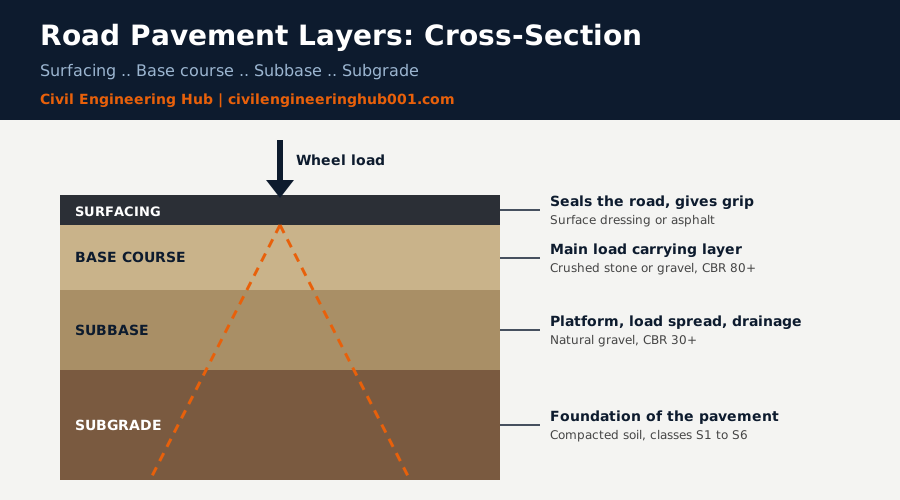
Quick Answer: A road pavement has four main layers: the subgrade (prepared natural ground), the subbase, the base course and the surfacing. Each layer spreads traffic load downward so the weaker material below is never overstressed, and each must be compacted and approved before the next is placed.
What Are the Main Road Pavement Layers and What Does Each One Do?
Think of the pavement as a load spreading system. A truck wheel puts a high, concentrated pressure on the surface. By the time that load reaches the subgrade, the layers above have spread it over a much wider area and reduced the pressure to a level the soil can carry.
That is why the strongest and most expensive materials sit at the top, where stresses are highest, and cheaper local materials sit lower down. The table below summarises the role of each layer.
| Layer | Main Function | Typical Material in Kenya |
|---|---|---|
| Surfacing (wearing course) | Waterproofs the road, gives skid resistance and a smooth ride | Asphalt concrete, surface dressing, cold mix |
| Base course | Main structural layer, carries and spreads traffic load | Crushed stone, natural gravel, cement or lime stabilised gravel |
| Subbase | Secondary load spreading, working platform, drainage, protects the subgrade | Natural gravel, lateritic gravel, gravel soil mixes |
| Improved subgrade (capping) | Strengthens weak ground where the design calls for it | Selected fill, lime or cement treated soil |
| Subgrade | Final foundation of the whole pavement | Compacted in situ soil or embankment fill |
Notice that the surfacing is usually the thinnest layer yet gets all the attention. On a surface dressed road it is often thinner than 25 mm. The real structural strength comes from the base and subbase beneath it.
Honestly, when a client says the road is failing, the surfacing is the symptom. The cause is normally found two or three layers down.
Why Is the Subgrade the Foundation of Every Road Pavement?
The subgrade is the natural ground or embankment fill that supports everything above it. Its strength is measured by the California Bearing Ratio (CBR), and that one number drives how thick the upper layers must be. A weak subgrade means thicker and costlier layers above it.
The Kenya Road Design Manual Part III groups subgrade strength into classes S1 to S6 using soaked CBR. Use the approximate values below as a quick reference, then confirm against your project design report.
| Subgrade Class | Soaked CBR (%) | What It Means on Site |
|---|---|---|
| S1 | 2 to 5 | Very poor, needs improvement or replacement |
| S2 | 5 to 10 | Poor, needs thicker layers |
| S3 | 10 to 15 | Fair |
| S4 | 15 to 30 | Good |
| S5 | 30 to 45 | Very good |
| S6 | Above 45 | Excellent |
Preparation matters as much as the class. Strip topsoil and organic matter, rip and re-compact the top 150 to 300 mm, and bring it to the density in your specification, often 95 percent of maximum dry density.
Black cotton soil is the classic Kenyan trap. It swells in the rains and shrinks in the dry season, so it should never be left directly under a pavement. Undercut it and replace it with selected fill, or stabilise it with lime or cement, as the design requires.
What Do the Subbase and Base Course Actually Do?
The subbase is the first layer placed on the prepared subgrade. It acts as a working platform for trucks and rollers, spreads load, and stops the wet subgrade from pumping fines up into the base. It must also drain, because trapped water is the fastest way to destroy a pavement.
The base course is the main structural layer. It carries most of the traffic load, so it needs high stiffness, good particle interlock and tight control of grading and plasticity. A base with too many fines will soften in the wet season and fail under the first heavy trucks.
The figures below are typical values from Kenyan practice and the Road Design Manual. Your contract specification always overrides them.
| Layer | Typical Minimum Soaked CBR | Typical Compaction (% of MDD) | Typical Thickness |
|---|---|---|---|
| Subbase (natural gravel) | 30% | 95% | 150 to 200 mm |
| Base (natural gravel) | 80% | 98% | 150 to 200 mm |
| Base (crushed stone) | 80% or more | 98 to 100% | 150 to 200 mm |
Thickness is not guesswork. It comes from the pavement design, which uses subgrade CBR and the traffic the road will carry over its design life.
On many Kenyan projects the gravel comes from a borrow pit, and quality varies from one pit face to another. Test samples from each source before approval, and again during hauling, because a pit that passed in the dry season can deliver wetter, siltier material in the rains. Where natural gravel is too weak, the designer may specify cement or lime stabilisation to lift the CBR instead of importing crushed stone from far away.
How Does the Surfacing Protect the Layers Below It?
The surfacing seals the pavement against water and gives vehicles grip. Once it cracks or ravels, water enters the base and subbase, the fines soften, and potholes follow quickly. This is why many failed roads show potholes right after the first heavy rains.
Two main options are used on Kenyan roads:
- Surface dressing: a bitumen spray covered with stone chips. It is cheaper, quick to place and common on low to medium traffic roads.
- Asphalt concrete: a hot mix of aggregate and bitumen laid in one or two courses. It suits heavy traffic corridors such as KeNHA trunk roads.
Between layers, a prime coat is sprayed on the finished base so the surfacing bonds to it, and a tack coat is applied between asphalt courses so they act as one. Skip these and the layers slip against each other under braking.
In simple terms, the surfacing protects the structure, and the structure supports the surfacing. Neither works alone.
Here is a simple site example. A 6 m wide access road carries mostly light vehicles and the occasional lorry. The designer may specify a 150 mm gravel subbase, a 150 mm gravel base and a single surface dressing. On a trunk road with thousands of heavy axles a day, the same ground may need a thicker crushed stone base and two asphalt courses. The ground is the same, but the traffic changes the structure.
What Should You Check on Site Before Placing the Next Layer?
Each layer is a hold point. The supervisor should inspect and approve it in writing before the contractor covers it. The Standard Specification for Road and Bridge Construction sets the tests, and your project documents set the limits.
| Check | How It Is Done | What It Prevents |
|---|---|---|
| Levels and thickness | Spot levels, string line and straightedge | Thin layers and a poor ride |
| Density | Sand replacement or nuclear gauge against laboratory MDD | Settlement and rutting |
| Material quality | Grading, Atterberg limits and CBR on delivered material | Soft, plastic layers in the wet season |
| Moisture content | Compare field moisture with optimum before rolling | Weak, loosely compacted layers |
| Proof rolling | Pass a loaded truck or heavy roller and watch for movement | Hidden soft spots |
| Drainage and crossfall | Check camber, side drains and outlets | Water trapped in the layers |
Honestly, the cheapest repair is the one you never need. Failing a layer at the hold point costs a day. Failing it after surfacing costs the whole road section.
Record test results, levels and approvals by chainage in your daily site report so nothing is lost when the next layer goes down.
For students heading to site, learn to read the pavement layer details on the typical cross-section drawing. It shows each layer, its thickness, its material and its compaction target, and it is the document your inspection should be measured against.
Frequently Asked Questions
Q: Which road pavement layer is the most important?
No single layer carries the road alone. The base course is the main structural layer, while the subgrade is the foundation. If the subgrade is weak, even a good base will settle over time. Treat every layer as critical on site.
Q: What is the difference between the subbase and the base course?
The base course sits directly under the surfacing and carries most of the traffic load, so it uses higher quality material. The subbase sits below it and uses cheaper local gravel. It spreads load further, gives a working platform and helps drainage. Base material needs a higher CBR and tighter grading control than subbase.
Q: Why do roads develop potholes after heavy rain?
Water enters through cracks in the surfacing and softens the base and subbase. Passing wheels then crush the weak material and the surfacing breaks into a pothole. Poor drainage and fines in the base make this worse. Good drainage, sealed cracks and correct compaction are the best prevention.
Final Takeaway on Road Pavement Layers
A road is only as strong as its weakest layer. The subgrade carries the load, the subbase spreads it, the base takes most of it and the surfacing protects all three from water.
For students, learn the function of each layer and the CBR and compaction targets. For site teams, treat every layer as a hold point and test before you cover. Do that consistently and the road will outlast its design life instead of failing in two rainy seasons.
Want more practical construction knowledge delivered directly to you?
Subscribe to our YouTube channel: https://www.youtube.com/@TheCivilEngineeringHub-001
PS: Join our engineering WhatsApp community for daily learning at +254731393520