

Every road engineer, contractor and site supervisor has seen it. A well-compacted embankment stands fine for months, then one heavy rainy season later, a crack opens at the crest and a chunk of the slope slides toward the toe. The question is never whether it can happen. It is why it happens, and whether you can see it coming before it does.
Slope failure in embankments happens when the forces trying to pull a soil mass downhill overcome the forces holding it in place, usually triggered by water, poor compaction or a slope built steeper than the soil can support.
Quick Answer: Embankment slopes fail mainly because of water saturation, inadequate compaction, slopes cut steeper than the soil’s strength allows, or a change in load at the crest or toe. Engineers control this by checking the factor of safety against known causes before construction, not after cracks appear.
What Is Slope Stability and Why It Matters on Site
Slope stability is simply the ability of an earth slope, whether it is a road embankment, a cut on a hillside, or the side of a borrow pit, to resist sliding under its own weight and any load placed on it. In simple terms, every slope has forces trying to pull it down and forces holding it up. As long as the resisting forces are greater, the slope stays put.
On a construction site, this is not an abstract calculation. A failed embankment on a highway project means reworked earthworks, delayed handover, and in the worst cases, damage to structures or loss of life. The truth is, most slope failures on Kenyan road and building sites trace back to decisions made during design and construction, not bad luck.
What Causes Slope Failure in Embankments
Most embankment failures come down to a small set of repeating causes. Knowing them lets you catch the warning signs before the slope actually moves.
| Cause | What Happens on Site |
|---|---|
| Water infiltration | Rainwater or a rising water table saturates the soil, adds weight, and reduces the internal friction that holds particles together. |
| Poor compaction | Soil placed in thick layers or compacted below the required density leaves voids that collapse or shift under load. |
| Excessive slope angle | A slope cut steeper than the soil’s angle of repose has less resisting force from the start, even before rain or loading. |
| Toe erosion or excavation | Removing soil at the base of a slope, by a river, a drain, or nearby digging, takes away the support holding the upper slope in place. |
| Surcharge loading | Stockpiling materials, parking heavy plant, or building too close to the crest adds load the slope was never designed to carry. |
| Weak or layered soil | A hidden weak layer, such as soft clay or a sand seam, gives the slope a natural plane to slide along once disturbed. |
Honestly, water is the trigger behind most of these on Kenyan sites. It softens weak layers, adds weight, and increases pore water pressure, which directly reduces the shear strength the soil relies on to stay stable.
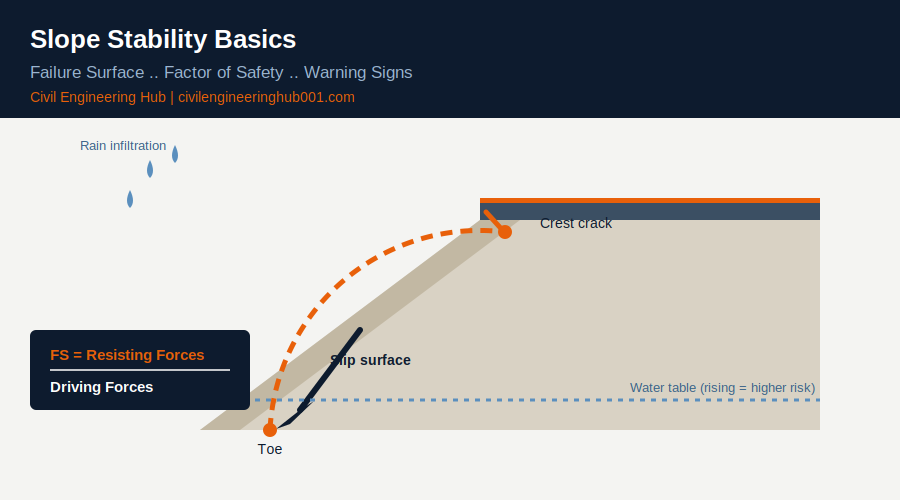
Understanding Factor of Safety in Slope Design
Every slope design is checked against a factor of safety, FS, which compares the forces resisting failure to the forces driving it.
FS = Resisting Forces (shear strength of soil) ÷ Driving Forces (weight and loading pulling the slope down)
An FS of 1.0 means the slope is on the edge of failure. Most design codes and geotechnical practice, including guidance referenced in the Kenya Road Design Manual Part III and BS 6031: Code of Practice for Earthworks, require a minimum FS of 1.3 to 1.5 for permanent embankments, and higher for slopes near structures or where failure would be catastrophic. In simple terms, engineers deliberately over-design the slope so it has a safety margin, not a knife-edge balance.
This is where soil testing earns its place. A Proctor test confirms the soil is being compacted to the density the design assumed, and shear strength parameters from lab testing feed directly into the FS calculation. Skip the testing, and the FS on paper stops meaning anything on the actual ground.
Types of Slope Failure You Will See on Site
Not every failure looks the same. Recognising the type helps you diagnose the cause faster.
| Failure Type | Typical Sign |
|---|---|
| Rotational (slip circle) | A curved slide surface, common in homogeneous clay or fill slopes, with a visible scarp at the crest. |
| Translational (planar) | Soil slides along a flat weak plane, often a bedding layer or interface between fill and natural ground. |
| Wedge failure | Common in rock cuts, where two intersecting discontinuities release a wedge-shaped block. |
| Toe failure | Failure surface exits at or near the base of the slope, often linked to erosion or excavation at the toe. |
How to Prevent and Remediate Slope Failure
Prevention is always cheaper than remediation. On active sites, these are the checks that matter most.
- Design the slope angle to the soil, not the other way round. Use geotechnical investigation results, not assumptions, to set the cut or fill angle.
- Compact in controlled layers. Follow the specified lift thickness and confirm density with field density tests against the Proctor maximum.
- Manage water actively. Install surface drains along the crest, benching to break up long slope runs, and subsurface drainage where seepage is expected.
- Protect the toe. Avoid excavation near the base and use toe walls or riprap where erosion is a risk.
- Monitor during and after construction. Watch for tension cracks at the crest, bulging at the toe, or leaning trees and fences, these are early warning signs before a full slide.
Where a slope has already shown signs of movement, remediation typically involves flattening the slope, installing retaining structures, improving drainage, or in some cases soil nailing and reinforcement. The right fix depends entirely on which of the causes above is driving the movement, which is why a proper site investigation before repair work is not optional.
Frequently Asked Questions
Q: What is the minimum factor of safety for a road embankment?
Most design guidance, including the Kenya Road Design Manual and BS 6031, calls for a minimum FS of 1.3 for normal embankments under long-term conditions, rising to 1.5 or more near structures or where consequences of failure are severe. The exact figure depends on the soil type, loading, and design standard applied by the project engineer.
Q: Can heavy rain alone cause a slope to fail?
Yes. Rainwater increases pore water pressure and reduces the effective shear strength of the soil, which is why many embankment failures in Kenya happen during or shortly after the rainy season, even on slopes that stood fine for months prior.
Q: How can I tell if a slope is starting to fail?
Watch for tension cracks running parallel to the crest, bulging or heaving near the toe, sudden seepage points on the slope face, and any tilting of trees, fences or poles on the slope. These signs usually appear before a full collapse and should trigger an immediate geotechnical inspection.
Final Takeaway
Slope failure is rarely a surprise to the ground, it is usually a surprise to the people who skipped the checks. The truth is, water control, correct compaction, and a slope angle matched to real soil strength prevent the vast majority of embankment failures seen on Kenyan sites. Build that discipline into every earthworks stage, and the factor of safety on your drawing stays true on the ground too.
Want more practical construction knowledge delivered directly to you?
Subscribe to our YouTube channel: https://www.youtube.com/@TheCivilEngineeringHub-001
PS: Join our engineering WhatsApp community for daily learning at +254731393520