

Getting pipe sizing wrong on a residential building is one of the most common plumbing mistakes on Kenyan construction sites. It is not always visible until the building is occupied — and by then, fixing it is expensive and disruptive. Residents complain of low water pressure at upper floors, taps running dry when multiple outlets are open, or noisy pipes that hammer every time a valve closes. All of these problems trace back to one decision made during design or installation: pipe diameter selection.
This guide explains how to size water supply pipes for a residential building correctly, using a step-by-step approach that applies whether you are a plumber, site engineer, architect, or building services consultant.
Quick Answer: Pipe sizing for a residential building is determined by the peak demand flow rate for each section of the system, calculated using fixture units (as per BS EN 806 or BS 6700), then matched against standard pipe velocity limits (typically 1.0–2.0 m/s) using pipe sizing charts or the Hazen-Williams formula. The main supply to a residential building in Kenya typically ranges from 25 mm to 50 mm depending on the number of units and floors.
Why Pipe Sizing Matters More Than Most Plumbers Realise
The water supply system in a building is a pressure system. Every fitting, every elbow, every vertical rise, and every metre of pipe length consumes pressure. If your pipes are too small, friction losses eat into the available pressure before the water reaches the upper floors. If your pipes are too large, the water velocity drops so low that sediment settles inside the pipes over time.
The truth is.. most problems with low water pressure in Kenyan residential buildings are not caused by the utility supply. They are caused by undersized internal pipes and too many fittings installed without accounting for pressure loss.
Getting this right is not complicated. It requires understanding three things: demand, flow rate, and pipe velocity.
Step 1: Calculate the Peak Demand Using Fixture Units
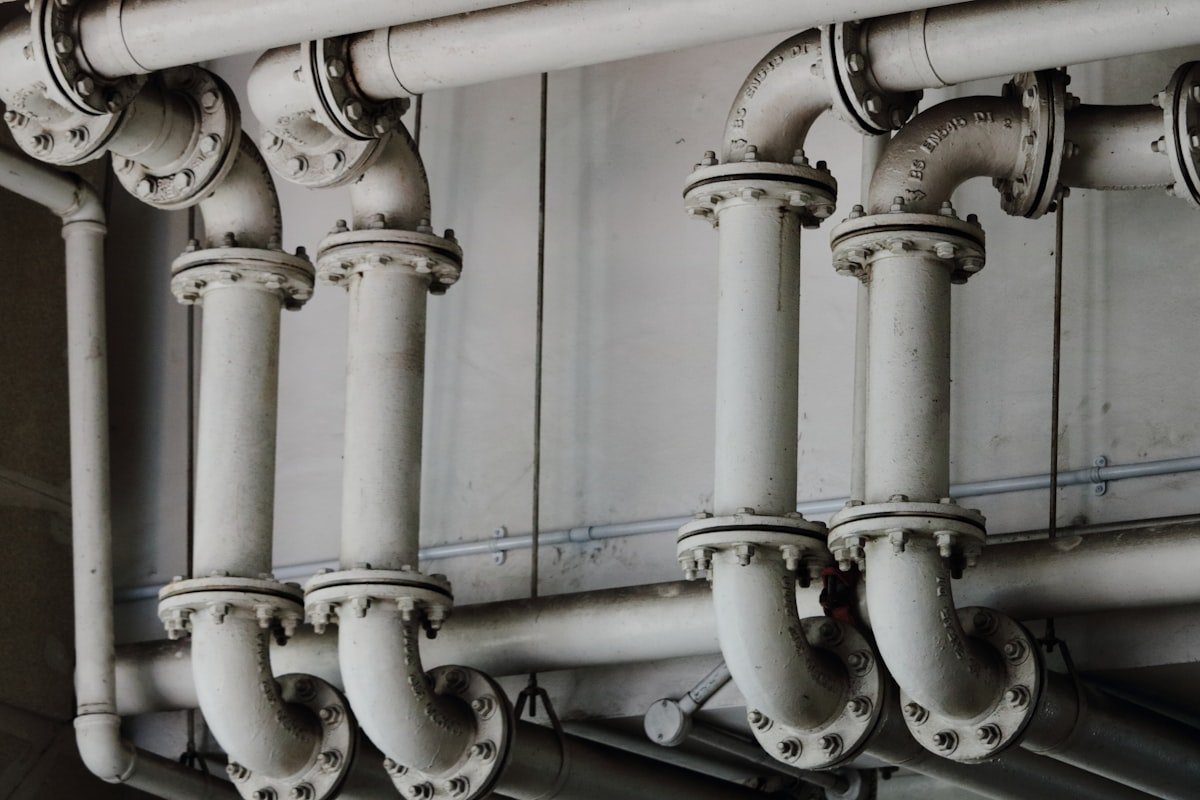
The first step is to count all the water outlets in the building and assign them a fixture unit (FU) value. Fixture units are a standardised measure of flow demand so that engineers can compare different fittings on a common scale.
Under BS EN 806-3, the standard used in Kenya and most East African countries, each fitting type carries a loading unit value:
| Fitting | Loading Units (LU) |
|---|---|
| WC cistern | 2 |
| Washbasin (tap) | 1 |
| Kitchen sink | 2 |
| Shower | 2 |
| Bathtub | 3 |
| Washing machine | 3 |
| Utility tap (garden/outdoor) | 3 |
For a typical two-bedroom apartment, total loading units are usually in the range of 15 to 22 LU. For an eight-unit residential block, you are typically sizing the main supply for 120 to 180 LU.
Once you have the total LU for each branch and the entire system, you use the BS EN 806-3 design flow rate graph (or lookup table) to convert LU into design flow rate in litres per second (l/s).
Step 2: Select Pipe Diameter Based on Flow Rate and Velocity
Once you have the design flow rate for each section, you size the pipe diameter so that water flows within acceptable velocity limits.
Acceptable velocity range:
- Minimum: 0.5 m/s (to prevent sediment settling)
- Maximum: 2.0 m/s for cold water (to prevent noise and pipe erosion)
- Maximum: 1.5 m/s for hot water (to reduce thermal degradation of plastic pipes)
The relationship between flow rate, pipe area, and velocity is: Q = A × v, where Q = flow rate (m³/s), A = cross-sectional area of pipe (m²), and v = velocity (m/s).
In simple terms.. you work backwards. You know Q from Step 1. You choose a velocity within the safe range. You solve for A, then derive the pipe diameter.
For most practical purposes on site, plumbers and engineers use pre-calculated sizing tables. Here is a simplified reference for uPVC and copper pipes:
| Design Flow Rate (l/s) | Recommended Pipe Diameter |
|---|---|
| Up to 0.15 | 15 mm |
| 0.16 – 0.30 | 20 mm |
| 0.31 – 0.60 | 25 mm |
| 0.61 – 1.20 | 32 mm |
| 1.21 – 2.00 | 40 mm |
| 2.01 – 3.50 | 50 mm |
| 3.51 – 6.00 | 63 mm |
These are indicative values for plastic pipe (uPVC/CPVC) with smooth internal surfaces. Always verify against your specific pipe manufacturer’s pressure loss tables for the material in use.
Step 3: Account for Pressure Losses Along the Route
Selecting the right pipe diameter is only part of the calculation. You also need to confirm that after all friction losses, the residual pressure at the highest and furthest outlet still meets the minimum required.
In Kenya, the minimum pressure at any outlet under KEBS KS 02-95 and common plumbing practice is 0.1 bar (10 kPa) for a WC cistern and 0.2 bar (20 kPa) for a shower. For mixer taps and thermostatic valves, you often need 0.5 bar (50 kPa) minimum.
Pressure loss in a pipe is calculated using the Hazen-Williams formula: hf = (10.67 × L × Q^1.852) / (C^1.852 × D^4.87), where hf = friction head loss (m), L = pipe length (m), C = roughness coefficient (uPVC = 140, copper = 135), and D = internal pipe diameter (m).
On a five-storey residential building with a 3 bar mains supply, you typically lose 0.5 bar per floor rise (each 10 m vertical = approximately 1 bar). That means by the time water reaches the fifth floor, you only have about 0.5–0.8 bar remaining before friction in the horizontal runs takes further toll. This is why booster pumps and roof tanks remain common in Kenyan residential buildings above three storeys.
Step 4: Verify Your Sizing Against the Full Schematic
Before finalising your pipe schedule, sketch a simplified schematic of the system showing the main supply, sub-mains to each riser, and branches to each apartment. Label each section with the design flow rate and the selected pipe diameter.
Check three things: every section stays within the velocity limits; pressure at the most critical outlet (highest floor, furthest point) meets the minimum requirement; and the main supply meter and connection pipe from the utility are not undersized relative to your internal design.
Honestly.. this final check step is skipped on most small projects in Kenya, and it is exactly why so many buildings struggle with pressure issues once occupied.
Frequently Asked Questions
Q: What is the standard pipe size for a single-family house in Kenya?
The main supply to a single-family residential house typically uses a 25 mm uPVC pipe from the main to the building, with 15 mm branches to individual fixtures. This handles most standard three-bedroom configurations with up to 20 loading units without pressure problems.
Q: Can I use HDPE pipes instead of uPVC for water supply?
Yes. HDPE pipes are widely used for water supply in Kenya, particularly for underground supply mains and connections from the street. They are more resistant to ground movement and UV degradation. The sizing method is the same — use the same flow rate and velocity limits, but apply the HDPE-specific Hazen-Williams C value of 150.
Q: What causes water hammer in building plumbing systems?
Water hammer is caused by rapid velocity changes when a valve closes suddenly, creating a pressure shock wave in the pipe. Installing air chambers or water hammer arrestors at vulnerable points, and keeping velocities below 2 m/s, resolves most cases.
Get the Pipe Sizing Right Before Construction Starts
Pipe sizing is a design decision, not a site decision. By the time you notice a pressure problem on site, the pipes are already in the walls. The right approach is to do the calculation at design stage, size every section against the load, check residual pressure at critical points, and only then commit to a pipe schedule.
This applies whether you are a plumber reading a services drawing, a site engineer checking the subcontractor’s work, or an architect reviewing the mechanical services package. Understanding the sizing logic makes you better at your role regardless of your title.
Want more practical construction knowledge delivered directly to you?
👉 Subscribe to our YouTube channel: https://www.youtube.com/@TheCivilEngineeringHub-001
PS: Join our engineering WhatsApp community for daily learning at +254731393520