

The truth is.. most premature road failures that get blamed on poor asphalt or weak subgrade start with one simple thing: water that had nowhere to go. After a heavy downpour in Nairobi, Kisumu or Mombasa, a road that holds water on its surface will soften, pothole and break up far sooner than it should.
Road camber is the first line of defence against that. It is the deliberate cross-slope built into a carriageway so rainwater runs off to the edges instead of ponding on the surface or soaking into the pavement layers.
In simple terms.. camber is a gentle slope from the centre of the road down to both edges, usually around 2.5 percent on paved roads in Kenya. In this guide we cover what camber is, the typical rates, how to set it out on site, and the mistakes that cost contractors money. It matters to engineers, surveyors, foremen, machine operators and anyone who touches a road project.
Quick Answer: Road camber is the cross-slope built into a road so surface water drains to the edges. It is typically 2.5 percent (1 in 40) on paved roads and 4 percent (1 in 25) on gravel roads in Kenya. Without it, water ponds, weakens the pavement and shortens the life of the road.
What exactly is road camber and how is it different from crossfall?
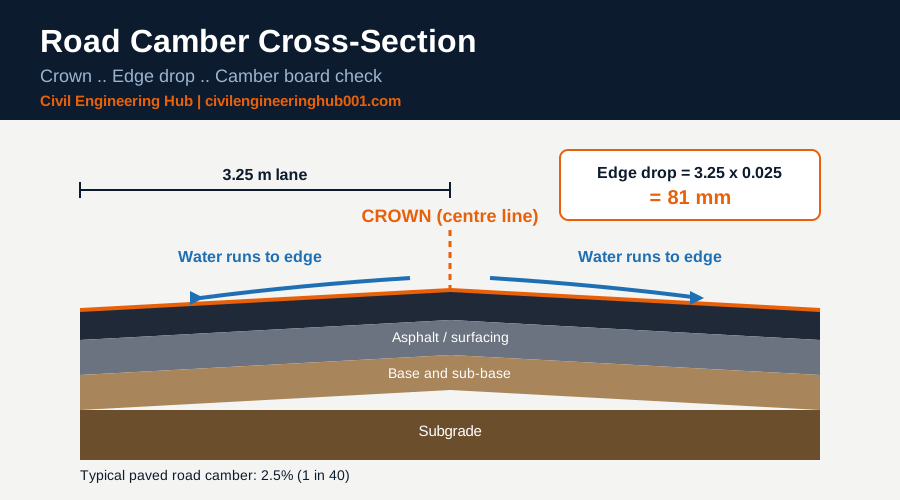
Camber is the transverse slope of a road surface, measured across the carriageway from the centre line to the edge. On a two-way road the crown sits at the centre and the surface falls away on both sides.
Crossfall is the broader term for any slope across the road. On a straight section with a crown we call it camber. On a bend, the whole carriageway tilts in one direction and that tilt is called superelevation, which also helps vehicles hold the curve. The Kenya Road Design Manual (Part 1, Geometric Design of Rural Roads) covers both.
Honestly.. many site teams use the words interchangeably, and that is fine in conversation. What matters is that the drawing, the setting out and the finished surface all agree on one number.
| Camber shape | Where it is used | Site note |
|---|---|---|
| Straight-line (two-slope) | Most paved roads and urban streets | Easy to set out with a camber board and string line |
| Parabolic | Older roads and some wide highways | Flatter at the crown, steeper at the edges, harder to build accurately |
| One-way crossfall | Dual carriageways, ramps, bends | Whole surface tilts one way, drains to one side drain |
What camber rates are used for different road surfaces in Kenya?
The right camber depends on how quickly water can soak into the surface. A tight bituminous surface sheds water easily, so it needs less slope. A gravel road is rougher and more porous, so it needs more slope to move water before it softens the wearing course.
The figures below reflect typical values used on Kenyan projects under the Kenya Road Design Manual and the Standard Specification for Road and Bridge Construction. Always confirm the exact rate in your project drawings and specification.
| Surface type | Typical camber | Ratio |
|---|---|---|
| Bituminous (asphalt or surface dressing) | 2.5 percent | 1 in 40 |
| Concrete pavement | 2 percent | 1 in 50 |
| Gravel wearing course | 4 percent | 1 in 25 |
| Earth road | 4 to 5 percent | 1 in 25 to 1 in 20 |
| Shoulders | Slightly steeper than the carriageway | Per drawings |
How is camber set out and checked on site?
Camber is only as good as the setting out behind it. Because the slope is so gentle, a small error in levels shows up as a big error in drainage. A 20 mm mistake across a 3.25 m lane can turn a 2.5 percent fall into a 1.9 percent fall.
The calculation is simple. Drop at the edge equals the distance from the crown multiplied by the camber rate. For a 6.5 m carriageway with two 3.25 m lanes at 2.5 percent, the edge sits 3.25 x 0.025 = 81 mm below the crown.
| Step | What to do | Tool |
|---|---|---|
| 1 | Fix the centre line and edge pegs from the survey control | Total station or level |
| 2 | Calculate the design level at crown, lane edge and shoulder | Drawings and long section |
| 3 | Set profile boards or string lines at each station | Pegs, string, level |
| 4 | Trim and shape each layer to the profile before compaction | Grader with operator |
| 5 | Check the cross-section with a camber board and spirit level | Camber board |
| 6 | Record levels and get the engineer to sign off before the next layer | Inspection form |
Check camber at every layer, not only at the final surface. If the subgrade and base carry the correct slope, the wearing course follows without needing extra thickness on one side. Most Kenyan specifications allow only a small tolerance on finished levels, so read the contract specification before the grader operator starts.
What happens when camber is too flat or too steep?
Both extremes cause trouble. Too flat and water lingers. Too steep and the road becomes uncomfortable and unsafe for heavy vehicles, especially loaded trucks on the Mombasa Road or Northern Corridor.
| Problem | Too flat | Too steep |
|---|---|---|
| Drainage | Water ponds on the surface | Water runs fast and erodes shoulders |
| Pavement life | Water enters cracks, base softens, potholes form | Edge wear and rutting on the low side |
| Vehicles | Aquaplaning risk in heavy rain | Vehicles drift to the edge, trucks feel unstable |
| Cost | Early rehabilitation | Extra material to reach the crown level |
In black cotton soil areas, which are common across parts of Nairobi, Kisumu and the Rift Valley, poor camber is even more costly. Water that reaches the subgrade makes the soil swell, and the road then ripples and cracks along the wheel paths.
What are the most common camber mistakes on Kenyan sites?
After years of watching roads fail early, the same mistakes keep appearing. None of them need advanced engineering to avoid. They need discipline and a clear handover between the engineer, the surveyor and the machine operator.
- Trimming by eye. A grader operator working without profile boards will drift from the design slope within a few stations.
- Checking only the final surface. By then the error is already built into the base and cannot be fixed cheaply.
- Forgetting the shoulders. If the shoulder is flatter than the carriageway, water stays on the pavement edge, which is the weakest part of the road.
- Ignoring tie-ins. Where a new section meets an existing road, the camber must blend smoothly, otherwise water ponds at the joint.
- Skipping the rain test. After the first heavy rain, walk the road. Standing water shows exactly where the levels are wrong.
A short walk after rain is one of the best free inspections you can do. It costs nothing, and it shows problems that a level reading can miss.
How does camber work together with drains, shoulders and culverts?
Camber only moves water to the edge. After that, the shoulder, side drain and culvert must carry it away. If the edge is higher than the surrounding ground, or the side drain is blocked, the water has nowhere to go and the camber is wasted.
On site, the foreman should confirm four things before the final surface goes down: the shoulder falls away from the carriageway, the side drains are clear and have a positive gradient, mitre drains lead water off the formation, and culvert inlets sit at the correct level.
Compaction matters just as much. A well compacted base holds its shape, while a loose layer settles unevenly and flattens the camber over time. That is why quality control on earthworks and base layers is part of drainage, not a separate topic.
Frequently Asked Questions
Q: What is the standard camber for a paved road in Kenya?
Most paved roads use about 2.5 percent, which is 1 in 40. Concrete roads are often a little flatter at 2 percent. The exact figure is always set by the project drawings and the Kenya Road Design Manual, so confirm it before setting out.
Q: Can camber be corrected after the road is built?
Yes, but it is expensive. Minor errors can be corrected with a levelling course of asphalt or by regravelling and reshaping on gravel roads. Large errors usually need milling or reconstruction, which is why checking camber at every layer is far cheaper.
Q: Is camber the same as superelevation?
No. Camber slopes both ways from the crown on straight sections to shed water. Superelevation tilts the whole carriageway toward the inside of a bend to counter the sideways force on vehicles. On curves, the camber is replaced by superelevation, with a transition length between the two.
Conclusion: Get camber right and the road looks after itself
Camber is a small slope with a big job. A correct 2.5 percent fall keeps water off the pavement, protects the base and subgrade, and gives the road years of extra life.
The lesson for every site team is to calculate it, set it out carefully, check it at every layer and keep the drains clear. Honestly.. that is cheaper than any repair. Whether you are an engineer, surveyor, foreman or grader operator, you own a piece of this result.
Want more practical construction knowledge delivered directly to you?
Subscribe to our YouTube channel: https://www.youtube.com/@TheCivilEngineeringHub-001
PS: Join our engineering WhatsApp community for daily learning at +254731393520