

Almost every construction project changes course before it is complete. A client wants an extra room, a soil test reveals different ground conditions, or a design clash forces a redesign mid build. These changes are called variations, and how they are valued determines whether a contractor gets paid fairly or a client ends up overcharged.
In simple terms, a variation is any change to the original scope of work instructed after the contract has been signed. Understanding how variations are valued protects everyone on the project, from the quantity surveyor preparing the valuation to the civil engineer, architect, or site supervisor executing the change on the ground.
This guide breaks down what counts as a variation, how it gets valued under Kenyan construction practice, and what every professional on site needs to confirm before signing off on one.
Quick Answer: A variation is a change instructed to the original contract scope. It is valued first using the rates already priced in the Bill of Quantities where similar work exists, and only when no comparable rate exists does the team move to a fair new rate through dayworks or a pro rata calculation.
What Is a Variation in a Construction Contract?
A variation is any addition, omission, or change to the works described in the original contract documents. It can be an extra column added to a structural design, a change in tile finish requested by the client, or the removal of a section of drainage that turned out unnecessary.
The truth is, a variation only becomes valid once it is instructed in writing by the person with authority to do so under the contract. This is usually the architect, the project’s lead consultant, or the resident engineer, depending on how the contract is structured. Under the Joint Building Council (JBC) Conditions of Contract, which most private building projects in Kenya are built on, verbal instructions carry real risk. A contractor who executes a change based on a verbal instruction alone may struggle to recover payment later if it is disputed.
What Causes Variations on Site?
Variations are rarely random. In practice, they trace back to a handful of recurring causes.
Design changes requested by the client after construction has started are the most common. Unforeseen ground conditions, such as soft spots or rock encountered during excavation, come next, especially on sites where geotechnical investigation was limited. Discrepancies between architectural, structural, and MEP drawings also force variations once the clash is discovered on site rather than at design stage.
Statutory or regulatory changes, updated fire safety requirements or county planning conditions, can equally trigger a variation. Honestly, the earlier a team catches a coordination issue, the cheaper the variation. A clash caught at design review costs a redline. The same clash caught after concrete has been cast costs a demolition and a delay claim.
How Are Variations Valued?
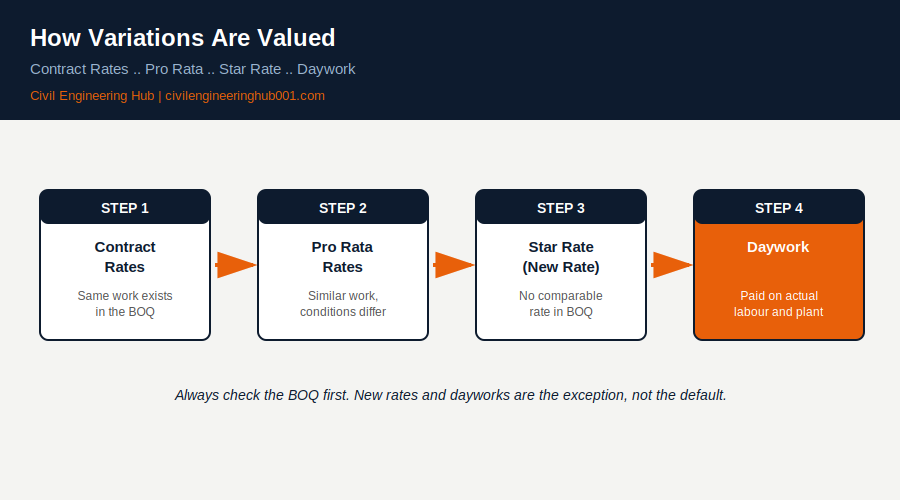
Valuation follows a clear order of priority, not a random negotiation between contractor and client. Most standard forms of contract used in Kenya, including JBC and FIDIC based agreements common on larger infrastructure works, apply the same logic in this order.
| Method | When It Applies | How It Works |
|---|---|---|
| Contract rates | Work of the same character and conditions exists in the priced Bill of Quantities | The existing BOQ rate is applied directly to the varied quantity |
| Pro rata rates | Similar work exists but conditions differ, such as increased height or depth | The nearest BOQ rate is adjusted up or down to reflect the changed conditions |
| Star rate (new rate) | No comparable rate exists anywhere in the BOQ | A new rate is built from first principles, covering materials, labour, plant, and overheads |
| Daywork | Work cannot be measured properly, such as emergency repair or investigative work | Paid on actual labour hours, plant hours, and materials used, plus an agreed percentage for overhead and profit |
In simple terms, the quantity surveyor always checks the BOQ first. Star rates and dayworks are the exception, not the default, and both sides should agree on the rate before the work proceeds wherever that is practically possible.
The Variation Process, From Instruction to Payment
A variation that is properly documented protects both the contractor and the client. Skipping steps is where most payment disputes begin.
| Step | Action | Responsible Party |
|---|---|---|
| 1 | Issue a written variation instruction describing the change | Architect or lead consultant |
| 2 | Assess the cost and time impact before work starts | Quantity surveyor |
| 3 | Confirm the rate to be applied and record it in writing | Quantity surveyor and contractor |
| 4 | Execute the varied work and keep site records or dayworks sheets | Contractor and site supervisor |
| 5 | Include the valued variation in the next interim payment certificate | Quantity surveyor |
Site supervisors carry more weight in this process than they often realise. A daywork sheet signed on the day work happens is far stronger evidence than a recollection weeks later during a dispute.
What Do Kenyan Contracts Say About Variations?
On private developments, the JBC Conditions of Contract remain the reference most quantity surveyors and architects in Kenya work from. It sets out who can instruct a variation, the timeframe for the contractor to raise concerns, and the default valuation hierarchy described above.
On public projects, the Public Procurement and Asset Disposal Act adds another layer. Variations on government funded works usually require approval before a specified threshold is exceeded, and procuring entities must justify any variation against the original tender scope. On larger infrastructure contracts, particularly those following FIDIC based conditions used by agencies such as KeNHA, the same principle of engineer’s instruction plus documented valuation applies, just with more formal notice periods attached.
Whatever form of contract is in use, the underlying discipline does not change. No instruction, no valuation, no payment. Every professional on the project, not just the quantity surveyor, has a stake in getting that discipline right.
Frequently Asked Questions
Q: Can a contractor refuse to carry out a variation?
Yes, in most standard contracts a contractor can object to a variation if it substantially changes the nature of the works or if it was instructed by someone without the authority to do so. The contractor should raise the objection in writing immediately rather than proceeding and disputing payment later.
Q: What happens if a variation is done without written instruction?
The contractor carries significant risk. Without a written instruction, the client or consultant can argue the work was never authorised, which makes recovering payment difficult even if the work genuinely benefited the project. Always insist on paper trail before mobilising for extra work.
Q: Do variations always increase the contract sum?
No. A variation can be an omission, which reduces the contract sum, just as easily as it can be an addition. Both are valued using the same hierarchy of contract rates, pro rata rates, or new rates, and both must be documented the same way.
The Takeaway
Variations are a normal part of construction, not a sign that something has gone wrong. What separates a smooth variation from a payment dispute is discipline: a written instruction, a rate agreed before work starts, and records kept as the work happens.
Whether you sit in the quantity surveyor’s office, on the architect’s drawing board, or on site running the works, understanding this process protects your side of the project. Build the habit of documenting every change from day one, and variations will never catch your project off guard.
Want more practical construction knowledge delivered directly to you?
Subscribe to our YouTube channel: https://www.youtube.com/@TheCivilEngineeringHub-001
PS: Join our engineering WhatsApp community for daily learning at +254731393520