 Civil


A site safety inspection is the single habit that separates well-run sites from the ones that end up in the news. Most accidents on Kenyan construction sites do not come from rare, unpredictable events. They come from the same handful of hazards.. open edges, unsupported trenches, poor scaffolding and unguarded machines.. that nobody stopped to check.
In simple terms.. a site safety inspection is a planned walk-through of the site where you look for hazards, check them against a standard, record what you find and make sure someone fixes it before work continues. Under the Occupational Safety and Health Act 2007, the contractor and the occupier carry a legal duty to identify and control these risks.
This guide is for the whole site team. Site supervisors and foremen run the inspections, but engineers, masons, electricians, plumbers and QS teams all work inside the same hazards, so everyone should know what a good inspection looks like.
Quick Answer: To conduct a site safety inspection, prepare a checklist based on OSHA 2007 and your site risk assessment, walk the whole site zone by zone, record every hazard with its location and risk level, assign a responsible person and deadline for each correction, then follow up to confirm it was closed.
Why Site Safety Inspections Are a Legal Duty in Kenya
The truth is.. many sites treat safety inspections as paperwork for the client. In Kenya they are a legal requirement. The Occupational Safety and Health Act 2007 (OSHA 2007) requires every occupier to provide a safe workplace, carry out risk assessments and take steps to remove or control the hazards identified.
Construction sites are also covered by the Building Operations and Works of Engineering Construction Rules (Legal Notice 40 of 1984). These rules set specific requirements for scaffolds, excavations, lifting equipment, ladders and working at height. The Directorate of Occupational Safety and Health Services (DOSHS) enforces both.
| Requirement | Source | What It Means on Site |
|---|---|---|
| Provide and maintain a safe workplace | OSHA 2007 | The contractor must actively find and control hazards |
| Carry out risk assessments | OSHA 2007 | Inspections must be based on a documented site risk assessment |
| Report serious accidents to DOSHS | OSHA 2007 | Fatal accidents are reported within 24 hours, with written notice to follow |
| Safety and health committee | Safety and Health Committees Rules 2004 | Required where 20 or more workers are employed |
| Scaffold, excavation and lifting checks | LN 40 of 1984 | Specific items must be inspected by a competent person |
Honestly.. when an accident happens, the first document an investigator asks for is your inspection record. If there is no record, the assumption is that no inspection happened.
What You Need Before You Start the Inspection
A good inspection starts at the desk, not on the scaffold. Walking the site without preparation means you only notice what is obvious, and you miss the hazards that matter most for today’s activities.
Before you walk out, gather these items:
- The site risk assessment and method statements for the work happening today, so you know which hazards to expect.
- A checklist built around your site activities.. excavation, concreting, formwork, roofing, electrical installation.
- The previous inspection report, so you can confirm earlier issues were closed.
- Your own PPE.. helmet, reflective vest, safety boots, gloves and eye protection. An inspector without PPE loses credibility immediately.
- A phone or camera to photograph hazards, plus a notebook or digital form.
Also check the programme. If the slab pour is today, focus on formwork, falsework, edge protection and concrete pump positioning. If the electrician is running temporary supply, focus on distribution boards and cable routing.
How to Conduct the Inspection Step by Step
The best inspections follow a fixed route and a fixed process. That way, nothing depends on memory or mood. Use the sequence below on every walk-through.
| Step | Action | Practical Tip |
|---|---|---|
| 1 | Start at the site entrance | Check gate control, signage, the visitor register and the first aid point |
| 2 | Walk the site zone by zone | Use the same route each time.. perimeter, ground level, then each floor upwards |
| 3 | Observe people before conditions | Are workers wearing PPE and working as the method statement says? |
| 4 | Check conditions against the checklist | Edges, openings, scaffolds, trenches, machines, electrical, housekeeping |
| 5 | Rate each hazard | High, medium or low, based on likelihood and severity |
| 6 | Stop work where the risk is high | Do not wait for the report. Make the area safe first |
| 7 | Photograph and record | Location, hazard, risk level, responsible person, deadline |
| 8 | Brief the foreman and trades | Share findings at the toolbox talk or end of the walk |
| 9 | Follow up and close out | Revisit each item and sign it off only when it is physically fixed |
Step 3 is where most inspectors fall short. Conditions can look fine while people are working unsafely. A guardrail is useless if a worker removes it to pass materials and never puts it back.
The Key Hazard Areas Every Inspector Must Check
Every site is different, but the hazards that cause serious injuries on Kenyan building sites are very consistent. Focus your attention where the consequences are worst.
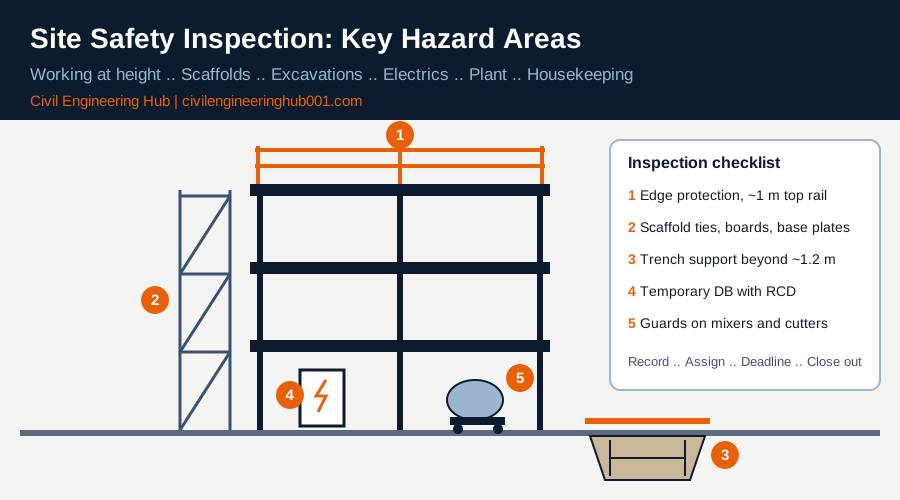
Working at height. Check edge protection on slabs, covers over floor openings and stair voids, scaffold condition and ladder use. Guardrails should have a top rail at about 1 metre, a mid rail and a toe board. Scaffolds must be inspected by a competent person before first use, at regular intervals and after heavy rain or strong wind.
Excavations. Trenches deeper than about 1.2 metres need support, battering or stepping. Check that spoil and materials are kept back from the edge, that there is safe access by ladder and that barriers stop people and vehicles falling in.
Plant and machinery. Check that operators are trained, reversing alarms work, banksmen are used, and guards are in place on concrete mixers, poker vibrators and bar cutting machines.
Electrical safety. Temporary supply should run through a proper distribution board with RCD protection. Look for damaged cables, joints taped with no proper connectors and cables lying in water.
Housekeeping and materials. Projecting rebar should have caps. Nails in formwork timber, blocked access routes and poorly stacked blocks or cement bags are everyday causes of injury.
| Hazard Area | What to Look For | Trades Most Exposed |
|---|---|---|
| Slab edges and openings | Missing guardrails, uncovered shafts and voids | Masons, formwork carpenters, steel fixers |
| Scaffolding | Missing ties, bad base plates, incomplete boards | Masons, plasterers, painters |
| Excavations | No support, spoil at edge, no access ladder | Plumbers, labourers, civil crews |
| Temporary electrics | No RCD, damaged cables, overloaded sockets | Electricians and all trades using power tools |
| Plant and machinery | No guards, untrained operators, no banksman | Operators, labourers, steel fixers |
| Housekeeping | Exposed rebar, nails, blocked walkways | Everyone on site |
How to Record Findings and Make Sure They Get Fixed
An inspection that ends in a notebook achieves nothing. The real value is in the close-out. Every finding needs four things: a clear description, a location, a responsible person and a deadline.
Write findings so that someone who was not on the walk can act on them. “Poor scaffolding” is useless. “Block B east elevation, second lift.. two scaffold boards missing and no toe board. Foreman Otieno to fix before 2 pm” is a finding that gets closed.
Keep a simple tracker with columns for date, location, hazard, risk rating, action, responsible person, deadline and status. Review it at the weekly site meeting. If the same hazard keeps appearing, the problem is not the worker.. it is the system, the method statement or the supervision.
How Often Should Site Safety Inspections Happen
Frequency depends on the risk and the stage of the project. As a working rule on most Kenyan building sites:
- Daily: a quick walk by the site supervisor or foreman before work starts, focused on today’s activities.
- Weekly: a formal documented inspection covering the whole site, often done with the safety officer.
- Before first use and after bad weather: scaffolds, excavations and falsework.
- After any change: new plant, a new subcontractor or a new stage such as roofing.
- Annually: OSHA 2007 also requires a safety and health audit of the workplace by an approved auditor.
Remember that inspection is not only the safety officer’s job. Engineers checking reinforcement, QS teams measuring work and electricians testing circuits all walk the site. Train them to report hazards as they see them.
Frequently Asked Questions
Q: Who is responsible for site safety inspections in Kenya?
The main contractor, as the occupier of the site, carries the legal duty under OSHA 2007. In practice, the site supervisor or safety officer runs the inspections, while foremen handle daily checks in their areas. The consultant team and client may also inspect, but this does not remove the contractor’s responsibility.
Q: What is the difference between a safety inspection and a safety audit?
An inspection is a frequent, practical check of physical conditions and work practices on site. An audit is a deeper review of the whole safety management system, including policies, training records, risk assessments and incident records. In Kenya, OSHA 2007 requires an annual audit by an approved safety and health auditor.
Q: Can a site supervisor stop work during an inspection?
Yes. Where there is an imminent risk of serious injury, the supervisor should stop that activity immediately and make the area safe. Stopping work for ten minutes costs far less than an accident, a DOSHS investigation or a prohibition notice on the whole site.
Conclusion
A site safety inspection is not about catching people out. It is about finding the hazard before it finds someone. Prepare with the risk assessment, walk the site on a fixed route, watch people as well as conditions and record every finding with a name and a deadline.
Most importantly, close the loop. A hazard is only controlled when it is physically fixed and signed off. Build this habit as a student or intern and you will become the kind of site professional every contractor wants on their team.
Want more practical construction knowledge delivered directly to you?
Subscribe to our YouTube channel: https://www.youtube.com/@TheCivilEngineeringHub-001
PS: Join our engineering WhatsApp community for daily learning at +254731393520