 Civil


Walk onto any site in Nairobi at 7am and you will see it.. engineers checking drawings, a foreman allocating gangs, masons already laying blocks, a quantity surveyor measuring work in the corner. It looks busy, but a well-run site is an organised system where every person has a defined role.
The truth is, most site problems do not start with bad materials. They start with unclear roles. When nobody knows who approves, who instructs and who is accountable, work gets repeated, defects slip through and money is lost.
In simple terms, a construction site runs on three layers: the client side that owns and funds the project, the design and supervision team that defines and checks quality, and the contractor side that actually builds. Knowing which layer each person sits in is the first step to working well on any project.
This guide explains who does what, who reports to whom, and how Kenyan law shapes these roles, whether you are a student on attachment, a young engineer or an artisan.
Quick Answer: The roles on a construction site are split between the client, the consultants (architect, engineers, quantity surveyor) who design and supervise, and the contractor team (project manager, site agent, foremen and artisans) who build. Each role has defined duties, and the chain of instruction must flow through the right person.
Who are the main parties on a construction project in Kenya?
Every project, from a small maisonette in Kitengela to a KeNHA road contract, involves three groups. The client pays and approves. The consultants design, supervise and certify. The contractor builds and takes responsibility for the works until handover.
Honestly, many young engineers mix these up in their first month on site. Here is the simple breakdown.
| Party | Main Duty | Typical Members |
|---|---|---|
| Client (Employer) | Funds the project, approves design and variations, pays certificates | Developer, county government, private owner |
| Consultants | Design, supervise, measure and certify the works | Architect, structural engineer, MEP engineer, quantity surveyor |
| Main Contractor | Builds according to drawings, specifications and the contract | Project manager, site agent, foremen, artisans, labourers |
| Subcontractors | Execute specialist packages under the main contractor | Electrical, plumbing, lifts, roofing, ceiling and finishing firms |
The architect is usually the lead consultant and the contract administrator. That means formal instructions to the contractor normally come through the architect or the supervising engineer, not through the client directly.
What does each professional actually do on site every day?
Job titles are one thing. Daily duties are what keep a project moving. The table below shows the core responsibility of each key role, the document they work with most, and who they report to.
| Role | Core Responsibility | Key Document | Reports To |
|---|---|---|---|
| Architect | Design intent, contract administration, issuing instructions | Architectural drawings, schedules | Client |
| Structural Engineer | Structural design, inspection of reinforcement and formwork before concreting | Structural drawings, bar schedules | Client or Architect |
| Quantity Surveyor | Measures work, values variations, prepares payment certificates | BOQ, valuations | Client |
| Project Manager | Overall delivery: time, cost, quality and safety | Programme, budget | Contractor director |
| Site Agent or Site Engineer | Runs daily site operations, setting out, quality checks and records | Site diary, method statements | Project Manager |
| Foreman | Directs gangs, allocates tasks, checks workmanship | Working drawings, daily task list | Site Agent |
| Mason, Carpenter, Steel Fixer, Tiler | Skilled execution of the physical work | Drawings as explained by the foreman | Foreman |
| Safety Officer | Hazard control, toolbox talks, incident records | Risk assessments, safety file | Project Manager |
Notice something important. The structural engineer inspects reinforcement before pouring, but the foreman is the person who makes sure the inspection is requested at the right time. If that link breaks, concrete gets poured without approval and the whole slab can be questioned later.
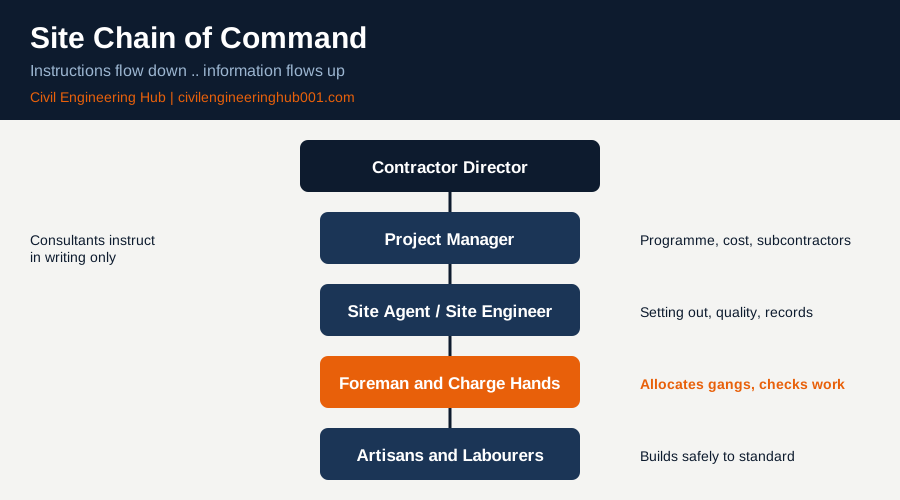
How does the chain of command work from the director to the labourer?
Instructions on site should flow downward in a clear order, and information should flow upward in the same order. Skipping a level is the fastest way to create confusion.
A mason who takes instructions from three different people will build three different things. Here is how a typical contractor team is arranged.
| Level | Position | Typical Decision Authority |
|---|---|---|
| 1 | Contractor Director | Contract terms, resources, major claims |
| 2 | Project Manager | Programme, subcontractor appointments, cost control |
| 3 | Site Agent or Site Engineer | Daily planning, setting out, approving workmanship |
| 4 | Foreman and Charge Hands | Gang allocation, task sequencing, material requests |
| 5 | Artisans and Labourers | Executing the task safely to the required standard |
On the consultant side, the same discipline applies. The contractor takes instructions only from the architect or engineer in writing. A verbal instruction from the client on a Saturday visit should be confirmed in writing before any extra work starts, because that is what protects the contractor and the QS when the variation is valued.
What do Kenyan laws and standards say about site roles?
Roles on a Kenyan site are not just habits. They are backed by regulation, and knowing the framework makes you more credible on site.
- National Construction Authority Act, 2011: contractors must be registered with the NCA in the right category, and projects are registered with the Authority.
- Engineers Act, 2011: engineers must be registered with the Engineers Board of Kenya to practise and sign off designs.
- Architects and Quantity Surveyors Act: architects and quantity surveyors register with the Board of Registration of Architects and Quantity Surveyors.
- Occupational Safety and Health Act, 2007: the occupier of a workplace must provide a safe site, and construction sites should be registered as workplaces with the Directorate of Occupational Safety and Health Services.
- Building Code and county by-laws: require approved drawings and inspections at defined stages by the county.
In practice, this means a supervisor should always ask three questions. Is the contractor registered? Are the drawings approved? Is the site compliant on safety? If any answer is no, raise it early.
How should students and young engineers fit into these roles?
If you are on attachment or just starting out, you will usually sit between the site engineer and the foreman. That is a powerful position, because you learn from both the paperwork side and the practical side of the job.
Here is how to use it well:
- Learn the drawings first, then walk the site and match what you see to what is drawn.
- Ask the foreman why a task is done a certain way. Site practice often carries lessons that textbooks skip.
- Keep your own notebook of instructions, quantities and dates. It becomes your evidence and your learning record.
- Respect the artisans. A good mason or steel fixer has years of practical knowledge, and the relationship you build now will help you manage teams later.
The best site engineers are not the ones who shout the loudest. They are the ones who understand every role well enough to coordinate them all.
What are the most common role mistakes on site and how do you avoid them?
After enough site visits, the same mistakes keep repeating. They are all fixable once you know where to look.
- Artisans taking instructions from several people. Route every instruction through the foreman so one person owns the task.
- Verbal changes without records. Write it down, send it, file it. The site diary and instruction register exist for this reason.
- Skipping inspection hold points. Always request the engineer’s inspection before concreting, backfilling or covering services.
- Safety treated as one person’s job. The safety officer coordinates, but every supervisor and foreman is responsible for their gang.
- Subcontractors working without coordination. The site agent must sequence trades so electricians, plumbers and tilers do not damage each other’s work.
A simple habit helps. Before starting any task, ask: who gives the instruction, who does the work, who checks it and who records it? If you cannot answer all four, the role is unclear and trouble is coming.
Frequently Asked Questions
Q: What is the difference between a site agent and a project manager?
A project manager looks after the whole project: programme, budget, subcontractors and client relations. A site agent focuses on daily site operations, setting out, supervision and quality records. On smaller projects one person may do both jobs, but on larger ones the project manager sits above the site agent.
Q: Who is allowed to give instructions to the contractor?
Formal instructions come from the architect or the supervising engineer acting as contract administrator, usually in writing. The client can express wishes, but these should be passed through the consultant so cost and time effects are assessed. This protects both the client and the contractor.
Q: Is a foreman the same as a site engineer?
No. A site engineer is a trained professional who plans, sets out and checks work against drawings and specifications. A foreman usually rises through the trades and directs gangs on the ground. Both are essential, and the best sites have them working closely together.
Conclusion: clear roles build better buildings
Every strong site has one thing in common. People know their role, respect the next person’s role and communicate through the right channel. Learn these roles early and you will earn trust faster, avoid costly disputes and grow into leadership.
Whether you are an engineer, architect, QS, mason, electrician or plumber, your work only succeeds when the whole team does. Start by knowing who you report to and who reports to you.
Want more practical construction knowledge delivered directly to you?
Subscribe to our YouTube channel: https://www.youtube.com/@TheCivilEngineeringHub-001
PS: Join our engineering WhatsApp community for daily learning at +254731393520