 Civil


Every month, someone on a Kenyan site asks the same question: when is the money coming? The answer usually sits in one document.. the interim payment certificate. Get it right and project cash flow stays healthy. Get it wrong and you end up with disputes, late payments and suppliers who stop delivering materials.
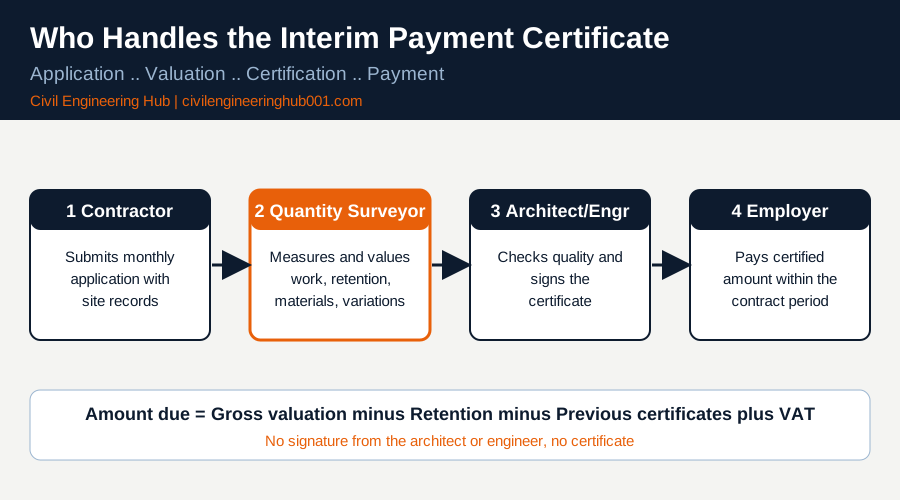
An interim payment certificate (IPC) is a document issued during construction that states how much the employer must pay the contractor for work done up to a given date, after deducting retention and the amounts already paid. The quantity surveyor prepares the valuation, and the architect or engineer certifies it.
In simple terms, it is a monthly bill that has been checked against what is actually built on site. In this guide you will learn who does what, what to check before valuing, the exact calculation steps, and the mistakes that cause payment disputes on Kenyan projects.
Quick Answer: To prepare an interim payment certificate, measure the work done to date, add approved materials on site and valued variations, deduct retention and previous payments, then add VAT. The architect or engineer certifies the amount for the employer to pay.
What is an interim payment certificate and who is responsible for it?
The truth is, an IPC is not one person’s document. It passes through several hands, and each one has a defined job under the contract. Most building contracts in Kenya use the Agreement and Schedule of Conditions of Building Contract, or the PPRA standard tender documents on public projects. The payment clauses and time limits are set out in the contract Appendix, so always read it before the first valuation.
| Party | Role in the IPC process |
|---|---|
| Contractor | Submits the monthly application with measured quantities and supporting records |
| Quantity Surveyor | Measures and values the work, prepares the valuation and the certificate calculation |
| Architect or Engineer | Confirms the work is complete to standard and issues the certificate |
| Employer | Pays the certified amount within the period stated in the contract |
Honestly, the QS carries most of the workload. But the certificate has no legal weight until the architect or engineer signs it, so the contractor should never treat a QS valuation as an approved payment.
What must you check on site before valuing the work done?
A valuation done from the office is a guess. The best QSs walk the site with the foreman before they open the BOQ, because the numbers on paper must match the concrete, blockwork and pipes on the ground.
Before you value anything, collect the records below. If one is missing, the item is likely to be questioned at certification.
| Document or check | Why it matters |
|---|---|
| Priced Bill of Quantities | Gives the rates used to value every measured item |
| Previous certificate | Shows the amount already paid so nothing is paid twice |
| Site measurements and dayworks sheets | Proves the quantity of work actually executed |
| Concrete cube results and test reports | Confirms the work meets the specification before it is paid for |
| Delivery notes for materials on site | Supports any claim for unfixed materials |
| Signed variation orders | Only instructed changes can be added to the valuation |
Here is a mistake we see often. A contractor claims 100 percent of a slab, but the cube tests at 28 days have not been signed off. In that case the architect or engineer can hold back the value until the quality record is complete. Think of it as the site engineer’s paperwork protecting the contractor’s payment.
Also confirm that the work is in the right place. Item numbers in the BOQ must match what is on the drawings, otherwise the same wall can be claimed under two different bills.
How do you calculate an interim payment certificate step by step?
The calculation follows the same order every month. Once you learn the sequence, any IPC becomes routine, whether the contract is KES 5 million or KES 500 million.
| Step | Action |
|---|---|
| 1 | Value work executed to date from measured quantities and BOQ rates |
| 2 | Add preliminaries pro rata to progress or as the contract allows |
| 3 | Add materials on site that are properly stored and approved |
| 4 | Add the value of approved variations |
| 5 | Deduct retention at the percentage in the Appendix |
| 6 | Deduct the total of all previous certificates |
| 7 | Add VAT at 16 percent on the amount due |
Let us run a worked example. A contractor has a KES 24,000,000 contract with 5 percent retention. The substructure is 100 percent complete at KES 3,600,000. The superstructure is 60 percent complete, valued at KES 5,400,000 from a KES 9,000,000 bill. Preliminaries at 35 percent come to KES 840,000.
| Item | Amount (KES) |
|---|---|
| Work executed to date (substructure, superstructure, preliminaries) | 9,840,000 |
| Materials on site | 650,000 |
| Approved variations | 320,000 |
| Gross valuation | 10,810,000 |
| Less retention at 5 percent | (540,500) |
| Net valuation | 10,269,500 |
| Less previous certificates | (6,200,000) |
| Amount due before VAT | 4,069,500 |
| VAT at 16 percent | 651,120 |
| Total payable on this certificate | 4,720,620 |
Notice that retention is taken from the full gross valuation each time, not just from the new work. That is why you deduct previous certificates afterwards.
How are materials on site, retention and variations treated in an IPC?
These three items cause the most arguments, so it helps to know the rule for each before the valuation meeting.
Materials on site. Most conditions allow payment for unfixed materials only when they are reasonably needed for the works, delivered to site and stored safely against theft and weather. Cement left in the rain or steel dumped in mud will not be certified. Take photos and attach the delivery notes.
Retention. Retention is money held back as security for defects. It is commonly 5 to 10 percent, with a cap stated in the Appendix. Half is usually released at practical completion and the balance after the defects liability period, so the contractor should diarise both dates.
Variations. Only work covered by a written instruction from the architect or engineer is valued. If the site team builds an extra wall on a verbal instruction, the QS has nothing to certify.
| Item | Added or deducted | Key condition |
|---|---|---|
| Materials on site | Added | Delivered, stored properly and approved |
| Variations | Added | Written instruction on file |
| Retention | Deducted | Percentage and cap as in the Appendix |
| Previous payments | Deducted | Total of all earlier certificates |
What mistakes delay interim payment certificates on Kenyan sites?
Most delays are not caused by the employer. They come from small errors in the valuation that force the architect or engineer to send it back.
- Over-valuing incomplete work. Claiming 100 percent of plastering when only the ground floor is done invites a rejection of the whole valuation.
- Missing quality records. No cube results, no test certificates, no payment for that element.
- Arithmetic and carry-forward errors. Always copy the previous certificate total exactly. A single wrong figure is repeated in every later certificate.
- Forgetting VAT or applying it wrongly. Check whether the project is subject to withholding rules from KRA and show them clearly.
- Late submission. Contracts set dates for application and certification. Miss them and the payment slips by a full month.
A practical tip: agree the measured quantities jointly on site with the contractor’s surveyor before the certificate is drafted. Disputes are cheaper to settle at a wall than in an email thread three weeks later.
How do you keep your valuations accurate month after month?
Accuracy is a habit, not a one-off effort. The QS who keeps a simple running record of measured quantities for every BOQ item rarely has a certificate returned. Set up a valuation workbook in Excel with one row per BOQ item, columns for previous quantity, current quantity and percentage complete, and let the formulas carry the totals forward.
Reconcile the valuation against the contractor programme each month. If the programme shows the roof should be 40 percent complete but the valuation shows none, one of the two is wrong, and it is better to find out before the architect does.
Finally, file a copy of every certificate with its supporting measurements. When the final account is prepared months later, that folder will save days of rework. In Kenya, where projects often change hands between consultants, a clean paper trail also protects you if a dispute reaches adjudication.
Frequently Asked Questions
Q: How often is an interim payment certificate issued?
Most building contracts in Kenya provide for monthly certificates, although the exact interval is set in the contract Appendix. Some projects use stage payments tied to completed milestones instead. Always check which method your contract uses before you plan cash flow.
Q: Can the contractor be paid for materials not yet fixed?
Yes, if the conditions of contract allow it and the materials are delivered, stored well and approved by the architect or engineer. Many contracts exclude perishable or poorly protected items. The QS should list them separately in the valuation so the certifier can review each one.
Q: What happens if the employer does not pay a certified amount?
The contract usually allows the contractor to charge interest on late payment and, after notice, to suspend works. The exact steps and notice periods are written in the payment clauses. Serious disputes can go to adjudication or arbitration, so keep every certificate and notice on file.
Conclusion: Treat the IPC as a record, not just a bill
A good interim payment certificate protects everyone on the project. The contractor gets paid for what is genuinely built, the employer pays only for verified work, and the QS leaves a clear paper trail for the final account.
Walk the site, check your records, follow the seven steps in order, and submit on time. Do that every month and payment disputes become the exception.
The takeaway is simple.. accurate measurement plus complete paperwork equals faster payment.
Want more practical construction knowledge delivered directly to you?
Subscribe to our YouTube channel: https://www.youtube.com/@TheCivilEngineeringHub-001
PS: Join our engineering WhatsApp community for daily learning at +254731393520