 Civil


A site meeting is only as good as the actions it produces. If everyone leaves with a clear list of who is doing what by when, the meeting worked. If people leave talking about the same problems they brought in, it was an expensive tea break.
The truth is, most site meetings fail before they start. There is no agenda, the wrong people are in the room, and nobody writes down what was agreed. On a live project in Kenya, that means a missed concrete pour, a drawing clarification that sits for three weeks, or a subcontractor who “never heard” about the instruction.
In simple terms, an effective site meeting is a short, structured, decision-focused session where the contractor, consultants and trades review progress, close out old actions, raise new issues and leave with owners and deadlines recorded in minutes.
Quick Answer: To run an effective site meeting, issue an agenda in advance, start with the previous actions, keep to a fixed order (safety, progress, issues, look-ahead), assign an owner and a date to every decision, and circulate signed minutes within 48 hours.
What makes a site meeting effective, and why do most fail?
An effective meeting has one purpose: to move the work forward. It is not a place to assign blame or to re-argue decisions already made. Honestly, the biggest difference between a good site and a chaotic one is often the discipline of the weekly meeting.
Most failures come from four causes: no agenda, no time limit, no recorded actions, and no follow-up. Fix those four and the quality of the whole project improves.
Not every meeting on a project is the same. Each type has its own audience and purpose, so do not mix them.
| Meeting type | Frequency | Led by | Main purpose |
|---|---|---|---|
| Toolbox talk | Daily or before each task | Site supervisor or safety officer | Brief the crew on hazards and the day’s work |
| Foremen coordination | Weekly | Site agent or supervisor | Sequence trades and resolve clashes |
| Site progress meeting | Weekly or fortnightly | Contractor’s project manager | Review progress, instructions and issues |
| Client or consultant meeting | Monthly | Project manager or architect | Cost, programme, variations and payments |
This post focuses on the site progress meeting, because that is where programme, quality, safety and instructions all meet.
Who should attend a site meeting and who runs it?
Invite people who can make decisions or who have actions to report. A room of fifteen people with only five speaking is a sign the invitation list is wrong.
The contractor’s project manager or site agent normally chairs the meeting, because the contractor controls the daily work. On some contracts the architect or engineer chairs it instead. Either way, one person must own the agenda and the clock.
| Role | What they bring to the meeting |
|---|---|
| Project manager or site agent (chair) | Programme status, resources, overall coordination |
| Site engineer | Technical queries, setting out, test results, RFIs |
| Architect or resident engineer | Drawing clarifications, instructions, approvals |
| Quantity surveyor | Variations, measurements, payment status |
| Foremen and subcontractor leads | Labour, materials and the next three weeks of work |
| Safety officer | Incidents, inspections, permits and PPE compliance |
| Electrical and plumbing leads | Services coordination, first and second fix dates |
Most contracts used in Kenya, including JBC forms and FIDIC-based conditions, expect regular site meetings. The minutes of those meetings often become part of the contract record. That is why what is written down matters as much as what is said.
What agenda should a site meeting follow?
A fixed agenda saves time because everyone knows what comes next. Keep the same order every week so people prepare for their item instead of waiting to be surprised.
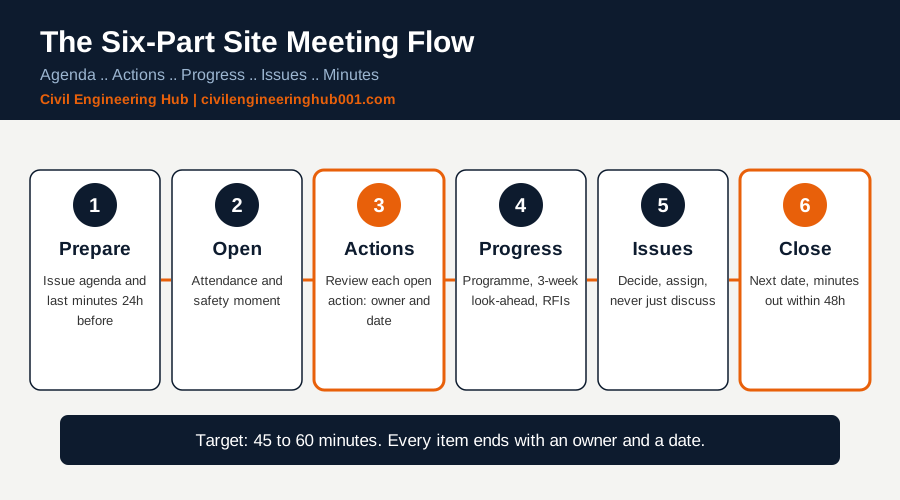
Circulate the agenda and the previous minutes at least 24 hours before the meeting. Aim for 45 to 60 minutes. If it regularly runs longer, the issues are being discussed instead of decided.
| Step | Agenda item | Time | What to cover |
|---|---|---|---|
| 1 | Attendance and apologies | 3 min | Who is present, who is missing and why |
| 2 | Safety | 7 min | Incidents, near misses, inspections, permits |
| 3 | Matters arising | 10 min | Every open action from the last minutes: done or not done |
| 4 | Progress against programme | 10 min | Planned versus actual, delays and recovery plans |
| 5 | Technical, RFIs and instructions | 10 min | Open queries, drawing revisions, approvals |
| 6 | Three-week look-ahead | 10 min | Labour, materials, plant and inspections needed |
| 7 | AOB and next meeting | 5 min | New points, date and venue |
Safety comes first on purpose. It sets the tone and it is a legal duty. Under the Occupational Safety and Health Act, 2007 of Kenya, the occupier of a workplace must provide a safe working environment, and a construction site is a workplace like any other. Recording safety items in the minutes also shows that the matter was raised.
Matters arising is the heart of the meeting. Go through the old actions one by one. If an action is not done, ask for the reason and a new date. Do not let it roll over silently.
How do you turn discussion into decisions and actions?
Every issue should end in one of three outcomes: decided, assigned or escalated. If a topic ends with “we will see,” it is not finished.
Use a simple rule: no action without an owner and a date. “Check the drainage level” is a wish. “Site engineer to confirm invert levels at manhole MH3 by Thursday” is an action.
- Park long technical debates and take them offline with the people involved.
- Ask each foreman for his or her three-week needs, not just today’s problems.
- Challenge vague promises like “soon” or “as early as possible” and ask for a day.
- Refer drawing queries to the architect or engineer in writing, and note the RFI number in the minutes.
Site practice tip: bring the latest drawings, the programme and a printed action log. When a mason says a dimension is different, the drawing on the table settles it in thirty seconds.
On Kenyan sites, add one more habit: record weather and access problems. Rain delays on earthworks and concrete, or late deliveries caused by road conditions, are common reasons for extension of time claims. If they are raised and minuted in the week they happen, they carry far more weight than a claim written at the end of the project.
How should you write and circulate site meeting minutes?
Minutes are a short record of decisions and actions, not a transcript. They protect everyone when a dispute comes up months later, because they show who was told what, and when.
Use a numbered layout so every point can be referred to later, such as item 4.2 from meeting 12. Put actions in a table with the owner and due date in separate columns.
| Item | Decision or discussion | Action by | Due date | Status |
|---|---|---|---|---|
| 4.1 | Second floor slab pour moved due to late reinforcement delivery | Site agent | Friday | Open |
| 5.2 | Clarify beam B4 depth on drawing revision C | Architect | Tuesday | Open |
| 6.1 | Conduit first fix complete on first floor | Electrical lead | Done | Closed |
Send the minutes within 48 hours. Give attendees a short window, often three days, to raise corrections, and after that the minutes stand as accepted. Keep every set in one folder, numbered in order, because they may be needed for extension of time or final account discussions.
What mistakes ruin site meetings and how do you avoid them?
Most meeting problems are habits, and habits can be changed. Here are the ones seen most often on Kenyan sites.
| Common mistake | Why it hurts | Fix |
|---|---|---|
| No agenda sent | People arrive unprepared and the chair improvises | Issue agenda 24 hours before |
| Wrong people in the room | Decisions are delayed because nobody has authority | Invite decision-makers and action owners only |
| Meeting runs for hours | Attention drops and issues are talked, not solved | Time-box each item and park debates |
| No written minutes | Instructions are denied and disputes follow | Circulate minutes within 48 hours |
| Old actions ignored | Same problems return every week | Review all open actions first |
One more habit worth building: close the meeting by reading back the actions aloud. It takes two minutes and it removes confusion on the spot.
Frequently Asked Questions
Q: How often should a site meeting be held?
Weekly is the best default for an active building project. Fortnightly can work on slower or smaller jobs, and civil works with tight sequencing may need twice a week at critical stages. Daily toolbox talks and foremen coordination should run alongside the formal meeting.
Q: Who is responsible for writing the minutes?
The chair appoints a secretary, usually the site engineer or the contractor’s administrator. The chair then reviews the draft before it is sent out. Responsibility for the content stays with the chair, so do not leave it to whoever has a free pen.
Q: How long should a site meeting last?
Aim for 45 to 60 minutes. If the meeting is longer, the agenda is probably too broad or too many technical items are being debated. Move those to a separate session with only the people who need to be there.
Conclusion
Running an effective site meeting is a skill you can learn quickly. Send the agenda, review old actions, follow a fixed order, give every decision an owner and a date, and circulate minutes within 48 hours.
The classroom teaches you how to design a beam. The site teaches you that the beam only gets built when people agree on who does what and when. Master the meeting and you become the person every project wants on the team.
Want more practical construction knowledge delivered directly to you?
Subscribe to our YouTube channel: https://www.youtube.com/@TheCivilEngineeringHub-001
PS: Join our engineering WhatsApp community for daily learning at +254731393520