 Civil


A busy site can have six or seven subcontractors working at the same time. Steel fixers on the slab, electricians chasing conduits, plumbers setting sleeves, tilers waiting for screed, and an aluminium fabricator asking when the openings will be ready. If nobody is coordinating them, the job slows down, quality drops and claims start flying.
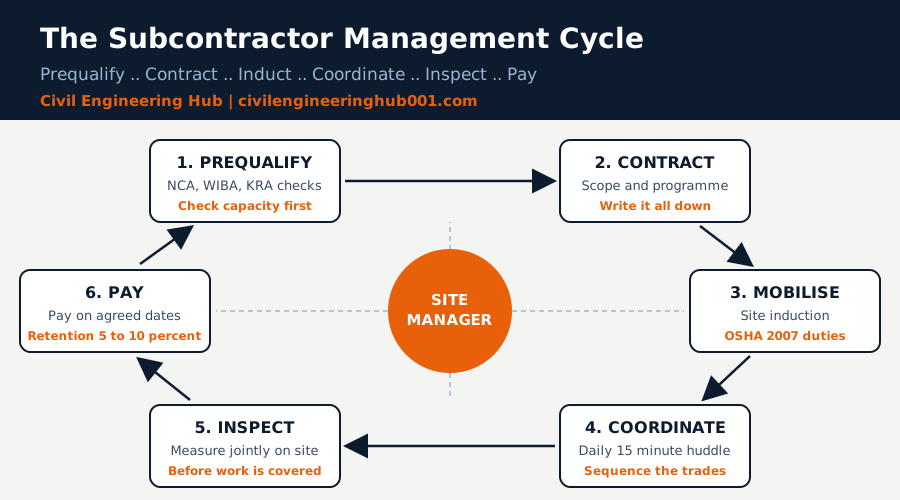
In simple terms.. managing subcontractors well means four things. You define their scope clearly before they start, you sequence their work so trades do not block each other, you inspect and measure what they do, and you pay them fairly and on time against agreed milestones.
This guide is written for site supervisors, foremen and project managers, but it matters to the whole team. Engineers, architects, QSs and the trades themselves all feel the effects when subcontractor management breaks down.
Quick Answer: To manage subcontractors on a busy site, prequalify them, lock down scope and programme in a written subcontract, run a short daily coordination meeting, inspect work before it is covered, and pay only against measured, approved work with proper retention.
Subcontractor Management Starts Before Anyone Arrives on Site
The truth is.. most subcontractor problems are created at the office, not on site. A vague scope, an unchecked company or a missing programme will show up later as delays and disputes.
In Kenya, every contractor and specialist subcontractor doing construction work should be registered with the National Construction Authority under the NCA Act of 2011. Check the registration category and class against the value of the work. A small electrical firm registered for low value works should not be carrying a major power installation package.
Use a simple prequalification check before you sign anyone.
| Check | What to Ask For | Why It Matters |
|---|---|---|
| NCA registration | Valid certificate, category and class | Legal requirement and a signal of capacity |
| Past projects | Two or three similar jobs with contacts | Proves they have done this scale before |
| Labour and plant | Crew size, key supervisors, own equipment | Shows if they can meet your programme |
| Insurance | WIBA cover for workers, public liability | Protects you under the Work Injury Benefits Act 2007 |
| Tax compliance | KRA tax compliance certificate | Needed for payments and audits |
| Safety record | Safety policy, incident history | Their accidents happen on your site |
Then write the scope down. The subcontract should list exactly what is included, what is excluded, who supplies materials, who provides scaffolding, water and power, and who clears their waste. Attach the relevant drawings, specification clauses and BOQ items so nothing is left to memory.
Domestic and Nominated Subcontractors Are Managed Differently
Not every subcontractor on your site was chosen by you. Understanding the type of subcontractor tells you how much control you have and who carries the risk.
A domestic subcontractor is chosen and appointed by the main contractor. A nominated subcontractor is selected by the employer or consultant, usually through a Prime Cost sum in the BOQ, and the main contractor is then instructed to engage them. Under FIDIC 2017, Clause 5 covers subcontracting, with Sub-Clause 5.2 dealing with nominated subcontractors and the contractor’s right to object on reasonable grounds.
On many Kenyan building projects that use the JBC form of contract, lifts, fire systems, electrical and mechanical installations are often nominated. The main contractor still coordinates them on site, gives them attendance and is responsible for their work fitting into the programme.
| Item | Domestic Subcontractor | Nominated Subcontractor |
|---|---|---|
| Who selects them | Main contractor | Employer or consultant |
| How they are priced | Inside the main contractor’s rates | Through a PC sum in the BOQ |
| Contract is with | Main contractor | Main contractor, on instruction |
| Main contractor adds | Own margin in rates | Profit and attendance items |
| Risk of poor performance | Mostly main contractor | Shared, depending on the contract |
| Payment route | Paid by main contractor | Certified by consultant, paid through main contractor |
Honestly.. even with a nominated subcontractor, the site team cannot sit back. If their late work holds up your slab, your programme suffers first. Treat them as part of your team and coordinate them with the same discipline.
Sequencing Trades Is the Real Job of the Site Manager
On a busy site, the biggest losses come from trades waiting for each other or damaging each other’s work. A plumber who comes back to cut a finished wall because sleeves were missed has just cost you time, materials and a quality complaint.
Build a trade sequence for every floor or zone and share it with all subcontractors. For a typical reinforced concrete frame building it looks like this.
- Formwork and steel fixing on the slab and beams.
- Electrical conduits and plumbing sleeves placed and checked before the pour.
- Concrete pour only after a signed pre pour checklist from every affected trade.
- Blockwork after striking and back propping.
- First fix MEP chasing and pipework before plaster.
- Plaster and screed, then tiling, ceilings and second fix.
The pre pour checklist is where classroom theory meets site reality. Your structural drawings tell you cover and bar spacing, but it is the site team that must confirm every conduit, sleeve and box out is in place before the concrete truck arrives.
A Short Daily Coordination Meeting Saves Hours
Weekly site meetings are important, but they are too far apart for a busy site. Run a fifteen minute coordination huddle every morning with each subcontractor’s foreman.
Keep the agenda tight. What did each trade finish yesterday, what are they doing today, what is blocking them, and what do they need from another trade. Record any clashes, information gaps or safety concerns, and assign an owner and a deadline before the meeting ends.
Under the Occupational Safety and Health Act 2007, the person in control of the workplace has a duty to keep everyone on site safe, including subcontractor workers. So the morning meeting is also where you confirm permits to work, scaffold inspections and any hot works planned for the day.
Every subcontractor worker should go through a site induction before starting. Keep a signed induction register and do not let anyone onto the scaffold or into an excavation without it.
Inspect, Measure and Pay Against Approved Work
Quality is controlled through inspection before work is covered up. Use inspection requests for each stage, such as conduit before plaster, pipework before pressure testing and waterproofing before screed. Once a finish goes over it, the problem becomes very expensive to find and fix.
Payment is where many relationships break. Agree a measurement method in the subcontract, measure jointly on site, and pay against approved quantities. Retention is commonly held, often in the range of 5 to 10 percent of each payment, with half released at practical completion and the rest after the defects liability period. Pay on the agreed dates. A subcontractor who is not paid will quietly reduce labour on your site.
Keep your records clean. Daily site diaries, signed variation instructions, inspection forms and measurement sheets protect both sides when a dispute comes up later.
Common Subcontractor Problems Have Simple Site Fixes
Most issues you will face repeat from project to project. Once you recognise the pattern, you can deal with it early instead of fighting it at the end of the job.
Scope gaps are the first one. Two trades both assume the other is doing the making good around pipes, so nobody does it. Fix it by writing an interface list for each zone that states who does what at every meeting point between trades.
Labour shortages are the second. A subcontractor wins three jobs at once and spreads the same crew thin. Ask for a named supervisor and a minimum crew size in the subcontract, then count heads on site every morning.
The third is late information. Subcontractors stop work because a detail is unclear and nobody has raised a request for information. Make it a rule that any trade can raise a query at the morning meeting, and track the response date until it is closed. Small habits like these keep a busy site moving.
Frequently Asked Questions
Q: Who is responsible for a subcontractor’s poor workmanship?
The main contractor is usually responsible to the employer for all work on site, including subcontracted work. The subcontractor is then responsible to the main contractor under their subcontract. That is why inspection before covering and clear specification clauses in the subcontract are so important. With nominated subcontractors, the contract terms decide how risk is shared.
Q: Can a main contractor refuse a nominated subcontractor?
Under most standard forms, including FIDIC 2017 Sub-Clause 5.2, the contractor can raise a reasonable objection. Common grounds include lack of competence, poor financial standing or refusal to accept back to back terms. The objection should be made in writing, with reasons, and within the time the contract allows.
Q: How do I handle a subcontractor who keeps falling behind?
Start with facts. Compare their progress against the agreed programme and raise it at the coordination meeting with a written record. If it continues, issue a formal notice under the subcontract asking them to increase resources by a set date. Only after that should you consider bringing in another crew, deducting costs or terminating, and always follow the contract steps.
Conclusion
Subcontractor management is not about controlling people. It is about creating a system where every trade knows its scope, its slot in the sequence and the standard it must meet. Prequalify carefully, write the scope down, run daily coordination, inspect before covering and pay on time.
Get these basics right and your site runs smoother, your quality improves and your programme holds. Whether you are a supervisor, an engineer, a QS or a trade foreman, this is the kind of practical discipline that builds a strong reputation on site.
Want more practical construction knowledge delivered directly to you?
Subscribe to our YouTube channel: https://www.youtube.com/@TheCivilEngineeringHub-001
PS: Join our engineering WhatsApp community for daily learning at +254731393520