 Civil


Every construction contract answers one money question before a single block is laid: who carries the risk if the quantities change? Re-measurement and lump sum contracts answer that question in opposite ways, and choosing the wrong one is how projects end up in disputes, cost overruns and unpaid certificates.
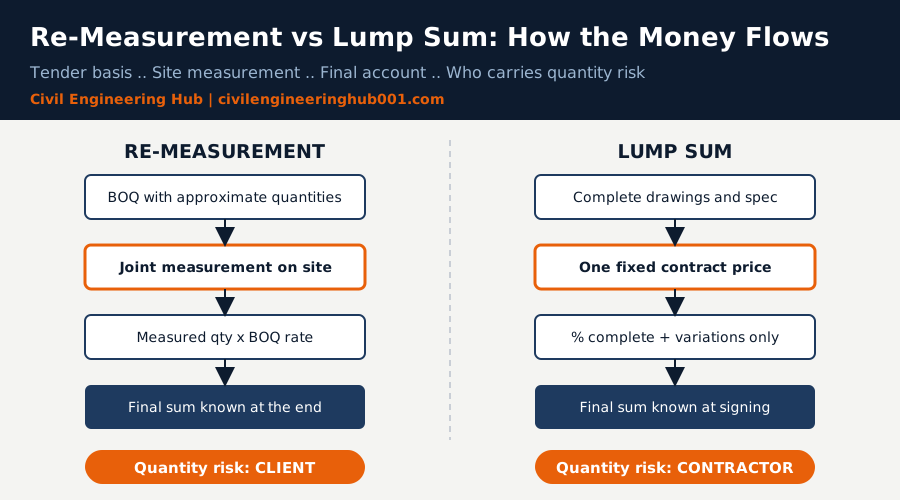
In simple terms.. a re-measurement contract pays the contractor for the work actually done, measured on site and priced at the tendered rates. A lump sum contract pays a fixed price for a defined scope, and the contractor carries most of the quantity risk.
This guide breaks down how each one works, how payments are valued, what the Kenyan standard forms say, and how the whole team.. the QS, the engineer, the architect, the contractor and the site supervisor.. should behave differently under each type.
Quick Answer: A re-measurement contract pays the contractor for the actual quantities of work done at agreed BOQ rates, so the client carries the quantity risk. A lump sum contract pays one fixed price for a fully defined scope, so the contractor carries the quantity risk.
What Is a Re-Measurement Contract and How Does It Work?
A re-measurement contract, also called a measure and value or admeasurement contract, is tendered on a Bill of Quantities with approximate quantities. The contractor prices each item with a rate, and the total is only an estimate of the final cost.
As work progresses, the QS and the contractor measure what has actually been built. The final contract sum is those measured quantities multiplied by the tendered rates, plus any variations and adjustments.
The truth is.. this type exists because some work cannot be fully defined at tender stage. Earthworks, foundations in uncertain ground, road works and drainage are classic examples, because nobody knows exactly how much rock or soft material sits below the surface until excavation starts.
That is why most KeNHA, KeRRA and county road contracts are let on a measurement basis under FIDIC-based conditions. The engineer does not know the exact volume of cut to spoil, so the contract pays for what is measured on the ground.
What Is a Lump Sum Contract and When Is It Used?
A lump sum contract fixes the price for a defined scope of work. The contractor agrees to deliver the drawings and specification for that one figure, and the quantities are the contractor’s responsibility.
There are two common versions. A lump sum with quantities, where a firm BOQ is part of the contract, and a lump sum without quantities, where the contractor prices from drawings and specification only and builds their own take-off.
Honestly.. lump sum works best when the design is complete before tender. A standard residential block, a school classroom built from a repeated design, or a fit-out with full drawings are good candidates, because there is little room for quantity surprises.
Under the JBC Agreement and Conditions of Contract for Building Works used widely in Kenya, the contract sum is treated as fixed except where the conditions allow adjustment.. mainly variations instructed by the architect, provisional sums, prime cost sums and specified fluctuations. Design-build projects under the FIDIC Yellow Book also run on a lump sum basis.
Key Differences Between Re-Measurement and Lump Sum Contracts
The table below puts the two side by side. Read it with one question in mind: who is paying for the unknowns?
| Feature | Re-Measurement Contract | Lump Sum Contract |
|---|---|---|
| Basis of tender | BOQ with approximate quantities | Complete drawings and specification, with or without a firm BOQ |
| Final contract sum | Known only after final measurement | Known at signing, adjusted only for variations and allowable items |
| Quantity risk | Carried by the client | Carried by the contractor |
| Design completeness needed | Partial design is acceptable | Design should be complete |
| Measurement on site | Continuous and detailed for every item | Mostly for variations and valuations |
| Typical use in Kenya | Roads, earthworks, water and sewer lines, foundations | Buildings with full design, fit-outs, design-build |
| Common standard forms | FIDIC Red Book, KeNHA conditions | JBC Building Works, FIDIC Yellow and Silver Books |
| Admin effort for the QS | High, with joint measurement records | Lower, focused on variations and claims |
How Are Payments Valued Under Each Contract Type?
This is where the classroom meets site. The interim payment certificate looks similar under both contracts, but the way the QS builds the figure is very different.
Under re-measurement, every interim valuation is built from joint measurement sheets. The site engineer, the contractor’s QS and the client’s QS agree quantities on site, record them, sign them, and price them at BOQ rates. If the bill said 1,200 m3 of excavation and the site needed 1,650 m3, the contractor is paid for 1,650 m3 at the tendered rate.
Under lump sum, the valuation is usually done by percentage complete of each element or by agreed milestones. If substructure is 60 percent complete, the QS certifies 60 percent of the substructure value. Extra quantities caused by the contractor’s own take-off errors are not paid.
| Step | Re-Measurement Valuation | Lump Sum Valuation |
|---|---|---|
| 1 | Carry out joint measurement on site with signed records | Assess percentage complete per element or milestone |
| 2 | Multiply measured quantities by BOQ rates | Apply percentage to the elemental cost breakdown |
| 3 | Add valued variations and dayworks | Add valued variations and expended provisional sums |
| 4 | Add materials on site where the contract allows | Add materials on site where the contract allows |
| 5 | Deduct retention, usually 5 to 10 percent | Deduct retention, usually 5 to 10 percent |
| 6 | Deduct previous certificates and issue the IPC | Deduct previous certificates and issue the IPC |
One thing site supervisors must take seriously under re-measurement: if it is not measured and signed, it is very hard to get paid for it. Excavation depths, rock quantities and backfill volumes disappear once covered. Measure before you cover.
What Are the Risks and Advantages for Each Party?
Neither contract is better in every situation. Each one moves risk to a different party, and each party prices that risk.
For the client, re-measurement gives a fair price for uncertain work and allows tendering before the design is final. The downside is cost uncertainty, because the final account can move a long way from the tender sum. Lump sum gives budget certainty, but contractors add a premium for the risk they carry.
For the contractor, re-measurement protects against quantity errors in the bill, which matters a lot on roads and foundations. Lump sum rewards efficient contractors who price accurately, but a missed item in the take-off comes straight out of their profit.
For the consultant team, re-measurement means heavy site measurement, detailed records and a longer final account. Lump sum shifts effort to the design stage, because incomplete drawings lead directly to variations and claims.
For artisans and subcontractors, the main contract type often flows down. A mason or plumber on a measured subcontract is paid per square metre or per point installed. On a lump sum subcontract, they agree a fixed figure for the package and must check the drawings properly before pricing.
How to Choose the Right Contract Type for a Kenyan Project
The choice should be made early, ideally at feasibility stage, by the QS and the lead consultant together with the client. Under the Public Procurement and Asset Disposal Act 2015, public entities must state the contract basis clearly in the tender documents, so this decision cannot be left until the last minute.
Use these practical checks before deciding:
- Is the design complete? If structural, architectural and MEP drawings are not final, lump sum will generate variations from day one.
- How uncertain is the ground? Black cotton soil, rock and high water tables in places like Athi River, Kisumu and the coast make re-measurement safer for substructure.
- Does the client need a fixed budget? Bank-financed private developments often need cost certainty, which favours lump sum.
- Is the work linear or repetitive? Roads, pipelines and drainage are naturally measured by length or volume, so re-measurement fits.
- Can the team manage the admin? Re-measurement needs a disciplined site team that measures and records daily.
Many Kenyan projects use a hybrid approach. The building superstructure is lump sum, while substructure and external works are measured as provisional quantities. The QS writes this clearly in the preliminaries so nobody is surprised at final account stage.
Frequently Asked Questions
Q: Can a lump sum contract still have variations?
Yes. A lump sum fixes the price for the defined scope, not for changes to it. If the architect or engineer instructs a change in design, quantity or specification, it is valued as a variation under the contract conditions. What the contractor cannot claim for is their own measurement errors.
Q: Who measures the work in a re-measurement contract?
Measurement is normally done jointly by the client’s QS or engineer’s representative and the contractor’s QS. Both parties sign the measurement records on site. These signed sheets become the basis for interim certificates and the final account, so accuracy and timing matter.
Q: Is a Bill of Quantities used in both contract types?
A BOQ is essential in re-measurement because its rates are applied to measured quantities. In a lump sum with quantities, the BOQ is also used for valuing variations and interim payments. In a lump sum without quantities, there is no client BOQ and the contractor prepares their own pricing document.
Conclusion
Re-measurement and lump sum contracts are not just legal labels. They decide how you measure, how you get paid, and who absorbs the cost when the ground or the design changes.
If the scope is uncertain, measure and pay for what is built. If the design is complete and the client needs budget certainty, fix the price and control variations tightly. Whatever the type, keep clean records from the first day on site.
Understand the contract basis before you price, measure or certify anything. That single habit protects your money, your professional reputation and the project.
Want more practical construction knowledge delivered directly to you?
Subscribe to our YouTube channel: https://www.youtube.com/@TheCivilEngineeringHub-001
PS: Join our engineering WhatsApp community for daily learning at +254731393520